What is a Toxicology Report in NZ? A Waikato Property Owner’s Guide

Imagine walking through a beautifully staged open home in Hamilton, admiring the fresh paint and polished floors, while being completely unaware that the walls could be harbouring invisible chemical residues. You aren't just buying a piece of Waikato real estate; you're inheriting its entire history. This is why obtaining a professional toxicology report nz has become a non-negotiable step for any serious buyer or landlord. It's the only way to ensure your investment doesn't turn into a "P-house" nightmare that leaves you with a massive decontamination bill and a property that banks simply won't finance.
We know that the process feels daunting, especially when you're caught between confusing DIY kits and the strict requirements of your insurance provider. You want to be certain that your family is safe and that your mortgage will actually be approved. Greg Brown and our team are here to simplify the technical data. This guide explains the legal health standards, the crucial differences between basic screening and detailed lab analysis, and how to interpret the results so you can make an informed decision with total peace of mind.
Key Takeaways
Understand exactly what a toxicology report nz entails and why it has become a standard requirement for protecting property investments in the local market.
Learn why you can't rely on your senses to detect chemical residues and why professional testing is the only way to ensure a healthy environment for your family or tenants.
Discover the important differences between basic field screening and detailed lab analysis so you can choose the right level of testing for your Waikato home.
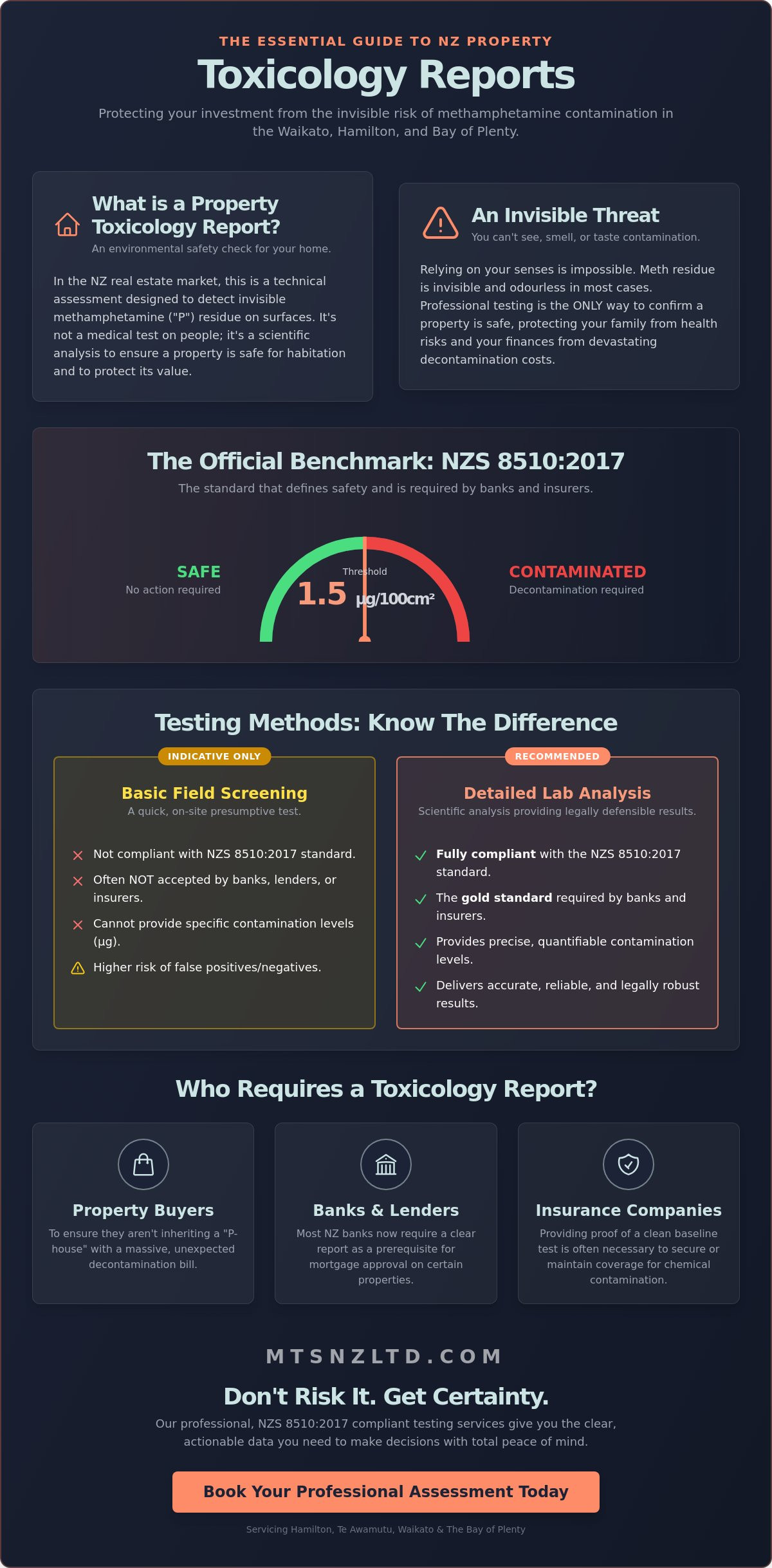
Get a clear breakdown of technical terms and the NZ Standard threshold of 1.5 µg/100cm², helping you make sense of your results without the confusion.
See how Greg Brown and the MTS NZ Ltd team provide the expert guidance you need to navigate property safety across Hamilton, Te Awamutu, and the Bay of Plenty.
Table of Contents
Understanding the Toxicology Report in the NZ Property Market
When you hear the term "toxicology report" in the New Zealand property sector, it rarely involves a lab coat or a medical clinic. In the context of the local real estate market, this document is almost exclusively focused on methamphetamine residue testing. Greg Brown and the team have seen this become a standard requirement for property transactions across the Waikato. It's a technical assessment designed to identify whether a home has been contaminated by the manufacture or heavy use of "P." While the name sounds clinical, its purpose is purely environmental safety.
The term "toxicology" is used because the process involves sampling for chemical substances that could pose a risk to human health. In the past, the industry operated without much oversight. This led to a lot of confusion for Hamilton homeowners who didn't know which results to trust. Everything changed with the introduction of the NZS 8510:2017 standard. This shifted the industry from unregulated, often alarmist testing toward a structured, scientific approach that provides clear answers for property owners.
You might wonder who actually asks for these documents. It isn't just cautious buyers. Most toxicology report nz requests are driven by three main groups:
Buyers: They want to ensure they aren't inheriting a massive decontamination bill.
Lenders: Most NZ banks now view a clear report as a prerequisite for mortgage approval on certain high-risk properties.
Insurers: Providing proof of a clean baseline is often necessary to maintain coverage for chemical contamination.
If you're looking to book a professional assessment to satisfy these requirements, you can view our specific testing services here to see how we handle the process.
Is it a Medical Test or a Property Test?
It's vital to distinguish between clinical toxicology and property contamination reports. We aren't testing people; we're testing surfaces. Technicians take swabs from areas like heat pumps, ceiling corners, and door frames to detect chemical residues. For Waikato landlords, these reports are a cornerstone of Healthy Homes compliance. They provide the documented evidence needed to prove a rental property is safe for habitation before a new tenancy begins. It's about protecting the building's integrity and the health of the people inside it.
The Role of NZS 8510:2017 Standards
The NZS 8510:2017 standard brought much-needed precision to Hamilton property inspections. It defines exactly how samples should be taken and what levels of residue require action. Before this standard existed, different companies used different limits, which created total chaos for sellers. Now, if a report doesn't meet this specific standard, most NZ banks will simply reject it. This ensures that every toxicology report nz provides a consistent and reliable data point for the property's history. NZS 8510:2017 is the benchmark for meth testing.
Why a Toxicology Report is Vital for Waikato and Bay of Plenty Homes
You can't rely on your senses to spot meth contamination. It's an invisible risk. There's no distinct smell or staining that gives it away in most cases. A professional toxicology report nz is the only way to confirm if a property is safe. In regions like the Waikato, where residential property turnover is high, the risk of moving into a contaminated environment is a genuine concern for families and investors alike.
Under the Residential Tenancies Act 1986, landlords are legally required to provide a premises in a reasonable state of cleanliness. If a home is contaminated above the NZS 8511:2017 standards, it's considered contaminated. Protecting occupants from passive chemical exposure is about more than just compliance; it's about preventing long term health issues, such as skin irritation, respiratory problems, or sleep disturbances. Greg Brown and the team emphasize that a clear report is the only path to total peace of mind for everyone involved.
Protecting Your Investment in Hamilton and Tauranga
Buying a home in Hamilton or Tauranga is a massive financial commitment. If you accidentally purchase what's known as a "P-house," the decontamination costs can reach tens of thousands of NZ$. We've seen property values in the Waipa district fluctuate, making baseline testing a crucial part of your due diligence. Think of it as a safety net that prevents you from inheriting someone else's expensive problem. You can learn more about protecting your Hamilton, Rotorua, or Tauranga investment through comprehensive inspections.
Meeting Healthy Homes and Insurance Requirements
Most major NZ insurers now have specific clauses regarding meth contamination. They often won't process a claim unless you can prove the house was "clean" at the start of a tenancy. This is where a toxicology report nz becomes indispensable. It links directly to the Healthy Homes Standards, ensuring you meet the safety expectations set by the Ministry of Housing and Urban Development. For those managing multiple units, having a clear record of testing protects your yield and your reputation. If you're unsure about your property's current status, you can check our available testing services to get a clear picture.
The Science Behind the Report: Lab-Based vs. Field Screening
When you request a toxicology report nz for a Waikato property, the data usually comes from one of two testing methods. The first is field screening, often called an "instant kit." These kits work similarly to a home pregnancy test, using a color-change reaction to show if methamphetamine is present above a certain level. While they offer immediate feedback, Greg Brown and our technical team at MTS NZ Ltd view these as preliminary indicators rather than final proof. They lack the granular detail needed to understand the full extent of contamination.
The second, more rigorous method involves laboratory analysis. This process follows the NIOSH 9111 sampling standards, which is the internationally recognized benchmark for wipe sampling. Our technicians take precise 100cm² swabs from specific surfaces like walls, ceilings, and extract fans. These samples are then analyzed by an IANZ-accredited laboratory using Liquid Chromatography-Mass Spectrometry. This engineering-grade equipment identifies the exact concentration of chemicals, providing a level of accuracy that manual kits simply can't match. For any property owner, this data is the only way to ensure the building meets the NZS 8511:2017 safety standards.
Why Laboratory Composite Tests are the Gold Standard
Composite testing is a highly efficient way to get a clear picture of a property's health without the high cost of individual room samples. In this process, our technicians take several swabs from different rooms and the lab combines them into a single test. If the result comes back well below the New Zealand Ministry of Health guidelines, you've saved money while gaining lab-certified peace of mind. If the levels are high, we then move to individual testing to find the exact source. You can find more details in our Waikato property owner’s guide to composite tests to see how this fits your specific needs.
The Problem with DIY "True/False" Kits
It's tempting to grab a DIY kit from a hardware store, but these "true/false" results carry significant risks. Uncertified kits have a documented history of false positives, often triggered by common household cleaning agents or even heavy tobacco smoke. Conversely, they might return a false negative if the kit hasn't been stored at the correct temperature or if the user misses a contamination "hotspot."
Beyond the technical failures, there's a legal reality to consider. New Zealand banks, insurers, and lawyers generally don't accept DIY results for property settlements or insurance claims. They require a professional toxicology report nz backed by an independent sampling strategy. Without a professional's eye to identify where residues are most likely to accumulate, such as inside heat pumps or behind electrical sockets, a DIY test is often a wasted investment that leaves you vulnerable to future liability.
How to Read and Act on Your Meth Test Report
Receiving your toxicology report nz can feel overwhelming if you aren't familiar with the technical units used by laboratories. The most critical metric you'll see is µg/100cm². This stands for micrograms per one hundred square centimetres. To put this in perspective, a microgram is one millionth of a gram. Scientists measure this by wiping a 10cm by 10cm square area on surfaces like walls or ceilings. This precision allows us to detect even microscopic traces of methamphetamine residue that are invisible to the naked eye.
The NZ Standard (NZS 8511:2017) sets the current decontamination threshold at 1.5 µg/100cm². If your results fall below this level, the property is considered safe for habitation under the standard. When levels exceed this mark, it indicates a level of contamination that requires professional attention. It's also vital to check for the lab certificate attached to the back of your report. This document confirms the samples were processed in an IANZ accredited facility, ensuring the data is legally defensible and scientifically accurate.
Understanding the Concentration Levels
When reviewing results for a home, look for the "below detection limit" or BDL result. This is the ideal outcome because it means the lab equipment found no traceable amount of the drug. If the report shows low levels, such as 0.2 µg/100cm², it indicates some history of use but doesn't require remediation. However, results exceeding 30 µg/100cm² are often categorized as "manufacturing" levels. These high readings suggest the property was likely used as a clandestine lab. You can learn more about how to read a meth test report in NZ to understand these variations better.
What Happens if the Report Shows Contamination?
If your toxicology report nz confirms contamination above the 15 µg/100cm² limit, Waikato landlords must take immediate steps to manage the risk. You shouldn't allow new tenants to move in until the levels are brought down. It's important to distinguish between "cleaning" and "decontamination." While cleaning involves surface washing, full decontamination might involve stripping out porous materials like carpets, curtains, or even internal linings if the chemicals have soaked in. After any work is completed, you must arrange for post-decontamination testing in Te Awamutu to verify the property is clear.
Greg Brown and the team at MTSNZ believe that clear, data driven reports are the best tool for property owners. Don't leave your investment to chance or rely on visual inspections alone. If you've received a report and need a second opinion or a more detailed analysis, schedule a professional property test today to get the facts you need.
Professional Meth Testing Services in Waikato with MTS NZ Ltd
Greg Brown leads MTS NZ Ltd with a focus on technical accuracy and property safety. We provide comprehensive testing services across the entire Waikato region, including Hamilton, Te Awamutu, and the wider Waipa district. Our reach also extends into the Bay of Plenty, ensuring property owners have access to reliable data regardless of their location. When you require a toxicology report nz to facilitate a property sale or manage a rental, you need results that are both precise and legally defensible. We treat every inspection with the same level of engineering-grade detail to ensure your investment is protected.
Our Commitment to Independent, Conflict-Free Testing
We maintain a strict boundary between testing and remediation. MTS NZ Ltd focuses exclusively on the detection and reporting of contaminants; we never perform decontamination or cleaning work. This separation is vital for maintaining the integrity of your results. If a testing company also offers cleaning services, they have a direct financial incentive to report higher levels of contamination. By choosing an independent specialist, you ensure that the findings are unbiased and serve your interests, not the cleaner's bottom line.
Our methodology strictly follows the NZS 8510:2017 standard. This is recognized as the gold standard for meth testing in New Zealand. Adhering to these regulations means our sampling techniques and reporting structures meet the highest professional benchmarks. We provide the following benefits through our independent approach:
Unbiased data that reflects the actual state of the property.
Full compliance with New Zealand insurance and legal requirements.
Detailed documentation that stands up to scrutiny during property transactions.
Clear recommendations based on technical facts, not sales targets.
Expert Guidance from Greg Brown and the Team
Greg Brown provides personalized support for homeowners and investors who need to navigate the complexities of property health. We recognize that time is a critical factor during property settlements. A delay in obtaining a toxicology report nz can create significant hurdles for buyers and sellers alike. Our team is structured to deliver fast turnaround times for all reports, helping you meet tight deadlines without sacrificing the quality of the inspection.
We don't just provide a document; we provide clarity. Our reports are designed to be accessible while maintaining the technical depth required by banks and insurers. If you're managing a property in the Waipa district or preparing for a house auction in Hamilton, we can help you understand the specific risks and requirements for your building. You can view our testing services and fees to find the right inspection level for your needs and book a compliant assessment today.
Protect Your Property and Health Today
Understanding the details of a toxicology report nz ensures you aren't walking into a costly or hazardous situation. It's about more than just checking boxes; it's about verifying that your home meets the NZS 8510:2017 standards. Since 2017, MTS NZ Ltd has provided clear, data-driven insights for homeowners across Waikato and the Bay of Plenty. Because the team doesn't offer decontamination services, you'll always receive an unbiased assessment. This independence eliminates any conflict of interest, giving you the raw facts you need to make an informed decision about your investment. Whether you're buying a new place or managing a rental, having professional lab-based results provides the ultimate peace of mind. You'll know exactly where your property stands without any marketing fluff or hidden agendas. It's the smartest way to safeguard your family's health and your financial future. Greg Brown and the team are ready to help you navigate these technical requirements with ease and precision.
You've got this; taking the right steps now will save you a lot of stress down the road.
Frequently Asked Questions
How much does a toxicology report cost in NZ?
A toxicology report nz typically costs between NZ$250 and NZ$3000 depending on the size of the property and the number of individual samples required for laboratory analysis. These prices generally cover the technician's site visit, the lab fees for processing the swabs, and the final professional documentation. If you only need a basic composite screening test, the price is often lower, frequently starting around NZ$250 plus GST.
Is a meth test mandatory for buying a house in Hamilton?
Meth testing isn't a legal requirement for property transactions in Hamilton or the wider Waikato region under current New Zealand law. However, many banks and insurance providers now insist on seeing a clear report before they'll approve a mortgage or provide cover for a new policy. It's a common practice for buyers to include a testing clause in their Sale and Purchase Agreement to ensure they don't inherit a contaminated site.
How long does it take to get a toxicology report back?
You can usually expect to receive your full results within three to five working days after the technician has visited the property. While the actual process of taking swabs from the walls and surfaces only takes about an hour, the laboratory needs time to process these samples using mass spectrometry to ensure the data is accurate. We offer an express urgent service (usually within 24-48 hours) if you're working under a tight deadline for a property unconditional date for an additional fee.
Can I use a toxicology report for my insurance claim?
Yes, a professional toxicology report is the primary document required by New Zealand insurance companies to process a chemical contamination claim. Standard DIY kits or basic field tests aren't usually accepted because they don't provide the quantifiable data needed to prove the contamination meets specific policy thresholds. A detailed lab report provides the evidential weight required to show exactly which areas of the home need professional decontamination.
What is the difference between a screening test and a toxicology report?
A screening test is a basic "yes or no" check that indicates if methamphetamine is present, but it doesn't provide a specific concentration level for each room. A toxicology report nz involves sending individual swabs to a laboratory to get precise, quantifiable measurements for every area sampled. This detailed data is essential if you need to plan for remediation or if you're trying to satisfy legal requirements for a high-risk rental property.
Does a standard building report include meth testing?
No, a standard pre-purchase building inspection focuses on structural integrity and weather-tightness, so it doesn't include chemical or drug residue testing. Most building inspectors aren't qualified or equipped to take forensic swabs for laboratory analysis. You'll need to book a separate specialist service to ensure the property is free from chemical contaminants before you finalize your purchase contract.
What is the safe level for methamphetamine in a NZ home?
The New Zealand Standard (NZS 8511:2017) sets the decontamination threshold at 1.5 micrograms per 100 square centimeters. While a 2018 report from the Prime Minister’s Chief Science Advisor suggested a higher threshold of 15 micrograms for properties where only smoking occurred, many insurers and landlords still follow the stricter 1.5 limit. Sticking to the NZS 8511:2017 standard helps property owners minimize future liability and ensures the home is safe for all occupants.
Who is Greg Brown at MTS NZ Ltd?
Greg Brown is the owner and founder of MTS NZ Ltd, where he oversees the technical operations and quality control for property testing services. He focuses on providing property owners with accurate, lab-backed data that meets New Zealand's strict safety and insurance standards. Under his leadership, the company has established a reputation for reliability and professional integrity within the Waikato property market.


Comments