Meth Residue Half-Life: How Long Does Contamination Last in a Property?

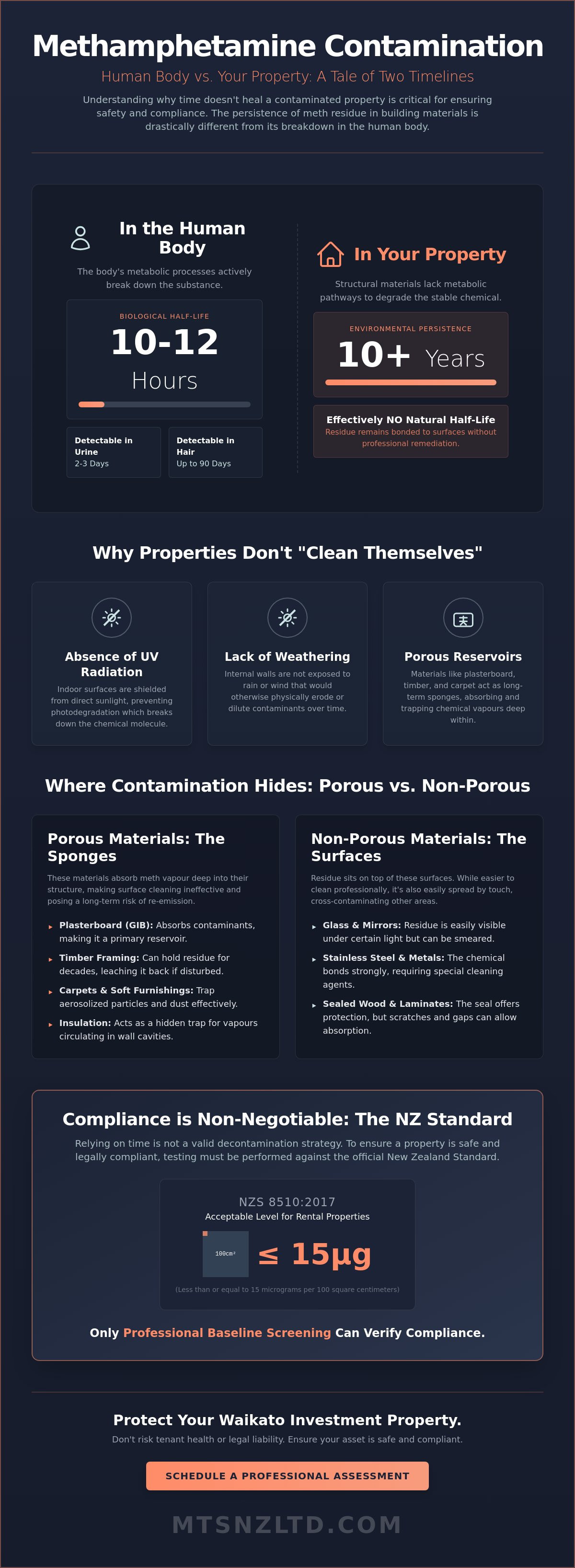
A human body can process methamphetamine in less than a day, but your investment property might hold that same chemical signature for over a decade. The biological meth residue half-life in humans is approximately 10 to 12 hours; however, this metric does not apply to the environmental persistence of the drug within a building. Structural materials such as porous plasterboard and timber lack the metabolic processes required to break down chemical contaminants. Consequently, residue from smoking or manufacturing can remain detectable for up to 10 years without professional remediation.
You're likely navigating the complexities of the Residential Tenancies (Managing Methamphetamine Contamination) Regulations 2026 and want to ensure your Waikato asset remains compliant. It's a common misconception that contamination levels will naturally dissipate to safe levels over time. This article clarifies the distinction between metabolic clearance and structural contamination to help you maintain a safe environment. We'll outline the current NZS 8510:2017 standards, the 15µg/100cm² acceptable level for rentals, and the technical necessity of a professional baseline screening assessment.
Key Takeaways
Distinguish between the 10-hour human biological half-life and the meth residue half-life in building materials, which can persist for over a decade.
Evaluate how environmental variables such as Waikato's humidity and residential HVAC systems facilitate the spread of chemical contaminants.
Understand why natural degradation isn't a viable solution for porous materials that've absorbed chemical vapours.
Ensure property compliance by utilizing professional baseline screening assessments that align with NZS 8510:2017 and the 2026 regulations.
Table of Contents
Understanding Meth Half-Life: Biological vs. Environmental Persistence
Property investors often apply medical terminology to structural engineering problems, which leads to significant misunderstandings regarding safety. While the term "half-life" describes the rate at which a substance reduces by half within a biological system, it's a technically inaccurate metric for property contamination. In a residential context, Methamphetamine functions as a persistent chemical residue rather than a metabolising agent. This distinction is critical because it explains why a property doesn't simply "clean itself" over time. The meth residue half-life in a building isn't a functional reality; without professional intervention, the chemical remains bonded to surfaces indefinitely.
The Biological Half-Life of Methamphetamine
In the human body, the biological half-life of the drug is approximately 10 to 12 hours. This means the concentration of the substance in the bloodstream reduces by 50% every half-day. Medical data indicates that it remains detectable in urine for two to three days, while hair samples can retain traces for up to 90 days. These figures are relevant for human health assessments but offer no insight into the safety or longevity of a physical structure's contamination levels.
Why Houses Do Not Have a Natural Half-Life
Building structures lack the metabolic pathways required to break down complex chemical molecules. Methamphetamine is a highly stable compound that doesn't readily biodegrade in indoor environments. Several factors contribute to this environmental persistence:
Absence of UV radiation: Indoor surfaces aren't exposed to the direct sunlight necessary for photodegradation of the molecule.
Lack of weathering: Internal walls aren't subject to rain or wind that might physically erode or dilute contaminants.
Porous reservoirs: Materials like plasterboard, timber framing, and soft furnishings act as long-term reservoirs, absorbing vapours and locking them into the substrate.
Because the molecule is so resilient, residue can remain at detectable levels for over 10 years without significant degradation. Relying on time as a decontamination strategy is technically flawed and fails to meet the safety requirements outlined in NZS 8510:2017. For a property to be considered safe, the contaminant must be physically removed or managed through professional remediation, as natural decay won't occur within a relevant timeframe for property ownership.
How Long Does Methamphetamine Residue Stay on Household Surfaces?
Scientific evidence confirms that methamphetamine residue is remarkably durable, with measurable levels persisting for five to ten years in properties where no remediation has occurred. The depth of contamination depends largely on whether the property was used for smoking or manufacturing the substance. While smoking releases a fine aerosol that settles on surfaces, manufacturing involves volatile chemical reactions that force contaminants deeper into the building's infrastructure. Standard domestic cleaning with soap and water is typically ineffective because the chemical bond between the residue and common household paints is exceptionally strong.
Environmental factors often trigger a re-emission effect, where trapped residues are released back into the air. This occurs when indoor temperatures rise or humidity levels increase, causing the materials to breathe. Because of this, a house that appears clean may still pose a risk. The concept of a functional meth residue half-life is misleading in these scenarios; the contamination levels remain static or fluctuate based on environmental conditions rather than degrading naturally. The persistence of illicit drug smoke residues is a documented reality that requires technical assessment to identify.
Porous vs. Non-Porous Materials
Materials react differently to chemical exposure. Non-porous surfaces like glass and stainless steel allow residue to sit on the surface, making it easier to detect but also easy to spread through touch. Conversely, porous materials like GIB board, insulation, and soft furnishings act as sponges. These substrates absorb the vapour, locking it deep within the material. Timber framing is particularly problematic as it can hold contaminants for decades, potentially leaching them back out if the wall linings are disturbed.
The Risk of Re-contamination
Older properties in the Waikato region often undergo renovations that inadvertently release trapped chemicals. Sanding painted walls or removing old carpets creates renovation dust laden with historic residue. This dust can settle in HVAC systems and heat pumps, redistributing the contaminant throughout the home. If you're planning a purchase or renovation, you can book a baseline screening to verify the structural integrity of the property before work begins.
Factors Influencing the Longevity of Meth Contamination in Waikato Homes
The duration of chemical presence in a structure is heavily influenced by local environmental variables and the building's mechanical systems. In the Waikato region, high relative humidity levels facilitate the movement of methamphetamine salts through porous substrates. This moisture-wicking effect allows contaminants to penetrate deep into the structural GIB board and timber framing. Research into the environmental persistence of meth residue confirms that these chemicals can remain active for years, regardless of the perceived meth residue half-life which is often incorrectly equated with human metabolism.
Mechanical ventilation and heat pumps play a significant role in distributing vapours from a primary source to secondary rooms. When a heat pump operates, it recirculates air that may contain trace amounts of aerosolised residue. This residue eventually settles in filters and ducting, creating a secondary contamination source that persists long after the initial drug use has ceased. We've observed that standard "encapsulation" methods, such as painting over affected surfaces, are technically insufficient. The chemical residue eventually migrates through the new paint layer or is released if the surface is ever scuffed or drilled.
Waikato Climate and Indoor Air Quality
Humidity serves as a primary transport mechanism for chemical salts. In damp Waikato homes, the moisture in the air bonds with surface residues, allowing them to seep into wall cavities. This process increases the complexity of remediation and heightens the meth contamination health risks for future occupants. It's a technical reality that high-use areas like kitchens and bathrooms often show higher sequestration rates due to steam and heat.
Structural Sequestration
Contaminants don't just sit on flat walls; they accumulate in dead-air spaces. Electrical sockets, light switches, and ceiling cavities act as collection points for chemical vapours. Because these areas are rarely cleaned, they provide a stable environment for long-term sequestration. If you suspect a property has a history of high-level usage, it's essential to book a comprehensive detailed assessment to evaluate these hidden structural elements rather than relying on surface-level visual inspections.
Mitigating Risk: Testing and NZS 8510:2017 Standards
The technical methodology for property inspections is governed by NZS 8510:2017, which remains the guiding standard for testing and decontamination in New Zealand. While the Residential Tenancies (Managing Methamphetamine Contamination) Regulations 2026 introduced on April 16, 2026, established a 15µg/100cm² acceptable limit for rental properties, the underlying science of chemical persistence hasn't changed. Because there's no functional meth residue half-life that reduces contamination to safe levels through time alone, property owners in Hamilton and Te Awamutu must rely on objective data to verify the safety of their assets.
A professional report serves as a critical component of due diligence, especially when navigating Healthy Homes legislation. If residue levels exceed the 30µg/100cm² threshold defined by the 2026 regulations, a property is considered uninhabitable. Obtaining a baseline screening assessment provides a clear snapshot of the property's current state, protecting landlords from liability and ensuring that any historic contamination is identified before new tenancies begin. For more complex scenarios, a comprehensive detailed assessment provides the granular data required to isolate specific areas of concern.
The Role of Independent Testing
Integrity in the testing process requires a complete separation between the assessing entity and the remediation provider. You should never engage a testing firm that also offers decontamination services, as this creates a fundamental conflict of interest. Independent, laboratory-grade reports are the only documents recognized by major New Zealand insurers for claims related to chemical contamination. We focus exclusively on the technical assessment and reporting phases to ensure our findings are unbiased and accurate.
Next Steps for Waikato Homeowners
Identifying high-risk properties involves reviewing historical rental data and looking for physical indicators such as unusual chemical odours or staining. If a property has been vacant for a long period, don't assume it's safe; as established in previous sections, residue doesn't degrade naturally. You can find more specific local guidance in our meth testing waikato guide. To secure your investment and confirm compliance with current regulations, you can book a baseline screening assessment to receive a professional evaluation of your property's structural health.
Securing Your Property Investment Through Technical Verification
The technical reality of property contamination is that time is not a remediation tool. Relying on the passage of years to reduce chemical levels is a flawed strategy because structural materials act as permanent reservoirs for hazardous vapours. Because there's no functional meth residue half-life that degrades these chemicals within a residential structure, proactive assessment is the only reliable method for risk mitigation. You cannot rely on visual inspections to detect substances that have bonded with the building's infrastructure over a decade ago.
We provide independent, lab-backed results that are fully compliant with NZS 8510:2017. These reports satisfy insurance requirements and ensure you meet the legal standards defined by the April 16, 2026 regulations. Our team delivers expert local service across the Waikato and Bay of Plenty regions, focusing on precision and objective data to protect your assets. Ensure your property is safe-Book a Baseline Screening Assessment today. Protecting your investment starts with accurate data and professional engineering standards.
Frequently Asked Questions
Does meth residue eventually disappear on its own?
Methamphetamine residue does not naturally degrade or disappear over time in an indoor environment. Because the molecule is chemically stable and shielded from UV light and weather exposure, it remains bonded to surfaces indefinitely. The concept of a meth residue half-life is a biological metric for human metabolism that doesn't apply to inert building materials like GIB board or timber framing.
Can you wash meth residue off walls with standard cleaners?
Standard domestic cleaners are typically insufficient to remove methamphetamine residue from painted surfaces. These chemicals form a resilient bond with household paints; simple wiping often redistributes the contaminant rather than removing it. Effective remediation requires specialized chemical surfactants and the physical removal of highly porous materials that've absorbed the vapour deep into their structural substrate.
Is a 10-year-old meth contamination still a health risk?
Contamination from a decade ago can still pose a measurable health risk to current occupants. The chemical doesn't biodegrade, and environmental changes like increased humidity or the use of heat pumps can trigger the re-emission of trapped particles. Historical data from properties abandoned for over 5 years shows that residue levels can remain well above the current 15µg/100cm² rental limit without professional intervention.
How does the NZS 8510:2017 standard define safe levels?
The NZS 8510:2017 standard provides the technical framework for testing and decontamination, though acceptable levels were modified on April 16, 2026. For rental properties in New Zealand, the maximum acceptable level is now 15µg/100cm². If levels exceed 30µg/100cm², the property is considered uninhabitable under the Residential Tenancies (Managing Methamphetamine Contamination) Regulations 2026.
Should I test a house for meth even if there are no visible signs?
Professional testing is recommended for due diligence because methamphetamine residue is invisible and often odourless. Visible signs are usually only present in extreme manufacturing cases, while casual usage leaves no aesthetic trail. A professional baseline screening assessment is the only technically sound method to verify that a property meets current safety requirements and protects your investment.


Comments