Meth Testing Laws for Landlords NZ 2026: A Guide for Waikato Property Owners

The Residential Tenancies (Managing Methamphetamine Contamination) Regulations 2026, which took effect on April 16, 2026, have introduced a dual-threshold system that fundamentally alters property management obligations. You likely recognize that keeping up with shifting legal standards is a complex task for any property owner. Understanding the specific meth testing laws for landlords nz 2026 is critical to avoiding the 30 µg/100cm² uninhabitable threshold that allows for immediate tenancy termination under the new laws. This article provides a technical breakdown of the 15 µg/100cm² contamination limit and the necessary laboratory-grade assessments required for legal compliance.
It's our goal to ensure you have the data needed to navigate these regulations with scientific precision. We'll detail how to implement a structured testing plan that protects your Waikato investments from liability and ensures your documentation meets the NZS 8510:2017 standard. By the end of this analysis, you'll understand how to utilize professional Baseline Screening and Area-by-Area lab composites to maintain a clear, compliant record for every tenancy while ensuring total independence from decontamination services.
Key Takeaways
Identify the technical requirements introduced by the Residential Tenancies (Managing Methamphetamine Contamination) Regulations 2026, which became effective on April 16, 2026.
Understand the dual-threshold system established under the meth testing laws for landlords nz 2026, distinguishing between the 15µg/100cm² contamination limit and the 30µg/100cm² uninhabitable level.
Establish a robust legal baseline for Waikato rental properties by implementing professional screening assessments at the commencement of every new tenancy to mitigate liability.
Ensure regulatory compliance and data integrity by utilising independent laboratory reports that adhere strictly to the NZS 8510:2017 testing standard.
Table of Contents
New Meth Testing Laws for Landlords NZ 2026: The April 16 Update
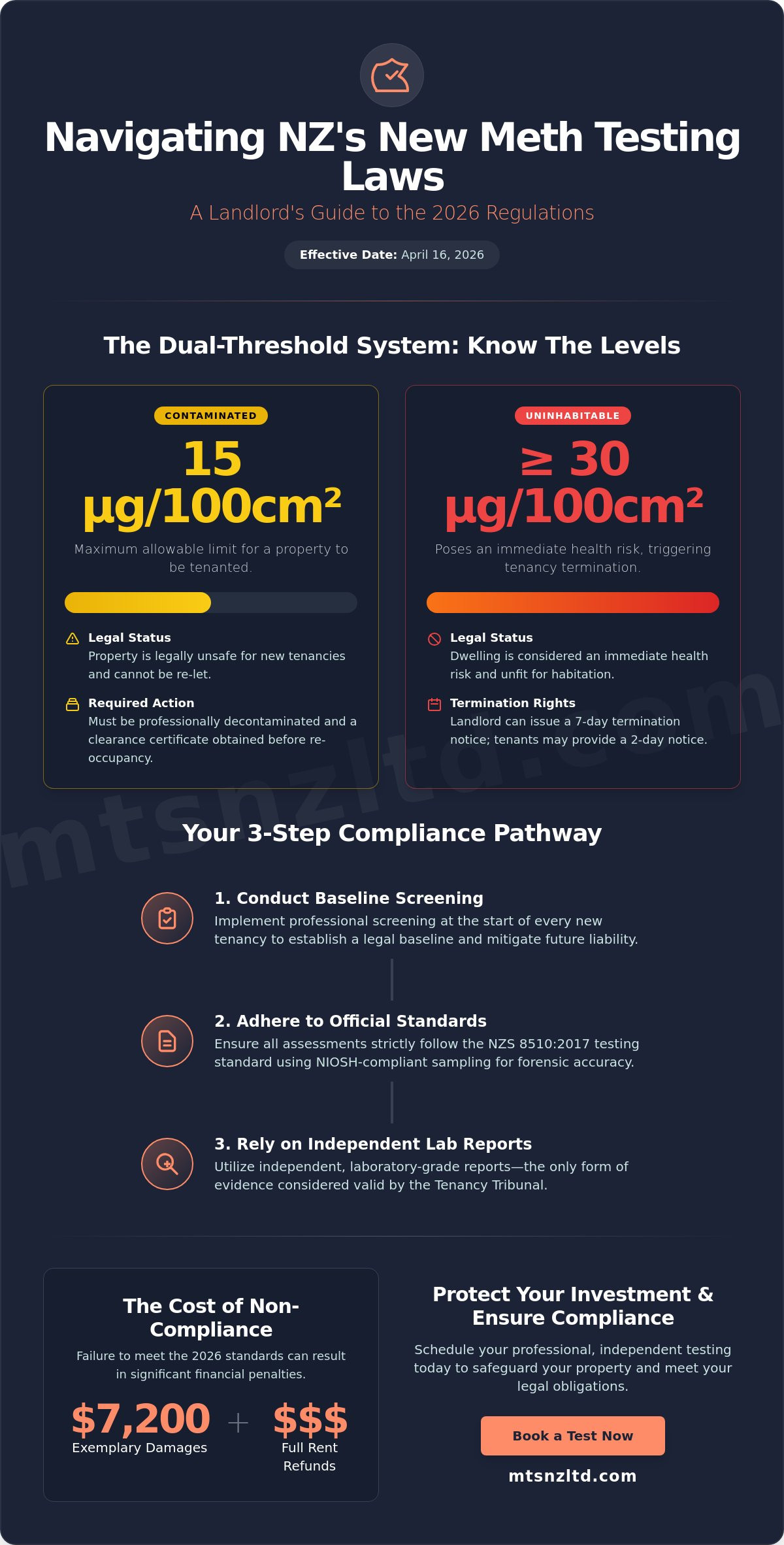
The Residential Tenancies (Managing Methamphetamine Contamination) Regulations 2026, which took effect on April 16, 2026, establish mandatory safety standards to protect tenants from health risks associated with methamphetamine residues in rental housing. This regulatory shift transforms what were previously voluntary guidelines into enforceable legal requirements under the Residential Tenancies Act. Under the meth testing laws for landlords nz 2026, owners are prohibited from knowingly providing a property for rent if methamphetamine levels exceed 15 micrograms per 100 cm². This specific value is the maximum allowable limit for a property to be considered safe for habitation.
Properties that test above the 15 µg/100cm² threshold are legally classified as contaminated and require professional remediation. The regulations also define a higher threshold of 30 micrograms per 100 cm², at which point a property is considered uninhabitable. This legal framework is rooted in the classification of methamphetamine as a Class A controlled drug under the Misuse of Drugs Act 1975, which underscores the technical necessity for rigorous testing protocols. Landlords in Hamilton and the wider Waikato region must now ensure their properties comply with these limits before any new tenancy begins to avoid significant legal liability.
The 2026 update removes the ambiguity that previously existed between different testing standards. By codifying these limits into law, the government has provided a clear technical benchmark for property safety. Failure to adhere to these standards can lead to significant legal repercussions, including rent refunds or exemplary damages of up to $7,200. Maintaining a technical record of compliance isn't just a best practice; it's a fundamental requirement for risk management in the current legislative environment.
Key Legislative Changes for Waikato District Landlords
The transition from the NZS 8510:2017 voluntary standard to mandatory regulations under the Residential Tenancies Act has significant implications for owners in the Waikato District. The Tenancy Tribunal now possesses expanded powers to adjudicate on contamination disputes using the 2026 standards as the definitive evidence base. This means that a Baseline Screening Assessment or a Comprehensive Detailed Assessment is no longer just a recommendation; it's a vital component of a landlord's legal defense. Property owners can find more information on securing these technical reports at mtsnzltd.com to ensure their documentation meets the new evidentiary requirements.
The 15µg/100cm2 Threshold: 2026 Contamination Standards
The New Meth Testing Regulations 2026 have established a streamlined safety standard that removes previous technical ambiguities. Under the meth testing laws for landlords nz 2026, the 15 µg/100cm² threshold applies universally to all internal areas of a rental property. This eliminates the complexity of distinguishing between high-use living spaces and low-use areas like crawl spaces or wall cavities. If a property exceeds this limit, it's legally contaminated and cannot be re-tenanted until it's remediated to levels below 15 µg/100cm².
The 30 µg/100cm² threshold represents a more severe classification of "uninhabitable." This distinction dictates specific legal actions required by property owners:
15 µg/100cm² to 29.9 µg/100cm² (Contaminated): The property is unsafe for new tenancies. Landlords must arrange professional decontamination and obtain a clearance certificate before re-occupancy.
30 µg/100cm² or higher (Uninhabitable): The dwelling poses an immediate health risk. Landlords can issue a 7-day notice to terminate the tenancy, provided they didn't cause the contamination. Tenants may provide a 2-day notice.
This uniform approach ensures that safety standards remain consistent across the entire building envelope. It simplifies the compliance process for Waikato property owners by providing a single, clear target for remediation and safety verification.
NZS 8510:2017 Compliance in Laboratory Reporting
Data integrity is paramount when presenting evidence to the Tenancy Tribunal. Laboratory-grade reports are the only valid form of evidence under the 2026 regulations. These reports must be generated using NIOSH-compliant sampling methods, which ensure the technical precision required for forensic accuracy. Professional property screening avoids the high error rates associated with DIY kits, which often lack the sensitivity to detect residues precisely at the 15 µg threshold. To ensure your compliance data is robust and legally defensible, you can book a technical assessment that adheres strictly to the NZS 8510:2017 standard.
Waikato Landlord Obligations: When to Conduct Meth Testing
Establishing a clean record at the commencement of each tenancy is the most effective method for technical risk mitigation under the meth testing laws for landlords nz 2026. We recommend conducting a Baseline Screening Assessment before every new tenancy agreement in Hamilton and Te Awamutu. This procedure provides an evidentiary baseline that distinguishes between pre-existing contamination and residues introduced by a specific tenant. Without this data, landlords face a significant technical challenge when attempting to prove liability for contamination discovered at the end of a lease. It's a standard business practice that protects the financial integrity of your asset.
Landlords are legally obligated to conduct testing if there's a reasonable suspicion that methamphetamine manufacture or use has occurred on the premises. This suspicion might arise from police notification, physical evidence of drug activity, or specific reports from neighbours. Transparency is a core component of the new regulations; if a test is performed, the results must be shared with the tenants within seven days of receipt. Providing this data fosters professional trust and ensures you're meeting the disclosure requirements set by the Tenancy Tribunal. For a deeper technical analysis of these requirements, review our Meth Testing Waikato: The 2026 Property Owner’s Guide.
Managing Meth Risks in Hamilton and Waipa Rentals
Waikato's rental market, particularly in high-density areas like Hamilton East and Te Rapa, often experiences higher turnover rates compared to national averages. This increased frequency of occupancy changes necessitates a more rigorous screening schedule to ensure no contamination goes undetected between tenancies. Integrating a Baseline Screening Assessment into your 2026 Healthy Homes compliance schedule ensures that property safety is managed with the same level of discipline as insulation or ventilation standards. It's a systematic approach to asset protection that reduces the risk of long-term contamination accumulation. To ensure your property meets these evolving standards, you can book a baseline screening assessment today.
Independent Compliance: Baseline Screening for Waipa Districts
Maintaining technical independence between testing and remediation services is a fundamental requirement for legal defensibility in the current regulatory environment. Under the meth testing laws for landlords nz 2026, the integrity of your property data depends entirely on the impartiality of the assessor. We don't provide decontamination services; our sole focus is on providing objective, laboratory-grade evidence that accurately reflects the state of your asset. This separation of duties eliminates the conflict of interest inherent in companies that both identify contamination and profit from its removal. For property owners in Te Awamutu and the wider Waipa District, this technical objectivity provides a robust shield against future liability claims.
The 2026 regulations demand a higher standard of proof than previous guidelines. Our assessments deliver detailed reports that adhere strictly to the NZS 8510:2017 standard, ensuring every sample is processed by an accredited laboratory using NIOSH-compliant methods. These reports serve as a vital component of your risk management strategy, especially when monitoring the 15µg/100cm2 threshold. Establishing a baseline before a new tenancy begins is the most effective way to protect your investment from the financial repercussions of tenant-led contamination. You can Book a Compliant Meth Test to secure this data for your property records.
The MTS NZ Ltd Approach to 2026 Standards
Our methodology utilises Area-by-Area lab composites to provide a precise map of a property's health. This technical precision is essential for insurance compliance, as many policies still reference older standards or require specific evidence types to trigger coverage. By providing scientific-grade assessments across the Waikato and Bay of Plenty, we ensure that landlords have the exact data needed to navigate the Tenancy Tribunal or insurance claims. Our focus on quality and accuracy means that every assessment we conduct is designed to withstand legal scrutiny and provide total clarity for property owners regarding their compliance obligations.
Securing Your Waikato Property Portfolio for 2026 and Beyond
The implementation of the Residential Tenancies (Managing Methamphetamine Contamination) Regulations 2026 on April 16, 2026, establishes a rigid technical framework for property management. Navigating the meth testing laws for landlords nz 2026 requires a disciplined approach to data collection and record-keeping. By maintaining a clean baseline through independent screening, owners can effectively mitigate the risks associated with the 15µg/100cm² contamination threshold. It's a systematic verification process that ensures your asset remains compliant and protects your legal position during Tenancy Tribunal proceedings.
Our expertise in Waikato and Waipa district property standards ensures that your assessments meet the highest technical requirements. We provide independent laboratory-grade analysis and reports that are fully compliant with NZS 8510:2017. This objective data is essential for insurance validity and long-term liability protection. Secure your Waikato rental with an independent baseline meth test today to ensure your property management processes are ready for the new regulatory environment. Taking these proactive steps provides long-term stability for your investment.
Frequently Asked Questions
Is meth testing mandatory for all NZ landlords in 2026?
Methamphetamine testing is not a universal mandatory requirement for every tenancy, but landlords are legally prohibited from renting out contaminated premises. The Residential Tenancies (Managing Methamphetamine Contamination) Regulations 2026, effective April 16, 2026, require that properties do not exceed the 15µg/100cm² limit. Testing is the only technical method to verify that a property meets these safety standards and to provide a defensible record for the Tenancy Tribunal.
What happens if a meth test in my Waikato rental returns a result over 15µg/100cm2?
A result exceeding 15µg/100cm² legally classifies the property as contaminated under the meth testing laws for landlords nz 2026. Landlords must immediately cease renting the affected areas and arrange for professional decontamination to bring levels below the 15µg threshold. If the concentration reaches 30µg/100cm², the property is considered uninhabitable, which allows for the termination of a tenancy with seven days' notice provided the landlord is not at fault.
Can I use a DIY meth test kit to comply with the 2026 regulations?
DIY meth test kits don't meet the evidentiary requirements established by the 2026 regulations or the NZS 8510:2017 standard. These kits lack the technical precision to accurately measure residues against the 15µg or 30µg thresholds. Compliance requires independent, professional sampling followed by accredited laboratory analysis. Using non-professional kits leaves landlords vulnerable to legal challenges because the results aren't considered reliable data in a judicial or insurance context.
Who pays for meth testing in a rental property: the landlord or the tenant?
Landlords are responsible for the costs associated with baseline screening and detailed assessments as part of their asset management and compliance duties. These expenses are treated as standard operational costs for maintaining a safe rental habitation. If a Tenancy Tribunal ruling eventually finds a tenant liable for contamination, the landlord can then apply to recover the testing and remediation costs as part of a formal damages claim against that tenant.
Does the Healthy Homes Standard include meth testing in 2026?
Methamphetamine testing remains a separate regulatory requirement and isn't included within the five specific Healthy Homes Standards. While Healthy Homes focus on technical aspects like ventilation and thermal performance, the meth testing laws for landlords nz 2026 fall under the Residential Tenancies (Managing Methamphetamine Contamination) Regulations. Property owners must manage both sets of regulations concurrently to ensure their Waikato rentals remain fully compliant with New Zealand housing laws.


Comments