Property Values in NZ: 2026 Trends and Hidden Risks for Waikato Homeowners

The most expensive mistake you can make in 2026 isn't overpaying for a house; it's ignoring the invisible issues that modern buyers now refuse to touch. You’ve likely noticed that tracking property values nz feels like a full-time job lately, especially with the volatility we've seen across Hamilton and the wider Waikato. It’s natural to worry that a sudden shift in market sentiment or a failed building inspection could wipe out years of hard-earned equity. Greg Brown and our team understand that your home isn't just a building; it's your primary financial security.
This article explores how the 2026 property market trends in the Waikato affect your home’s worth and why "hidden" health factors are now critical for any professional valuation. You'll learn how to identify potential remediation costs before they derail a sale. We'll also provide a clear roadmap for meeting Healthy Homes Standards to ensure you pass due diligence and maximize your resale value when it’s time to move on.
Key Takeaways
Understand the 2026 market shift where intrinsic health factors are becoming just as critical as location for determining property values nz.
Learn why traditional drivers like school zones are no longer enough to protect your investment from "invisible" value killers like mould and chemical contamination.
Discover the heavy financial burden of meth contamination, including remediation costs that can reach tens of thousands of NZ$ and lead to insurance complications.
Find out why a standard pre-purchase building report often misses chemical risks and how to conduct proper due diligence in the Waikato & Bay of Plenty regions.
See how professional, independent testing ensures you have the unbiased data needed to maintain your home’s market edge and long-term value.
Table of Contents
The 2026 Outlook for Property Values in NZ and the Waikato Region
Beyond the Price Tag: What Really Drives Property Values in Hamilton
The Meth Factor: How Contamination Slashes Property Values in NZ
Protecting Your Investment: Due Diligence for Waikato Buyers
Securing Your Property Value with MTSNZ Professional Testing
The 2026 Outlook for Property Values in NZ and the Waikato Region
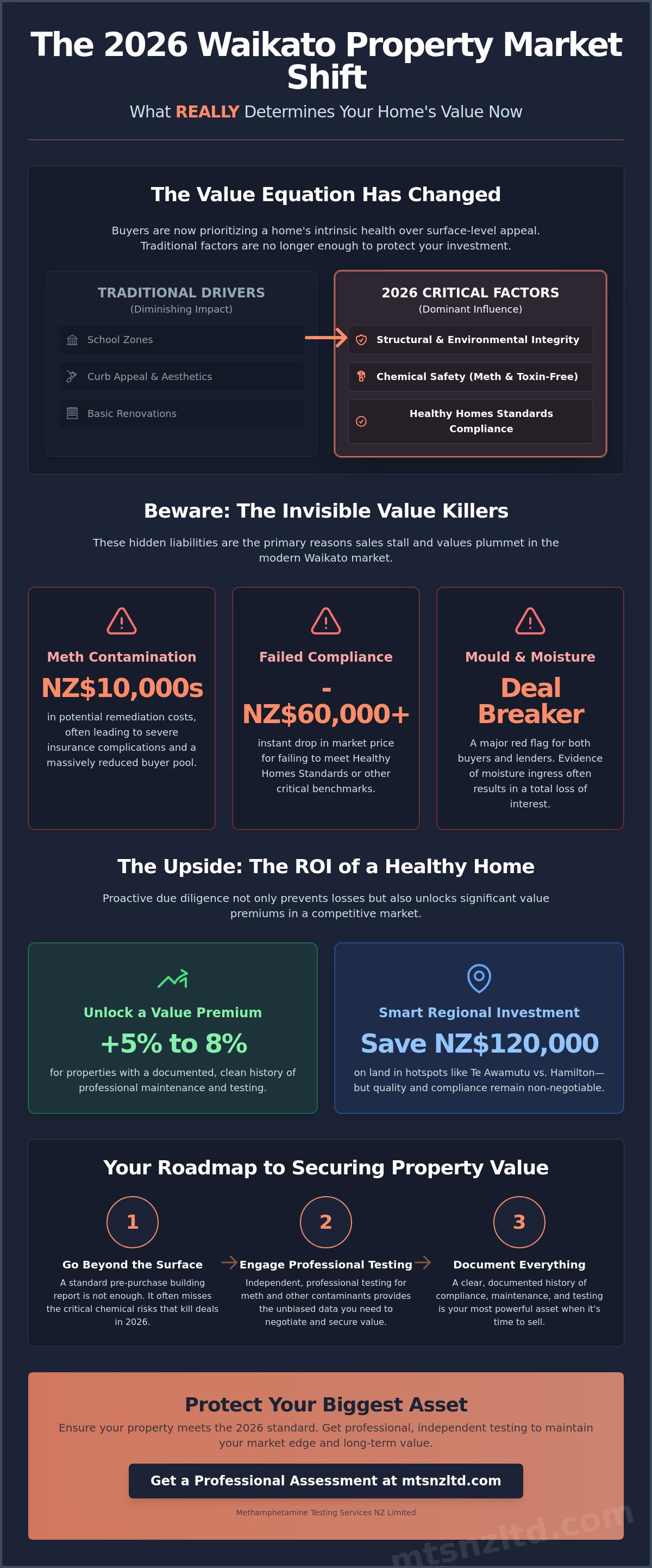
By March 2026, the way we define property values nz has shifted toward a more technical assessment of a home's "intrinsic health." It's no longer enough for a house to look good in photos. Buyers are now prioritizing the structural and environmental integrity of a building over purely aesthetic renovations. This trend follows a period of stabilization after the volatility of the New Zealand property bubble, where the focus has moved from rapid capital gains to long-term asset security. In the current market, a property's value is directly tied to its compliance with modern safety standards and its resilience against environmental risks.
The Waikato region continues to outperform many national averages because of its role as a primary logistics and infrastructure hub. While Auckland's market remains steady, the "Golden Triangle" effect keeps local demand high. Homeowners in the Waipa district and surrounding areas are seeing a consistent influx of buyers who are priced out of the Bay of Plenty but still require proximity to major employment centers. This regional shift means that local valuations are less about national speculation and more about the genuine utility of the land and the quality of the dwelling.
Hamilton and the Golden Triangle Growth
Hamilton City remains the central engine for regional growth in 2026. The completion of the final stages of the Waikato Expressway has permanently altered the commute dynamic, making Hamilton a viable base for those working across the upper North Island. Te Awamutu has specifically emerged as a hotspot for first-home buyers. Data from early 2026 shows that sections in Te Awamutu offer significantly better value for money, often costing NZ$120,000 less than comparable plots in Hamilton suburbs like Flagstaff. This demand isn't just about price; it's about the lifestyle and the modern infrastructure that connects these satellite towns to the city core.
The Shift Toward Quality and Compliance
In 2026, "quality" is a technical term rather than a marketing one. Buyers are increasingly wary of hidden liabilities that could compromise their equity. A property's value is only as strong as its underlying health. This is why a toxicology report nz is now a standard requirement in many residential sale agreements in the Waikato. People aren't willing to gamble on properties with potential contamination or moisture issues.
Healthy Homes Standards are now the baseline for all residential valuations.
Properties with documented maintenance histories fetch a 5% to 8% premium.
Pre-purchase tests for meth and mould are non-negotiable for most bank lending.
A house that fails to meet these technical benchmarks can see its market price drop by NZ$60,000 or more almost instantly. For Waikato homeowners, maintaining property equity in 2026 means staying ahead of these compliance requirements and ensuring that every technical aspect of the home is verified and documented.
Beyond the Price Tag: What Really Drives Property Values in Hamilton
While many homeowners focus on the aesthetics of a kitchen renovation or the curb appeal of a manicured lawn, the actual drivers of property values nz buyers prioritize in 2026 are often found beneath the surface. Traditional factors like being within the Hamilton Boys' High or Girls' High school zones, proximity to the CBD, and the total land size in suburbs like Rototuna or Tamahere remain influential. However, these are now secondary to the "invisible" factors that can either cement a premium price or cause a deal to collapse during the due diligence phase.
Value killers such as chemical contamination, hidden mould, and long-term structural neglect are the primary reasons sales stall in the Waikato. It's an observation that modern buyers are far more technically savvy than they were a decade ago. They aren't just looking at the floor plan; they're looking at the building's history and health. The psychological impact of a negative report is significant. Once a potential buyer sees evidence of moisture ingress or environmental hazards, the perceived risk often outweighs any price discount, leading to a total loss of interest in the property.
Proximity to transport hubs and employment centers in North Hamilton.
Compliance with current building codes and environmental safety standards.
The presence of verified, independent property health records.
Section size and the potential for future subdivision under local council rules.
Healthy Homes as a Value Multiplier
In the Waipa district and greater Hamilton area, compliance is no longer just a legal obligation for landlords; it's a financial asset. Rental properties that fully meet the healthy homes standards consistently fetch higher yields because they offer lower maintenance risks for investors. If you're selling, using a compliance certificate as a core part of your marketing toolkit provides a competitive edge. It reassures buyers that the property won't require immediate, costly upgrades to heating, insulation, or ventilation systems after the keys change hands.
The Risk of Unseen Contamination
Modern buyers in 2026 look past fresh paint to see what lies beneath the surface. Passive meth residue is a major concern that can quietly erode property values nz sellers expect to achieve. This residue doesn't always present visible signs, yet it can compromise the safety of the living environment and lead to expensive remediation if discovered late. Independent verification is the only way to provide the certainty that today's market demands. Sellers who proactively invest in professional testing and verification before listing their property often experience a smoother sale process, as they remove the "fear of the unknown" that frequently halts negotiations in the Waikato market.
The Meth Factor: How Contamination Slashes Property Values in NZ
Methamphetamine contamination remains a silent killer of property values nz homeowners need to address before listing their assets. When a property tests positive for P, the financial impact extends far beyond a simple cleaning bill. Remediation often involves stripping wall linings, replacing carpets, and even removing appliances in extreme cases. These technical procedures can easily cost tens of thousands of NZ dollars, depending on the level of chemical saturation. Greg Brown emphasizes that precision in the initial assessment is the only way to avoid ballooning costs later in the project.
Insurance companies have also tightened their requirements significantly. Most standard policies now include specific limits for chemical contamination, often capped at NZ$30,000 for a single claim. If the damage exceeds this, the owner covers the difference out of pocket. Beyond the immediate repair costs, there's the "Stigma Discount." Even after a house is professionally cleaned and cleared, it can sell for 10% to 20% less than its non-contaminated neighbors. This happens because buyers remain wary of long-term health risks and potential resale difficulties.
Waikato landlords face additional pressure under the Residential Tenancies Act. Failing to provide a clean environment isn't just a moral issue; it's a legal liability. If a landlord rents out a contaminated property, they could face exemplary damages of up to NZ$7,200 per breach. Testing between tenancies has become a standard risk management strategy to protect the asset's worth and ensure compliance with healthy homes regulations.
Stigma vs. Reality in the Waipa District
Public perception often creates a larger price drop than the actual physical damage. In areas like Te Awamutu or Cambridge, a single "meth house" on a street can suppress the values of surrounding homes due to the perceived association with crime. Banks are particularly sensitive to methamphetamine contamination nz wide. If a valuer flags a property for suspected manufacturing, obtaining a mortgage becomes nearly impossible until the site is cleared. There's a clear distinction between "use" and "manufacture," but for a bank, any presence of the drug represents a high-risk collateral asset.
Remediation as a Necessary Investment
Restoring a home isn't just about safety; it's about reclaiming equity. The recovery process starts with professional meth testing to map out the exact areas of concern. This data-driven approach ensures that remediation efforts are targeted and efficient, rather than a blanket removal of materials. Once the cleaning is complete, a clearance certificate serves as a "reset" for the property’s market reputation. It provides documented proof that the home meets NZS 8510 standards, giving prospective buyers the confidence they need to pay full market value.
Protecting Your Investment: Due Diligence for Waikato Buyers
By 2026, property values nz have reached levels where a single oversight can derail a family's financial future. Waikato homeowners often assume a standard check covers every potential issue before they sign on the dotted line. It doesn't. While a house might look pristine during a Sunday open home, the hidden risks are often microscopic and chemical rather than structural.
The Limits of a Standard Building Report
A traditional pre purchase building inspection focuses on structural integrity, moisture levels, and roofing. These are vital for identifying "leaky home" symptoms or foundation shifts, but they're blind to chemical contamination. Inspectors in the Waikato & Bay of Plenty now regularly suggest adding specialized meth testing to the due diligence list. Coordinating these visits within the standard 10-to-15 working day window requires precise scheduling. You don't want to find out about a contamination issue after your deposit is non-refundable. Professional inspectors work alongside specialized testers to ensure the property's health is as sound as its frame.
The Value of a Lab-Backed Report
Greg Brown emphasizes that "screening" is always better than "guessing." Relying on DIY kits or visual cues is a high-risk strategy that often leads to costly remediation later. Composite methamphetamine tests offer a superior ROI because they provide scientific evidence backed by the NZS 8510:2017 standard. This standard sets the threshold for decontamination at 1.5 micrograms per 100cm² for high-use areas. If a lab report shows levels above this limit, it gives the buyer a factual basis to negotiate property values in NZ or request full decontamination before settlement.
Using a lab-backed report ensures your data is legally defensible. It provides:
Precise microgram readings per room rather than a simple "yes/no" result.
Compliance with the NZS 8510:2017 standard, which is the benchmark for NZ insurers.
Clear documentation that protects your resale value in the future.
At MTSNZ, the engineering-led approach removes the emotion from the purchase. It treats the home as a technical asset that must meet specific safety criteria. In a market where remediation for a contaminated property can exceed NZ$30,000, the cost of a professional screen is a minor but essential line item in your budget. Don't leave your family's health or your financial equity to chance.
If you're ready to secure your future home with scientific certainty, book a professional screening today to ensure your investment is safe.
Securing Your Property Value with MTSNZ Professional Testing
Protecting your home's worth in the current market requires more than just aesthetic upgrades. It requires hard data. When looking at property values nz homeowners are discovering that transparency is a major selling point. MTSNZ provides that clarity through rigorous, independent testing that removes the guesswork from property transactions. By providing a certified report, you give potential buyers the confidence they need to commit to a purchase without fear of hidden contamination risks.
Greg Brown is a firm believer that accurate data beats a DIY home kit every time. These retail kits often lack the sensitivity required to meet New Zealand standards. They can provide false positives or, even worse, miss low-level contamination that a professional inspection would catch. The emphasis here is that relying on "off-the-shelf" solutions is a gamble with your equity. Professional, laboratory-backed results ensure you aren't guessing when it comes to your most significant asset.
MTSNZ operates as a strictly independent, third-party testing body. This is a critical distinction for Waikato & Bay of Plenty homeowners. Because we don't perform remediation or cleanup services, we have no financial incentive to find problems where they don't exist. Our only goal is to provide an unbiased, accurate picture of your property's health. For landlords, this includes baseline testing to create a legal "line in the sand." This benchmark protects your investment before a new tenancy begins, ensuring you have the evidence needed if a dispute arises regarding property damage or contamination. It's a proactive way to safeguard property values nz investors rely on for long-term growth.
Professional Testing in the Waikato Region
Our team regularly visits properties across the Waikato & Bay of Plenty to provide specialized on-site assessments. We ensure every inspection is an nzs 8510 compliant meth test, which is the gold standard for New Zealand property safety. We work closely with local real estate agents to facilitate smooth sales. By having the testing completed early, you avoid the stress of last-minute hurdles during the settlement process. This professional approach ensures that all parties have the facts they need to move forward with a sale.
Next Steps for Your Property
Ready to protect your investment? You can Request a professional assessment today for your residential or commercial premises. During a visit, the technician conducts a thorough walkthrough and sample collection, following strict protocols to ensure zero cross-contamination. You'll receive a detailed report that breaks down the findings in clear, understandable terms. This documentation gives you the facts you need to manage your property's future with total confidence and professional certainty.
Securing Your Waikato Investment for 2026
Navigating the shifts in property values nz homeowners face requires looking past the surface level of market trends. While the Waikato region shows promise for growth heading into 2026, hidden risks like methamphetamine contamination can quietly erode your hard-earned equity. You don't want to discover a costly contamination issue after the settlement is finalized and the keys are in your hand. Proper due diligence isn't just a recommendation; it's a fundamental necessity for anyone serious about protecting their financial future in a changing market.
Greg Brown and the team at MTSNZ provide the technical expertise you need to buy or sell with total confidence. We conduct independent testing that's fully compliant with NZS 8510:2017 standards. You'll receive detailed, lab-grade reports that meet the strict requirements of insurance providers and real estate professionals. By identifying these risks early, you ensure your property remains a safe, high-value asset for years to come. It's about making informed decisions based on hard data rather than guesswork. You deserve the peace of mind that comes from knowing your home is healthy and your investment is secure.
Take the right steps now to ensure your home remains the solid investment you intended it to be and enjoy the growth of the Waikato market.
Frequently Asked Questions
Do property values in NZ drop if a house has a history of meth use?
Yes, property values in NZ generally decline when a history of methamphetamine use is disclosed to potential buyers. Real estate agents are legally required to disclose known contamination under the Real Estate Agents Act 2008. This disclosure often leads to lower offers or longer times on the market as buyers factor in the perceived risk and potential for future remediation costs.
Is a meth test required for a building report?
A meth test isn't a mandatory part of a standard pre-purchase building report. However, many local buyers choose to add this as a specific condition of sale to protect their investment. Since standard building inspections focus on structural integrity and moisture, they won't identify chemical residues without specialized testing equipment and expertise.
How much does meth contamination typically devalue a Waikato home?
Meth contamination devalues a Waikato home primarily through the high cost of specialized cleaning and the permanent record on the property file (LIM report). While specific figures depend on the extent of the damage, homeowners often face remediation bills that can reach tens of thousands of New Zealand dollars. This financial burden, combined with the stigma of past use, reduces the final sale price compared to clean properties.
Can I get insurance for a property with a history of contamination?
You can obtain insurance for these properties, but most providers will insist on a clearance certificate showing the home meets the NZS 8511;2017 standard. Insurers typically have specific clauses regarding contamination. If you don't have proof of professional decontamination, you might find your policy excludes any future claims related to chemical damage or health issues.
How does the Healthy Homes Standard affect my property value in 2026?
By 2026, the Healthy Homes Standard will be a baseline expectation that directly supports property values nz by ensuring the asset is legally rentable. Homes that fail to meet these heating, insulation, and ventilation requirements are often viewed as projects by investors. This leads to lower valuations because the buyer must immediately spend capital to bring the property up to the legal New Zealand standard.
What is the difference between a screening test and a lab composite test?
A screening test provides an immediate result (Yes/No) to show if meth is present above a certain level, while a lab composite test offers a detailed quantitative analysis. During a lab composite test, the technician takes swabs from multiple areas and sends them to an IANZ accredited laboratory. This method is more precise and is usually required by banks and insurers to prove a property is safe for habitation.
Should I test my rental property between every tenant?
Testing your rental between every tenancy is the best way to prove when any damage occurred. Under the Residential Tenancies Amendment Act 2019, landlords must provide a clean environment. Regular testing protects your investment by establishing a clear baseline, making it much easier to hold tenants accountable for any contamination found at the end of their lease.
How long does a professional meth test take to get results?
You'll typically receive your professional results within two to three business days after the samples reach the laboratory. While some companies offer instant kits, these don't provide the level of detail needed for legal or insurance purposes in New Zealand. Waiting for a certified lab report is the only way to ensure the data is accurate and defensible.


Comments