Methamphetamine Testing Services NZ Limited: 2026 Growth Strategies for Hamilton, Rotorua, and Tauranga Property Owners

Updated: Apr 14
What if the difference between a secure property investment and a total insurance rejection in 2026 comes down to a single decimal point? Most property owners in Hamilton and Tauranga agree that the shifting line between the 1.5mcg and 15mcg contamination thresholds feels like a moving target that is hard to hit. Greg Brown and the team have refined Methamphetamine Testing Services NZ Limited strategies for growth to help local landlords navigate these technical complexities with confidence. It's frustrating to feel like your insurance coverage is at risk because of confusing Residential Tenancies Act regulations, but you don't have to face those risks alone.
In this guide, you'll discover how modern meth testing standards and independent data integrity are shaping property growth and insurance safety across the Waikato and Bay of Plenty regions. We promise to clarify how NZS 8510:2017 compliance acts as a shield for your assets while ensuring your documentation is ready for any insurer's scrutiny. We'll examine the specific steps you can take today to protect your property's value and secure a competitive edge in the 2026 market.
Key Takeaways
Learn why the 1.5mcg NZ Standard remains the vital benchmark for insurance safety in 2026, protecting your Waikato or Bay of Plenty assets from narrowing policy coverage.
Understand the importance of independent data integrity and why Greg Brown advocates for a strict separation between testing professionals and decontamination companies.
Discover how Methamphetamine Testing Services NZ Limited strategies for growth provide Hamilton, Rotorua, and Tauranga investors with the technical insights needed for secure property management.
Master the two-step process of baseline testing to establish clear liability and safeguard your rental yields before any new tenancy begins.
Table of Contents The 2026 Shift: Why Meth Testing is a Growth Strategy for NZ Property Understanding the 1.5mcg vs. 15mcg Insurance Risk The Independence Factor: Why Your Tester Should Never Be Your Cleaner Actionable Growth: Baseline Testing for Tauranga and Rotorua Investors Partnering with Methamphetamine Testing Services NZ Limited in 2026
The 2026 Shift: Why Meth Testing is a Growth Strategy for NZ Property
Clean data directly influences property valuation. In markets where buyers are increasingly cautious, a property with a documented history of negative meth results stands out. It's about building a "biological gold standard" for your portfolio. Greg Brown focuses on providing this clarity, helping owners move away from guesswork and toward a sustainable residential growth strategy. When you have a baseline test on file, you're protecting the future equity of the home.
The Regulatory Landscape in 2026
The 2026 legislative environment has placed a heavy burden of proof on property owners. Recent updates to the Residential Tenancies Act have tightened the requirements for providing a "safe and habitable" environment. Greg Brown remains a firm advocate for the NZS 8510:2017 standard. While political discussions often debate various "reference levels" for contamination, following the 8510:2017 standard provides the most robust legal protection for landlords. If a dispute reaches the Tenancy Tribunal, having a professional report that adheres to these recognized New Zealand standards is your best defense against liability claims. It's a key component of the Methamphetamine Testing Services NZ Limited strategies for growth, as it prevents sudden, unbudgeted expenses from legal settlements.
Waikato and Bay of Plenty Market Dynamics
Hamilton, Rotorua, and Tauranga are currently experiencing some of the highest rental pressures in the country. This high demand often leads to rapid tenant turnover, which naturally increases the risk of contamination going unnoticed between tenancies. In the Waipa district, smart investors are using baseline testing to support property growth. By testing between every tenancy, you create an unbroken chain of evidence.
Hamilton: High density living makes proactive testing essential to prevent cross-contamination in multi-unit dwellings.
Tauranga: Premium coastal valuations mean even a small contamination issue can lead to a massive drop in market appeal.
Rotorua: A diverse rental pool requires a standardized approach to ensure all properties meet health requirements consistently.
Establishing this baseline data doesn't just manage risk; it actively supports the long-term appreciation of the asset. Investors who can prove their property has been consistently "clean" since 2024 or 2025 find it much easier to secure financing and insurance at competitive rates.
Understanding the 1.5mcg vs. 15mcg Insurance Risk
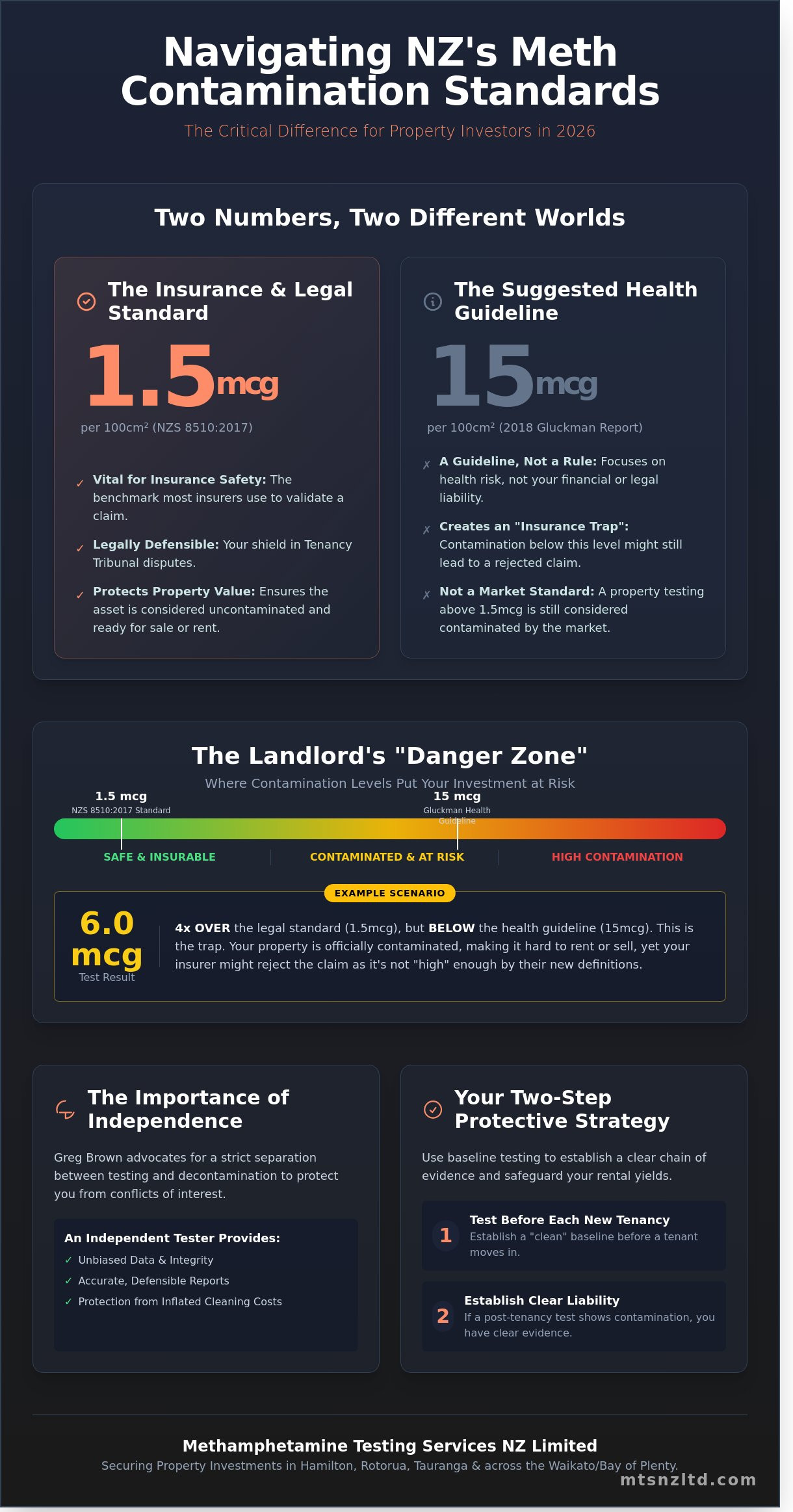
There's a lot of confusion in the New Zealand property market regarding the "safe" level of methamphetamine residue. On one hand, you have the NZS 8510:2017 standard, which sets the limit at 1.5mcg per 100cm2. This is the benchmark for professional decontamination. On the other hand, the 2018 Gluckman Report suggested that health risks aren't a major concern until levels reach 15mcg. This ten-fold difference creates a significant gap that many landlords fall into. Implementing Methamphetamine Testing Services NZ Limited strategies for growth involves helping property owners understand that while 15mcg might be a health guideline, the 1.5mcg standard is often what dictates your legal and financial liabilities.
The real danger lies in "mid-range" contamination. If a property tests at 6mcg, it's technically contaminated according to the New Zealand standard, but it sits well below the Gluckman health threshold. This creates a "no man's land" where a property might be difficult to rent out or sell, yet it doesn't meet the high threshold some insurers now require for a payout. Methamphetamine Testing Services NZ Limited strategies for growth focus on bridging this gap by providing reports that satisfy both health guidelines and strict insurance requirements.
The Insurance Trap for Landlords
Insurance policies in 2026 have become much more restrictive. Many providers have updated their wording to narrow coverage triggers, often refusing to pay out unless contamination is "sudden and accidental" or exceeds specific high thresholds. If you don't have a baseline test, your policy might stop responding to claims without warning. Greg Brown and his team emphasize the importance of a Laboratory Composite Methamphetamine Test to provide the forensic proof needed for a successful claim. This high-precision approach ensures you aren't left facing an "uninsured loss" scenario, which can easily cost upwards of NZ$25,000 in cleaning and lost rent.
Protecting Your Hamilton Investment
Waikato rental properties face unique challenges, and Hamilton investors need to be particularly vigilant. With high demand for housing, the turnover of tenants can be frequent, increasing the risk of undetected activity. A toxicology report nz is your best defense against a complicated insurance dispute or a Tenancy Tribunal case. It provides a clear, scientific record of the property's condition at a specific point in time. When you weigh the small cost of a professional test against the risk of a total remediation bill, the cost-benefit analysis is clear. If you're concerned about your property's status, it's a good idea to consult with a specialist to ensure your assets are fully protected.
The Independence Factor: Why Your Tester Should Never Be Your Cleaner
When you're managing a high-value property portfolio, the last thing you need is a "fox guarding the henhouse" scenario. In the New Zealand market, some companies offer both testing and remediation services under one roof. This creates a massive conflict of interest that can compromise your investment. If a tester stands to make a significant profit by finding a problem they can then charge thousands to fix, the integrity of that data is immediately questionable. Methamphetamine Testing Services NZ Limited strategies for growth rely on a different, more ethical path: total independence.
By focusing purely on testing and reporting, we provide property owners with a transparent paper trail that isn't influenced by potential cleaning contracts. This independence is a cornerstone of our business model. Greg Brown has built the company on the foundation that unbiased data is the only way to protect landlords and buyers. When we step onto a property, our only goal is to provide an accurate snapshot of the environment based on scientific evidence, not to find reasons to sell you a decontamination package.
Ensuring Unbiased Results in Rotorua
Using "all-in-one" companies in Rotorua puts buyers at risk because the results might be skewed toward securing a remediation job. Greg Brown’s business philosophy is built on the idea that transparency is the only way to protect a long-term investment. This is especially vital during a pre purchase building inspection. Buyers need to know exactly what they're walking into without worrying if the tester is trying to upsell them on a NZ$15,000 cleaning service. Independent data protects your portfolio's growth by ensuring you never pay for unnecessary work.
The MTS NZ Ltd Reporting Standard
We don't rely on basic "yes/no" field kits that can produce inconsistent results. These on-site tests often fail to meet the rigorous NZS 8510:2017 standards required for legal or insurance purposes. Our reporting standard involves laboratory-grade analysis. This ensures that every sample taken from a property follows NIOSH-compliant methods, which are the gold standard for chemical sampling. Whether you need meth testing waikato wide or in the local Rotorua area, these reports are designed to stand up to intense legal scrutiny. This commitment to data integrity is a core part of Methamphetamine Testing Services NZ Limited strategies for growth, as it builds lasting partnerships with insurers and professional property managers who require absolute certainty.
Unbiased reports are also essential for resolving insurance disputes. If a claim arises, an insurance provider will look for a report that is free from commercial bias. By maintaining a strict separation between testing and cleaning, we ensure our clients have the most robust documentation possible. It's about providing a service that is technically precise and ethically sound, ensuring that every property transaction or management decision is based on facts rather than a sales pitch.
Actionable Growth: Baseline Testing for Tauranga and Rotorua Investors
For property investors in Tauranga and Rotorua, protecting an asset requires more than just a standard rental agreement. Greg Brown and the team emphasize that a proactive approach to property health is the most effective way to secure long term returns. By following a structured testing protocol, you can eliminate the guesswork and ensure your investment remains a high performing asset. Implementing Methamphetamine Testing Services NZ Limited strategies for growth involves moving beyond reactive measures and adopting a systematic approach to property health.
The process starts with four critical steps designed to protect your liability and your capital:
Step 1: Establishing a baseline. You should always conduct a test before a new tenancy begins. This creates a legal "point zero" that proves the property was clear of contamination when the tenant took possession.
Step 2: Integrating inspections. Don't treat meth testing as a one-off event. By including it in your standard property inspection cycle every six months, you catch issues early before they become expensive remediation projects.
Step 3: Marketing "clear" reports. In competitive markets like Tauranga, a certified clear report is a powerful tool. It attracts high quality tenants who value safety and are often willing to pay a premium for a verified healthy home.
Step 4: Leveraging data. When you decide to refinance with a bank or sell the property, a documented history of negative test results provides the "clean bill of health" that lenders and buyers look for to justify a higher valuation.
Strategic Testing for Portfolio Scaling
Scaling a portfolio requires de-risking every new acquisition. In Tauranga, where property values often exceed NZ$1,000,000, the cost of a missed contamination issue is too high to ignore. Baseline tests prevent new tenants from claiming that existing contamination was there before they moved in. This documentation is also vital for meeting the Residential Tenancies (Healthy Homes Standards) Regulations 2019. Investors use MTS NZ Ltd to conduct thorough pre-purchase due diligence, ensuring they aren't buying a liability that will drain their cash flow later.
Maintaining Property Value in Rotorua
In the Rotorua rental market, maintaining a property's reputation is essential for long term rental yields. Regular monitoring prevents the "stigma" of contamination from ever attaching to your address. Professional testing acts as a value-add service for property managers, showing owners that their investment is being watched with professional precision. By following Methamphetamine Testing Services NZ Limited strategies for growth, you ensure that your Rotorua holdings remain compliant with NZS 8510:2017 standards, which protects the property's market value and your peace of mind.
Ready to secure your investment's future? Book a baseline test with the team at MTS NZ Ltd today to start your journey toward a safer, more profitable portfolio.
Partnering with Methamphetamine Testing Services NZ Limited in 2026
Success in the New Zealand property market hinges on risk mitigation and data-driven decisions. As we look toward 2026, Methamphetamine Testing Services NZ Limited strategies for growth focus on delivering high-precision technical assessments for investors in Hamilton, Rotorua, and Tauranga. Greg Brown leads the team with a focus on engineering-grade accuracy, ensuring that every residential or commercial property meets the NZS 8510:2017 standards. This level of detail provides the peace of mind necessary for high-value transactions.
Independent testing remains the most reliable way to protect an investment portfolio. We've seen that relying on DIY kits often leads to false positives or missed contamination. By choosing a professional service, you're securing a report that holds weight with insurers and legal bodies. Our process is designed to be transparent and efficient, fitting into the tight timelines of modern real estate settlements. We don't just provide data; we provide a foundation for safe property management.
Our Commitment to the Greater Waikato
Our operational focus extends deeply into Hamilton, Te Awamutu, and the wider Waipa district. We understand the specific nuances of the regional market, from suburban residential blocks to large-scale commercial facilities. For businesses, we handle commercial property meth testing with a focus on minimizing operational downtime. Local knowledge allows us to deliver reports that satisfy the specific requirements of regional councils and local property managers, ensuring your compliance is never in question.
Next Steps for Your Property
Integrating Methamphetamine Testing Services NZ Limited strategies for growth into your 2026 plan is a straightforward process. It starts with identifying the specific needs of your site. You can request a quote for a Laboratory Composite Methamphetamine Test, which provides a comprehensive overview of a property's status. This method involves sending samples to an IANZ-accredited laboratory for precise analysis rather than relying on field-based indicators that lack scientific depth.
If you're concerned about potential contamination risks or need to update your property's safety profile, contacting Greg Brown is the first step. He offers expert advice on how to manage identified risks and what steps to take for remediation if necessary. The future of property investment in the Waikato depends on maintaining high safety standards. We're here to ensure your assets remain clean, compliant, and ready for sustainable growth.
Securing Your Property Assets for 2026 and Beyond
Navigating the New Zealand rental market requires more than just standard maintenance. As we approach 2026, the distinction between the 1.5mcg decontamination limit and the 15mcg insurance risk threshold becomes a vital piece of your investment security. By implementing baseline testing now, property owners in Hamilton, Rotorua, and Tauranga can create a clear paper trail that protects equity and ensures compliance with the NZS 8510:2017 standard. It's about being proactive during tenant transitions to maintain long term value.
Choosing the right partner is essential for data integrity. We focus exclusively on professional assessment; we don't offer cleaning services, which eliminates any conflict of interest. Our 100% independent approach is central to the Methamphetamine Testing Services NZ Limited strategies for growth, providing you with unbiased reports you can trust. Greg Brown and the team deliver expert service across the Golden Triangle to help you mitigate risk effectively. Don't leave your portfolio's future to chance when professional certainty is just a booking away.
Taking these steps today ensures your investments remain resilient and profitable for years to come.
Frequently Asked Questions
Is meth testing still required for NZ landlords in 2026?
Landlords must provide a property that is in a reasonable state of cleanliness under the Residential Tenancies Amendment Act 2019. While the government is expected to update specific contamination regulations by late 2025, the current NZS 8510:2017 standard remains the benchmark for safety. You're legally responsible for ensuring meth levels don't exceed 1.5mcg before a new tenant moves in.
What is the difference between a screening test and a laboratory composite test?
A screening test uses an on-site kit to give you an immediate "yes or no" result regarding the presence of meth. Laboratory composite tests are much more detailed because we send swabs to an IANZ-accredited lab to find the exact concentration levels. This technical precision is a core part of Methamphetamine Testing Services NZ Limited strategies for growth, as it provides the data integrity needed for legal and insurance purposes.
How much does a professional meth test cost in Hamilton or Tauranga?
The cost of testing depends on the size of your property and the number of samples required for a conclusive result. Based on 2024 market trends reported by Tenancy Services, a basic baseline screening for a standard three-bedroom home typically starts between NZ$200 and NZ$300. More comprehensive lab-based testing involves higher fees because of the scientific processing and detailed reporting required.
Does a standard building report include methamphetamine testing?
No, a standard building inspection following the NZS 4306:2005 standard only covers the structural integrity and condition of the dwelling. Chemical contamination is a specialized field that requires separate equipment and training. Greg Brown recommends booking a dedicated meth test alongside your building report so you've got a full picture of the property's health before you sign a sale and purchase agreement.
What happens if my property tests positive for meth contamination?
If a test shows levels above 1.5mcg, you'll need to hire a professional decontamination team to clean the affected areas. Once the cleaning is finished, you must get a clearance test to prove the property is safe for people to live in again. Greg Brown emphasizes that keeping a strict paper trail during this process is essential for meeting council requirements and protecting your property's value.
How often should I test my rental property for methamphetamine?
We recommend testing at the beginning and end of every tenancy to establish a clear baseline of the property's condition. This approach is a vital element of Methamphetamine Testing Services NZ Limited strategies for growth because it helps landlords identify exactly when contamination occurred. If you've got long-term tenants, an annual check-up can provide peace of mind and ensure you're meeting your obligations as a provider of safe housing.
Why is independent testing important for insurance claims?
Insurance companies usually require an independent report to ensure there's no conflict of interest between the tester and the person doing the cleanup. If the same company tests and cleans, the insurer might worry the results are biased to increase the repair bill. Using a dedicated testing service ensures your claim is backed by objective data that meets the NZS 8510:2017 standard, which makes the claims process much smoother.


Comments