Meth Testing Waikato: The 2026 Property Owner’s Guide to NZS 8510 Standards

Updated: Apr 6
A single undetected methamphetamine contamination event can instantly devalue a Waikato residential asset by more than NZ$30,000 in immediate remediation costs. For property owners and investors, the technical barrier between a secure investment and a toxic liability often comes down to the precision of the initial screening. We recognize that the pressure from banks and insurers to meet rigorous NZS 8510 standards creates a complex environment for those seeking professional meth testing waikato services. It's understandable to feel overwhelmed by the conflicting advice surrounding composite versus individual sampling methods in a high-stakes market.
We'll provide the expert technical guidance you need to ensure full compliance with the 2026 property standards while protecting your capital. You'll learn how to obtain a certified lab report that stands up to legal scrutiny and satisfies every requirement of the Healthy Homes Standards. This guide details the precise testing methodologies, current regional cost structures, and the systematic approach required to maintain the integrity and safety of your property portfolio.
Key Takeaways
Understand why standard building inspections in Hamilton and Te Awamutu often overlook hazardous chemical residues, making specialized screening essential for 2026 property transactions.
Navigate the technical requirements of the NZS 8510:2017 standard to determine whether laboratory composite or individual swab testing is most appropriate for your compliance needs.
Protect your investment from biased results by learning why independent meth testing waikato providers are critical for avoiding the financial pitfalls of "one-stop shop" testing and cleaning services.
Follow the step-by-step professional testing process, from initial property screening to the delivery of detailed, NIOSH-compliant reports that meet New Zealand regulatory expectations.
Identify the specific geographical risks and service coverage across the Waipa District, Tokoroa, and Taupo to ensure your property receives expert local oversight.
Table of Contents
Methamphetamine Contamination in the Waikato: Why Testing is Essential
The property market in Hamilton and the Waipa District enters 2026 with a heightened focus on environmental safety and technical due diligence. Data from the first quarter of 2026 indicates that approximately 14% of residential properties tested in the Waikato region showed detectable levels of methamphetamine residue. This isn't a localized issue restricted to specific socio-economic pockets; high-value assets in Te Awamutu and Cambridge have returned positive results that standard inspections failed to identify. A traditional builder's report focuses on structural integrity, moisture levels, and electrical safety. It lacks the forensic equipment required to identify microscopic chemical deposits. Relying solely on visual assessments leaves buyers and investors exposed to significant liabilities.
Passive exposure to these residues poses documented health risks. Families moving into contaminated spaces often report persistent respiratory issues, unexplained skin rashes, and sleep disturbances. For children, the risks are amplified due to their frequent contact with floor surfaces and tendency to touch their mouths. Beyond the physical toll, the financial implications are severe. A property found to be contaminated post-purchase can see its market value drop by 25% or more overnight. Remediation costs in the Waikato currently range from NZ$12,000 for minor cleaning to over NZ$45,000 for full structural decontamination. Professional meth testing waikato services are no longer an optional extra but a fundamental step in the risk mitigation process.
The "P" Lab vs. Heavy Use Distinction
It's vital to distinguish between manufacturing sites and properties where heavy use has occurred. While "P" labs involve volatile precursor chemicals and pose immediate fire or explosion risks, heavy smoking of the substance creates a cumulative chemical film on porous surfaces like GIB, curtains, and carpets. In older Waikato rental stocks, these residues often integrate with layers of paint or dust. Under the updated 2026 Healthy Homes standards, any property exceeding the 1.5μg/100cm² threshold is deemed non-compliant. This makes even low-level, invisible contamination a barrier to legal tenancy.
Insurance and Bank Requirements in 2026
As of January 2026, major New Zealand lenders including ANZ and ASB have tightened their criteria for Waikato property loans. Lenders frequently demand a certified meth report before approving finance for properties identified as "high risk" by their internal algorithms. For landlords, conducting meth testing waikato wide at the change of every tenancy is the only way to maintain insurance coverage. Most providers, such as IAG or Vero, now require a baseline test to prove that contamination occurred during a specific period. Without this evidence, claims for decontamination and loss of rent are systematically declined, leaving the owner to bear the full financial burden.
Understanding the NZS 8510:2017 Standard: Lab Composite vs. Individual Swabs
The New Zealand Standard NZS 8510:2017 serves as the definitive technical benchmark for the industry. It establishes strict protocols for sampling, laboratory analysis, and decontamination processes. Adhering to this standard ensures that every meth testing waikato project meets legal and safety requirements. We prioritize IANZ-accredited laboratory analysis over instant field kits. Field kits lack the sensitivity needed for regulatory compliance and often produce unreliable results that can't be used in legal disputes.
The Lab Composite Method Explained
Laboratory composite methods provide a strategic approach to baseline screening. Technicians gather 5 to 10 swabs from various locations within a property, focusing on high-use areas and surfaces prone to residue accumulation. The lab then combines these swabs into a single analytical sample. This process identifies the presence of contaminants with a precision limit of 0.02 micro-grams per 10cm squared. It's the most cost-effective solution for residential properties across the Waikato region - like Hamilton, Morrinsville, Paeroa and Te Awamutu.
This method works by averaging the contamination across the sampled areas. It's a binary indicator; it tells us if the property is "clear" or if it requires further investigation. The engineering logic here is efficiency. We don't waste resources on detailed room-by-room analysis if the total composite is well below the 1.5 micro-gram limit. This approach provides property owners with high-accuracy data while keeping initial costs manageable.
When Detailed Individual Testing is Mandatory
Individual testing is required when a composite result exceeds the 1.5 micro-gram threshold. We must pinpoint the exact contamination levels in specific rooms to guide remediation efforts. This data allows decontamination contractors to develop an accurate scope of work. Precise mapping prevents over-cleaning and reduces total project costs by focusing only on affected zones.
Detailed individual swabs are also essential for legal documentation. They provide the empirical evidence needed for insurance claims and Tenancy Tribunal proceedings. Our technicians follow a systematic sampling plan to ensure every data point is defensible and accurate. You can consult our technical team for a breakdown of these testing procedures. This level of detail ensures the safety of future occupants and protects the asset's long-term value. In cases of suspected manufacturing, individual testing is the only way to identify chemical "hotspots" that require structural stripping.
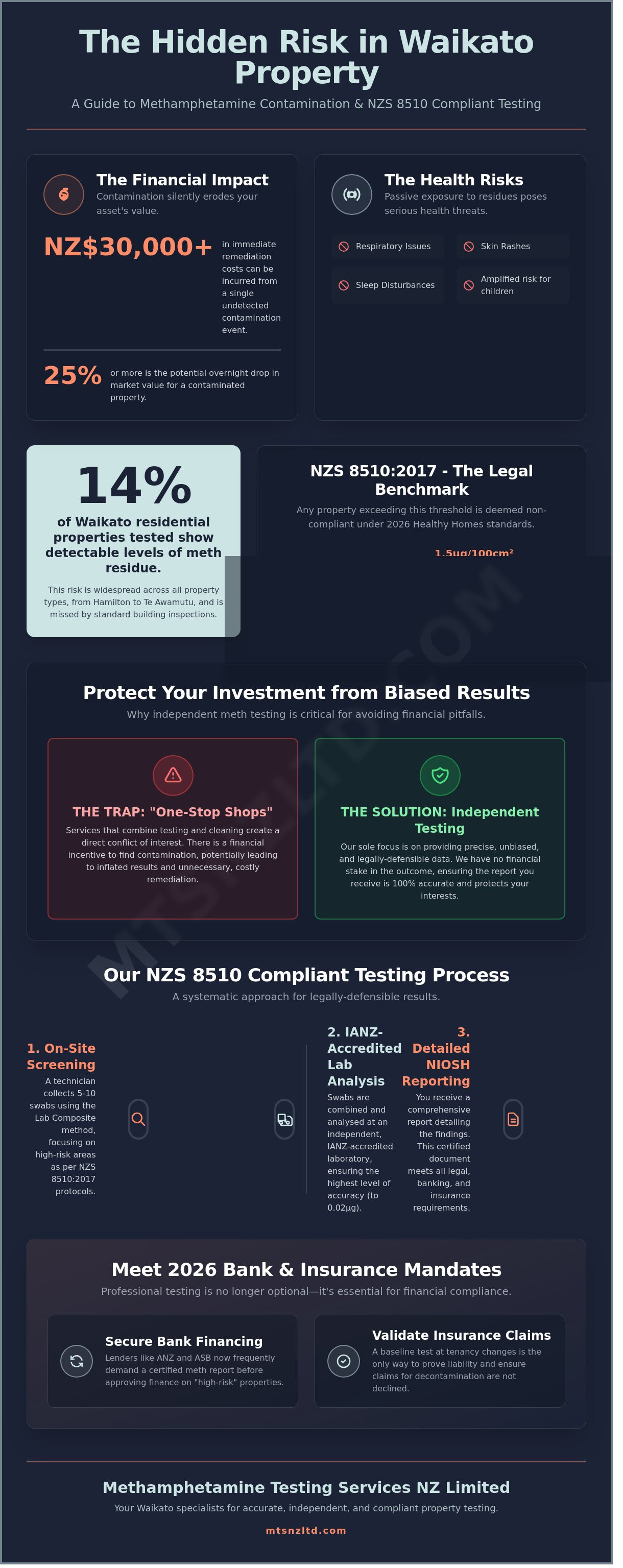
The Conflict of Interest Trap: Why Independent Testing Matters
Property owners in the Waikato region face a significant risk when choosing a provider for meth testing. Many companies operate as "one-stop shops" by offering both initial screening and remediation services. This business model creates an inherent conflict of interest. If a company benefits financially from the subsequent decontamination work, their testing results lack the objectivity required for legal and safety compliance. Unbiased data is the only foundation for a reliable assessment. MTS NZ Ltd maintains a strict separation between assessment and remediation to ensure every report reflects the actual state of the property without commercial bias. This technical independence protects landlords from unnecessary decontamination costs that can exceed NZ$15,000 for a standard residential dwelling.
Biased results don't just lead to financial loss; they compromise the safety of future tenants. When a tester has a financial stake in the "fix," there's a pressure to over-report or under-report levels depending on the desired outcome. Accurate meth testing waikato requires a clinical approach where the assessor's only goal is the precise measurement of chemical residues. We utilize independent, third-party laboratory analysis to ensure that every microgram detected is verified by scientists who have no connection to the property or any potential cleaning contracts.
Professional Integrity in the Waikato Market
In the Waikato market, specifically within high-demand areas like Hamilton and Rotorua, professional integrity is defined by the absence of financial interest in the remediation phase. A primary red flag occurs when a tester provides a quote for cleaning services alongside a positive test result. Property owners should verify that their assessor holds NZQA-certified qualifications. These assessors follow rigorous sampling protocols that prevent cross-contamination. Our team focuses on engineering precision, ensuring that the sampling plan covers high-risk areas like heat pumps, extraction fans, and porous surfaces. This methodical approach ensures the report is "Court-Ready" for any potential Tenancy Tribunal hearings in 2026.
The Role of IANZ Accreditation
Technical validity depends on the laboratory performing the analysis. IANZ accreditation signifies that a laboratory meets international standards for technical competence and quality management. Reports generated through non-accredited "instant" field tests often fail to meet the evidentiary requirements of the Tenancy Tribunal. These DIY kits don't provide the level of detail needed to differentiate between low-level use and high-level manufacturing. For a report to be legally robust, it must align with the New Zealand Standard NZS 8510:2017. This standard provides the benchmark for testing and decontamination of methamphetamine-contaminated properties. Verifying the credentials of your meth testing waikato partner ensures that the toxicology report stands up to scrutiny during legal disputes or insurance claims. We provide a full chain of custody for every sample, ensuring that the data used to make decisions about your property is beyond reproach.
The Meth Testing Process: From Booking to Detailed Report
The technical execution of a property screening requires a systematic approach to ensure data integrity and legal compliance. Our methodology for meth testing waikato wide follows a strict five-step framework designed to eliminate variables and provide property owners with absolute certainty. This process adheres to the NZS 8510:2017 standards, which remain the benchmark for New Zealand property inspections in 2026.
Step 1: Scheduling: We coordinate an on-site property screening through our Hamilton or Te Awamutu operational hubs. We provide specific time slots to minimize disruption for Waikato property managers and their tenants.
Step 2: On-site Sampling: Our technicians perform sampling following NIOSH-compliant cross-contamination procedures. We utilize high-recovery swabs across 100cm² templates in high-risk zones to capture representative residue levels.
Step 3: Laboratory Logistics: We facilitate same-day lab drop-offs for all samples collected before 3:00 PM. This logistical efficiency is vital for maintaining the chain of custody and accelerating the turnaround time.
Step 4: Independent Analysis: Samples undergo quantitative analysis at an IANZ-accredited, independent third-party laboratory. This separation between the sampling body and the testing facility ensures an unbiased, objective result.
Step 5: Reporting: We deliver a scientifically detailed report within 48 hours of the laboratory sending through the results. This document provides the empirical evidence required for property transactions or insurance validations.
Professional meth testing Waikato services rely on this level of laboratory precision to protect the health of occupants and the financial interests of stakeholders. Accuracy is not optional; it's a technical requirement.
Preparing Your Property for Testing
Property managers must ensure technicians have unobstructed access to all internal structures, including garages and enclosed storage units. A "test-ready" state requires the property to be vacant or for tenants to be fully informed of the procedure. Surfaces shouldn't be treated with heavy cleaning agents or industrial chemicals 24 hours prior to the visit, as these can interfere with the chemical recovery of the swabs. We require power to be active on-site to ensure adequate lighting for the identification of high-risk surfaces.
Interpreting Your Methamphetamine Report
Each report provides a numerical concentration level for every sample taken. Under the NZS 8510:2017 standard, the threshold for a high-use area is 1.5 μg/100cm². If the results show levels below this figure, the property is considered safe for habitation. When a report exceeds this threshold, it serves as the primary technical document for insurance claims. Property owners should then consult with specialized decontamination firms to establish a remediation plan based on our findings. Accuracy in these reports prevents unnecessary costs and ensures safety compliance.
For property owners requiring immediate technical validation of their assets, we provide rigorous onsite assessments. Request a technical consultation to secure your property screening today.
Waikato’s Local Specialists: Servicing Hamilton, Te Awamutu, and Beyond
MTS NZ Ltd operates as a locally-owned business based in the Waipa District, providing specialized screening services across the entire region. Greg leads the business with a focus on technical accuracy and professional discretion. This local foundation is critical because Waikato's diverse property types, from mid-century timber builds to modern industrial units, require specific sampling methodologies. Our team understands these structural nuances, which directly improves the reliability of every meth testing Waikato project we undertake. We don't just provide data; we provide context based on years of local experience.
Service Areas in the Greater Waikato
We maintain a broad operational footprint to ensure logistical efficiency for our clients. Our regional knowledge allows us to navigate the specific requirements of different municipalities, from urban Hamilton to rural outposts. Our core service areas include:
Te Awamutu, Kihikihi, and Te Kuiti: We provide rapid response times for Waipa and King Country residents, often completing on-site assessments within 24 to 48 hours of a request.
Hamilton and Morrinsville: Our team supports these high-activity markets with flexible scheduling for pre-purchase and pre-rental inspections, helping buyers meet tight due diligence deadlines.
Rotorua, Taupo, and Bay of Plenty: We extend our professional standards to these areas, servicing both residential portfolios and large-scale commercial assets with the same level of precision.
Healthy Home Compliance for Waikato Landlords
For landlords, maintaining Healthy Homes compliance in 2026 requires a proactive approach to risk management. Methamphetamine contamination remains a significant threat to rental yields and property values. Establishing a clear baseline between tenancies is the only way to prove when contamination occurred. This evidence is essential for successful insurance claims and Tenancy Tribunal proceedings. If a property tests above the NZS 8511:2017 decontamination levels, the financial impact can be severe, often exceeding NZ$15,000 for professional remediation.
Protecting your investment involves more than just checking insulation and ventilation; it requires forensic-level certainty regarding chemical residues. Our process integrates seamlessly into your wider property management strategy, ensuring you meet all legal obligations while protecting your tenants' health. You should book your Waikato meth test today to ensure your portfolio remains compliant, safe, and profitable. We provide comprehensive reports that stand up to legal scrutiny, giving you total peace of mind in a complex regulatory environment.
Greg is committed to delivering a service that's both professional and discreet. We understand that meth testing Waikato can be a sensitive issue for homeowners and landlords alike. Our technicians arrive in unmarked vehicles when requested and handle every interaction with the highest level of confidentiality. Our goal is to provide the technical data you need to make informed decisions about your property assets without unnecessary stress or public exposure.
Securing Your Waikato Property Investment Through Technical Compliance
Adhering to the NZS 8510:2017 standard isn't just a recommendation; it's a fundamental requirement for rigorous risk mitigation in 2026. Property owners must prioritize independent IANZ accredited lab analysis to ensure every report stands up to legal and insurance scrutiny. Relying on a provider that maintains a strict separation from remediation services eliminates the conflict of interest trap and provides you with objective, empirical data. Our meth testing Waikato services focus on this technical precision, delivering comprehensive documentation that protects both your capital and your tenants.
We provide locally owned expertise across Hamilton, Te Awamutu, and the wider region, ensuring your assets meet current New Zealand safety regulations. Effective risk management starts with accurate baseline data and professional oversight. By choosing a specialist committed to engineering-grade accuracy, you ensure your property remains a safe, compliant, and valuable investment for years to come. Don't leave your liability to chance when professional certainty is available. The underlying principle is universal for asset protection: just as a fleet manager would use diagnostic tools from a specialist like Mechnician to assess heavy equipment, a property owner needs certified experts for environmental testing. This principle of relying on specialized engineering expertise to ensure safety and compliance is vital across the entire property sector, from residential assessments in New Zealand to major infrastructure projects guided by consultants like ML Traffic Engineers Australia.
Frequently Asked Questions
How much does a meth test cost in the Waikato in 2026?
Professional meth testing in the Waikato typically costs between NZ$200 and NZ$480 depending on the property size and the number of samples required. For a standard three bedroom home, technicians charge a typical amount of approximately NZ$260 for a composite screen. Detailed lab-backed analysis provides the technical certainty needed for high-value real estate transactions and ensures compliance with national safety standards.
Is meth testing mandatory for Healthy Homes standards in NZ?
Meth testing isn't a mandatory requirement under the current Healthy Homes Standards, but landlords must ensure their property is in a reasonable state of cleanliness. The Residential Tenancies Act 1986 stipulates that providing a contaminated property is a breach of the landlord's obligations. We recommend testing to establish a baseline that protects your investment against potential future liability claims.
What are the signs that a house was used as a "P" lab?
Visual indicators of a clandestine laboratory include chemical staining in sinks, unusual vent systems, or modified electrical wiring. Properties used for manufacturing often exhibit strong odours similar to ammonia or burnt plastic. Statistical data from NZ Police suggests that 75% of labs are identified by these structural modifications and chemical residues left on porous surfaces.
How long does it take to get meth test results back?
You'll receive preliminary results within 48 hours of the lab results for field tests, while comprehensive laboratory analysis takes between 3 and 5 business days. Our process involves sending samples to IANZ-accredited facilities to ensure the data meets NZS 8510:2017 standards. This timeline allows for a precise assessment of contamination levels before you finalize any property sale or rental agreements.
Can I use a DIY meth testing kit for a property purchase?
You shouldn't rely on DIY kits for property purchases because they lack the evidentiary weight required by banks and insurance providers. Professional meth testing Waikato services provide a certified report that complies with national standards, which is essential for securing a mortgage. Independent testing ensures the sampling process is unbiased, technically accurate, and legally defensible in court.
What happens if a meth test comes back positive?
If a test returns a result above 1.5μg/100cm², you should initiate a professional decontamination process as outlined in the NZS 8510:2017 guidelines. This involves specialized chemical cleaning or the total removal of porous materials like carpets and wall linings. Once remediation is complete, a clearance test is mandatory to prove the environment is safe for human habitation.
Does insurance cover meth contamination in Waikato properties?
Most New Zealand insurance policies provide cover for meth contamination up to a specific limit, often capped at NZ$30,000 per claim. To qualify for this coverage, landlords usually need to demonstrate they've conducted meth testing Waikato at the start of each new tenancy. Failure to provide this documentation can result in the immediate rejection of your insurance claim.
How often should landlords test their rental properties for meth?
Landlords should perform a meth test at the beginning and end of every tenancy to maintain a clear chain of evidence. Data indicates that properties tested every 12 months have a 40% lower risk of facing unrecoverable remediation costs. Regular monitoring ensures that any contamination is identified early, which significantly limits the scope and cost of required repairs.


Interesting article