Meth Testing Rules & Regulations 2026: Hamilton, Rotorua & Tauranga Guide

What if the safety standards you have relied on to protect your Hamilton rental property are officially outdated by the time April 2026 rolls around? It's a common concern, as the rules and regulations for meth testing rental properties across the Waikato region have felt like a moving target for years. You want to protect your investment and your tenants, but the long-standing debate between different contamination thresholds has created a lot of unnecessary stress. It's frustrating to worry about legal liability or the risk of using a testing kit that doesn't actually meet New Zealand standards.
Greg Brown and our team understand these concerns, which is why we have simplified the latest updates for you. We promise to clarify the new April 2026 contamination laws so you can manage your properties with total confidence. This article breaks down exactly when you are legally required to test, how to navigate the shift to the new 15 and 30 thresholds, and how to find a qualified professional in the Waikato region. We are here to help you stay ahead of the regulations so your property remains safe and your business stays protected.
Key Takeaways
Understand the major legal shifts coming in April 2026 and how the new Residential Tenancies Regulations affect your properties in Hamilton, Rotorua, and Tauranga.
Learn the new room-by-room "15 vs 30" threshold rules to ensure you are following the latest rules and regulations for meth testing rental properties Waikato and Bay of Plenty.
Discover why using professional testing methods is crucial and how to avoid the legal risks associated with unvalidated DIY kits found in local hardware stores.
Identify the specific "triggers"-including police or council notifications-that legally require you to conduct a meth test on your rental property.
Find out how Greg Brown and the team at Methamphetamine Testing Services NZ Limited ensure your property meets the NZS 8510:2017 standard to keep you fully compliant and protected.
Table of Contents
The 2026 Shift: New Meth Testing Rules for Waikato and Bay of Plenty Landlords
Understanding the Thresholds: When is a Rental Contaminated in 2026?
Approved vs. Prohibited Testing Methods: Protecting Your Investment
Landlord Responsibilities: Testing Triggers and Terminating Tenancies
Navigating Compliance in Hamilton, Rotorua, and Tauranga with MTSNZ
The 2026 Shift: New Meth Testing Rules for Waikato and Bay of Plenty Landlords
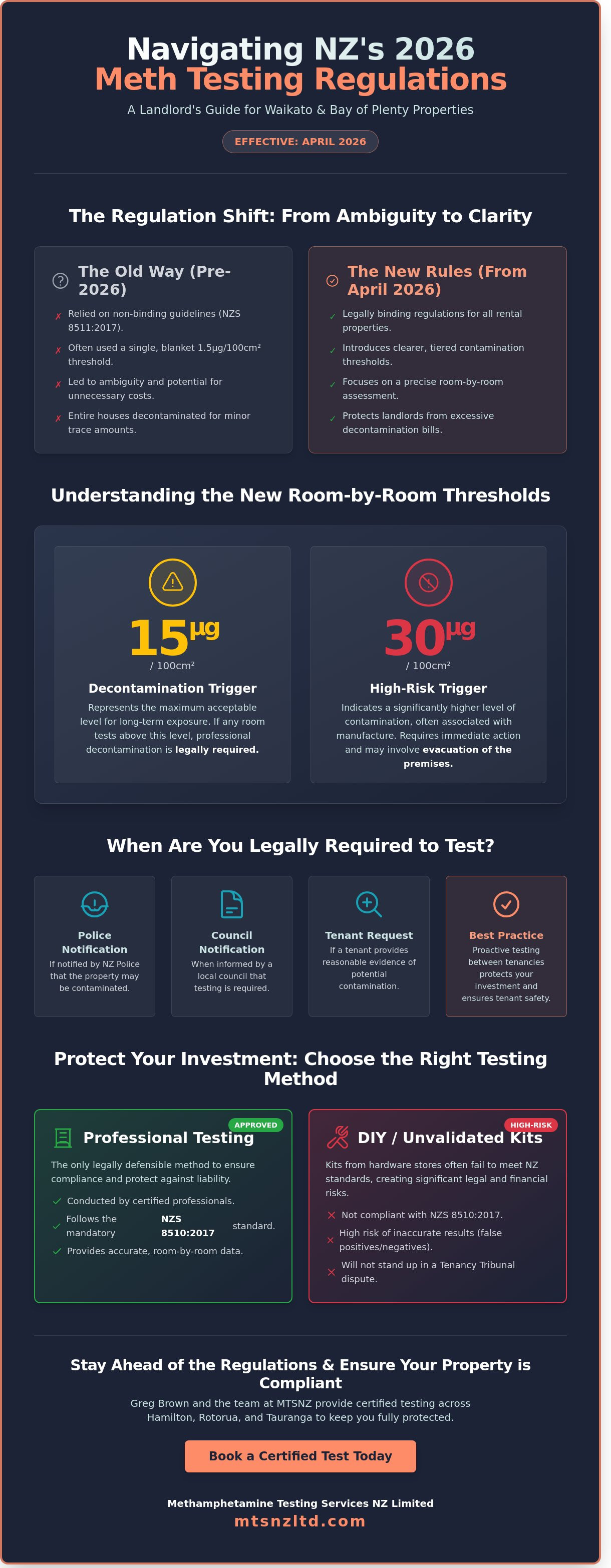
The landscape for property management changed on 16 April 2026. This date marked the official commencement of the Residential Tenancies (Managing Methamphetamine Contamination) Regulations. For landlords in Hamilton and Rotorua, these updates provide a long awaited framework that replaces previous industry ambiguity. Before this shift, many property owners relied on the NZS 8511:2017 standard, which often applied a blanket 1.5µg/100cm² threshold regardless of the source of contamination.
The 2026 rules introduce clearer, tiered thresholds that distinguish between simple consumption and chemical manufacture. This precision helps you manage your assets without the fear of unnecessary costs or legal disputes. Understanding the rules and regulations for meth testing rental properties Waikato and Bay of Plenty is now a core requirement for maintaining Healthy Homes compliance. Greg Brown emphasizes that these standards aren't just about ticking boxes; they're about ensuring structural safety and tenant health through technical accuracy. Key changes include:
New legally binding contamination limits that replace older, non-mandatory guidelines.
Standardised sampling methods that must be followed by all certified testers.
Specific requirements for when a property must be vacated and when it is safe for re-entry.
Why the Rules Changed in April 2026
The primary goal of the April 2026 update is clarity. Previous guidelines often led to entire houses being stripped for minor trace amounts, which caused massive financial strain for owners. The new regulations focus on a room-by-room contamination assessment. This approach stops landlords from facing the massive bill of a full-house decontamination when only one area is affected. Much of this contamination stems from clandestine chemistry, where the cooking or heavy use of substances leaves residues on surfaces. By isolating the assessment to specific rooms, the 2026 rules protect your investment while keeping safety as the top priority.
Local Context for Hamilton and Tauranga Rentals
Demand for rentals in the Waipa district and the Bay of Plenty remains high. In this competitive market, proactive testing has become a standard part of professional property management. You'll find that local councils in the Waikato region may have specific reporting requirements if a property tests above the new 2026 limits. Staying ahead of these rules and regulations for meth testing rental properties Waikato and Bay of Plenty ensures you don't face unexpected delays during tenant transitions. It's a practical step that builds trust with tenants and protects the long term value of your Tauranga or Hamilton portfolio. Precise data is your best defence against liability, and these regulations finally provide the technical roadmap needed to provide safe housing.
Understanding the Thresholds: When is a Rental Contaminated in 2026?
The landscape for landlords in the Waikato and Bay of Plenty changed significantly with the implementation of updated safety standards. We've moved past the old days of guessing whether a property is safe based on a single composite house average. Now, the Rules and regulations for meth testing rental properties Waikato and Bay of Plenty focus on specific room-by-room data. This means a kitchen might be clear while a back bedroom requires professional intervention. Greg Brown emphasizes that precision in these measurements isn't just about compliance; it's about protecting the health of your tenants and the long term value of your investment asset.
The new government regulations introduced a dual-threshold system that every property manager from Hamilton to Tauranga needs to understand. These levels determine whether you can continue a tenancy, whether you need to clean, or whether you must evacuate the premises immediately. Testing is no longer a "pass or fail" for the whole building, but a detailed map of the property's health.
The 15µg/100cm² Threshold: Decontamination Trigger
If a room tests above 15µg/100cm², it is legally contaminated. This figure represents the "maximum acceptable" level for long term exposure. You'll need to organize professional decontamination for any specific area that exceeds this limit. You don't necessarily have to evict everyone immediately if the levels stay below the next major cap. You can often keep the property tenanted between the 15 and 30 levels, provided you've informed the tenants in writing and have a clear remediation plan in place. This flexibility helps landlords managing high-turnover Hamilton city apartments avoid unnecessary vacancy periods while they coordinate cleaning schedules.
The 30µg/100cm² Threshold: The Uninhabitable Limit
Once a room hits a reading above 30µg/100cm², it's officially uninhabitable. This is a critical legal line that changes everything for a tenancy. At this point, the property is considered unsafe for human occupation. You're looking at immediate legal consequences, and the standard notice periods for termination change drastically because the premises are no longer fit for purpose. Whether you're running a long term rental in Tauranga or a short stay holiday home in Rotorua, hitting this number means the doors stay locked until a clearance certificate is issued.
Following the Rules and regulations for meth testing rental properties Waikato and Bay of Plenty ensures you don't get caught out by these strict limits. If you're currently managing a portfolio and haven't seen a room-by-room report lately, it's a good idea to get a professional assessment to ensure your documentation meets the 2026 requirements. Staying ahead of these thresholds is the only way to manage your liability effectively.
Approved vs. Prohibited Testing Methods: Protecting Your Investment
Choosing a testing method isn't just a box-ticking exercise for your tenancy agreement; it's about legal and financial protection. If you pick up a cheap DIY kit from a Hamilton hardware store, you're essentially gambling with your property's future. These kits often produce unreliable results that won't hold up in court. The updated rules and regulations for meth testing rental properties Waikato and Bay of Plenty are designed to eliminate this guesswork by requiring high-precision, professional standards.
Greg Brown often points out that while a $50 kit seems like a bargain, it lacks the scientific rigor required for a Tenancy Tribunal hearing. These kits don't provide the quantified data needed to prove a property is safe. If a tenant challenges your results, a DIY swab won't protect you. To stay compliant, you need independent, lab-grade testing that follows the NZS 8510:2017 standards. This is the only way to ensure your investment stays protected under the 2026 framework.
Laboratory Composite Testing: The Gold Standard
For landlords who want total certainty, Laboratory Composite Methamphetamine Testing is the most reliable option available. In this process, a technician takes individual swabs from various rooms, but the actual mixing and analysis happen in a controlled laboratory environment. This method is fully compliant because it ensures that every sample is handled with engineering-level precision. It provides a clear, numerical value of contamination levels rather than a simple yes or no answer.
At MTS NZ Ltd, we use NIOSH-compliant methods for every property we inspect in the Waikato. This means we follow the same strict protocols used by international health and safety agencies. Lab analysis is superior to on-site rapid tests because it eliminates human error during the testing phase. When you have a lab report in your hand, you have a legally defensible document that proves you've met your obligations as a landlord.
The "Field Composite" Ban: What to Avoid
It's vital to understand that "Field Composite" tests are effectively banned under the 2026 regulations. This is a method where a technician puts multiple swabs into a single tube while still at the property. While it's cheaper, it's incredibly risky. The Ministry of Housing and Urban Development provides official guidance on meth regulations that highlights why these shortcuts are no longer acceptable for high-stakes decisions.
The main danger with field composites is the risk of "false negatives." If one room has very high levels and another has zero, mixing them on-site can "average out" the result to look like it's below the limit. This hides dangerous "hot spots" in the home. Using these non-compliant tests could lead to your insurance being voided in Tauranga or Rotorua. If you can't prove you followed the rules and regulations for meth testing rental properties Waikato and Bay of Plenty, your insurer may refuse to cover decontamination costs, which can easily reach tens of thousands of NZ$.
Landlord Responsibilities: Testing Triggers and Terminating Tenancies
The 2026 regulatory landscape has shifted the burden of proof heavily onto property owners. You can't rely on guesswork when managing high value assets in Hamilton or Tauranga. Under the current framework, meth testing Waikato properties has transitioned from a recommendation to a core component of professional due diligence. If you don't have a clear record of your property's chemical health, you're exposed to significant legal and financial liabilities.
When Testing Becomes Mandatory
You're legally required to move beyond basic screening if an initial assessment identifies residues exceeding 15µg/100cm². This specific threshold triggers a mandatory detailed laboratory analysis to map the extent of the contamination. As a landlord, you have a strict duty to provide these test results to your tenants. You must deliver this information within seven days of receiving the report. Failing to disclose these findings is a breach of the Residential Tenancies Act; it can lead to exemplary damages in the Tenancy Tribunal.
The "Police or Council" trigger is another critical scenario. If authorities notify you that they suspect meth labs or heavy use at your Rotorua or Bay of Plenty rental, the property is effectively flagged. You must stop all access until a professional decontamination plan is established. Following the rules and regulations for meth testing rental properties Waikato and Bay of Plenty ensures you remain compliant during these high pressure interventions.
Ending a Tenancy Due to Contamination
The 2026 rules have streamlined the exit strategy for contaminated homes to protect human health. If testing confirms levels above 30µg/100cm², the property is considered uninhabitable. In these extreme cases, tenants can provide a 2 day notice period to vacate the premises. Landlords have the right to issue a 7 day notice to terminate the tenancy. This accelerated timeline is designed to prevent prolonged exposure to hazardous residues.
Managing abandoned belongings in contaminated Rotorua properties requires a disciplined approach. You can't simply toss items out; however, you aren't expected to store chemically compromised furniture. You should document everything and follow the specific disposal protocols outlined in the NZS 8510 standards. Remember, you cannot re-rent the property to a new family until a clearance certificate proves levels have dropped below the 15µg threshold.
Establishing a baseline between tenancies is the only way to protect your Hamilton investment. Without a "clean" test from the start of a lease, it's nearly impossible to prove a tenant caused the damage. Greg Brown emphasizes that precision in documentation is your best defense against tribunal claims. By testing every time a tenant moves out, you create an unbreakable chain of evidence.
Protect your investment and stay compliant with the latest NZ standards. Book a professional meth assessment with MTSNZ today to secure your property's future.
Navigating Compliance in Hamilton, Rotorua, and Tauranga with MTSNZ
Staying on top of the rules and regulations for meth testing rental properties Waikato and Bay of Plenty is a core responsibility for modern landlords. Greg Brown and the MTS NZ Ltd team specialize in making this process straightforward and legally robust. We focus on providing the technical clarity you need to manage your portfolio without the stress of shifting legislative goalposts. By choosing a professional service, you ensure that your property management decisions are based on hard data rather than guesswork.
One of the most important factors in choosing a tester is the absence of a conflict of interest. MTS NZ Ltd does not perform decontamination or cleaning services. We believe this distinction is vital for integrity. If a company both tests for meth and profits from cleaning it up, there's an inherent risk of biased results. Our role is to provide an objective, independent assessment that meets the NZS 8510:2017 standard. This New Zealand standard ensures that every sample collected and analyzed follows a rigorous, defensible process.
Booking a compliant test for your property in Hamilton, Rotorua, or Tauranga is a proactive step toward risk management. We've streamlined our scheduling to accommodate the fast-paced rental markets in the Waikato and Bay of Plenty. Whether you're transitioning between tenants or preparing a home for sale, our team provides the documentation required to prove you've met your obligations under the Residential Tenancies Act.
Independent, Lab-Grade Expertise
MTS NZ Ltd delivers detailed technical reports that go far beyond basic field kits. We use lab-grade analysis to provide precise readings of any contaminants present. These reports are essential tools for insurance claims, as most New Zealand insurers require evidence of professional testing to process claims related to chemical contamination. Our documentation also supports your Healthy Homes compliance by proving the environment is safe for habitation. We provide comprehensive coverage across the greater Waikato and Waipa district, including Te Awamutu and Cambridge, ensuring local landlords have access to engineering-grade precision.
Protecting Your Hamilton, Rotorua, or Tauranga Investment
Protecting your asset starts before you even take ownership. We strongly advise that pre-purchase building inspections always include a professional meth screen. This baseline testing is the only way to safeguard your property value in the long term. It establishes a "clean" point in time, which is crucial if you ever need to hold a tenant accountable for damage. Without a baseline test, it's nearly impossible to prove when contamination occurred. Don't leave your investment to chance. Get in touch with Greg Brown and the team today for a professional assessment that keeps you fully compliant with all rules and regulations for meth testing rental properties Waikato and Bay of Plenty.
Secure Your Rental Strategy for the 2026 Standards
Staying on top of the rules and regulations for meth testing rental properties Waikato and Bay of Plenty is the best way to protect your investment and your tenants. The 2026 updates clarify exactly when a property is considered contaminated, so you'll want to ensure your testing methods align with the latest NZS 8510:2017 requirements. Since 2017, MTSNZ has provided independent testing across Hamilton, Rotorua, and Tauranga. We don't have a conflict of interest because we focus solely on testing; we never perform the remediation work ourselves. This means you get an honest, unbiased look at your property's health every single time.
Greg Brown and the team understand the local market conditions and the legal triggers that require immediate action. Whether you're managing a single unit in Rotorua or a large portfolio in Hamilton, having a compliant report on file is your best defense against future liability. It's about more than just checking a box; it's about maintaining a safe environment for New Zealand families while securing your financial future. We're here to make the transition into these new 2026 standards as smooth as possible for you.
Frequently Asked Questions
Are meth testing regulations mandatory for all Waikato rentals as of 2026?
Meth testing isn't a mandatory legal requirement for every tenancy change under current New Zealand law, but landlords must provide a property in a reasonable state of cleanliness. If you don't test and a tenant later proves the property was contaminated before they moved in, you could be liable for significant financial penalties. Greg Brown and our technical team recommend baseline testing to establish a clear legal record of the property's state before a new lease begins.
What happens if my rental property in Tauranga tests above 15µg/100cm²?
If a lab report confirms levels above 15µg/100cm², the property is legally considered contaminated according to the Residential Tenancies Amendment Act 2019. You must notify your tenants immediately and stop charging rent if the property becomes uninhabitable. You'll need to hire a professional decontamination service and obtain a clearance certificate before anyone can live there again. This threshold is the current standard for safety in New Zealand living spaces.
Can I use a DIY meth testing kit from the hardware store in New Zealand?
You can use retail kits for a quick personal check, but they don't comply with the rules and regulations for meth testing rental properties Waikato and Bay of Plenty. These kits often produce false positives or negatives and aren't accepted as evidence by the Tenancy Tribunal or insurance companies. Professional testing follows the NZS 8510:2017 standard, which requires IANZ-accredited laboratory analysis to be legally valid for rental documentation.
How much notice do I need to give a tenant to conduct a meth test in Rotorua?
You must provide your tenant with at least 48 hours' notice before entering the property to carry out a meth test. This rule is strictly enforced under the Residential Tenancies Act 1986 to protect tenant privacy. After the test is completed, you're legally required to provide the tenant with the results in writing within seven days of receiving the laboratory report. Failure to provide these results can lead to a fine from the Tenancy Tribunal.
Does the Healthy Homes Standard in 2026 include meth testing?
The Healthy Homes Standards don't include meth testing as part of their specific compliance criteria for heating, insulation, or ventilation. Instead, meth contamination is managed under the broader "clean and safe" provisions of the Residential Tenancies Act. While you don't need a meth certificate for a Healthy Homes compliance statement, keeping the two records together helps demonstrate total property safety to prospective tenants and insurers.
What is the difference between a screening assessment and a detailed lab test?
A screening assessment is a cost-effective way to find out if meth is present above a certain limit, usually 1.5µg/100cm², but it doesn't show exact levels in each room. A detailed lab test involves taking individual swabs from every room and analyzing them separately in a controlled environment. You'll need this detailed data if a screening test comes back positive or if you're preparing for a decontamination project to identify specific hot spots.
Can I terminate a tenancy immediately if meth is found in my Hamilton rental?
You can't end a tenancy instantly unless the contamination is so high that the premises are unsafe to occupy, which usually means exceeding the 30µg/100cm² threshold. In Hamilton, if the property is uninhabitable, the landlord can give seven days' notice to terminate, while the tenant can give two days' notice. If the levels are lower, you'll likely need to work with the tenant or apply to the Tenancy Tribunal for a formal resolution.
Why are "Field Composite" tests no longer allowed under the new rules?
Field composite tests were phased out because they often lead to inaccurate results by mixing swabs from different rooms into a single container on-site. This method makes it impossible to tell which room has the highest concentration or if a single contaminated area is being diluted by clean samples. To follow the rules and regulations for meth testing rental properties Waikato and Bay of Plenty, testers must now use discrete sampling or lab-composited methods to ensure accuracy.


Comments