Meth Decontamination Cleaning: A Guide to NZS 8510 Standards and Remediation

Updated: Jun 17
Relying on the 2018 Gluckman report for residential property management decisions often leaves owners legally exposed and tenants at physical risk. It's understandable that you feel overwhelmed by the conflicting advice surrounding the NZS 8510:2017 standard and subsequent scientific reviews. The financial stakes are high. A failed remediation process can lead to significant property value loss and ongoing liability issues that affect your long-term investment goals and family safety.
This guide clarifies the technical requirements for meth decontamination cleaning and explains why independent testing remains the only verifiable way to ensure a property is safe for habitation. We'll examine the rigorous protocols defined by the New Zealand Standard and the critical role of third-party validation in protecting your assets. You'll gain a clear, structured understanding of the full remediation lifecycle, from the initial site assessment to the final clearance certificate. This process ensures your property meets the 1.5μg/100cm² limit required for high-use areas under current regulations. We provide the technical roadmap needed to navigate these complex requirements with scientific precision and absolute compliance.
Key Takeaways
Identify the regulatory benchmarks established by NZS 8510:2017 and understand why the 1.5μg/100cm² limit remains the professional standard for high-use areas in New Zealand.
Gain insight into the technical protocols of meth decontamination cleaning, from the systematic removal of contaminated porous materials to the execution of the specialised triple-wash method.
Understand the critical importance of avoiding conflicts of interest by ensuring that decontamination and final clearance testing are performed by independent, separate entities as recommended by national standards.
Learn how rigorous post-remediation clearance testing and laboratory analysis verify that a property has been successfully restored to safe, habitable conditions.
Table of Contents
Methamphetamine Contamination Standards: NZS 8510:2017 vs. The Gluckman Report
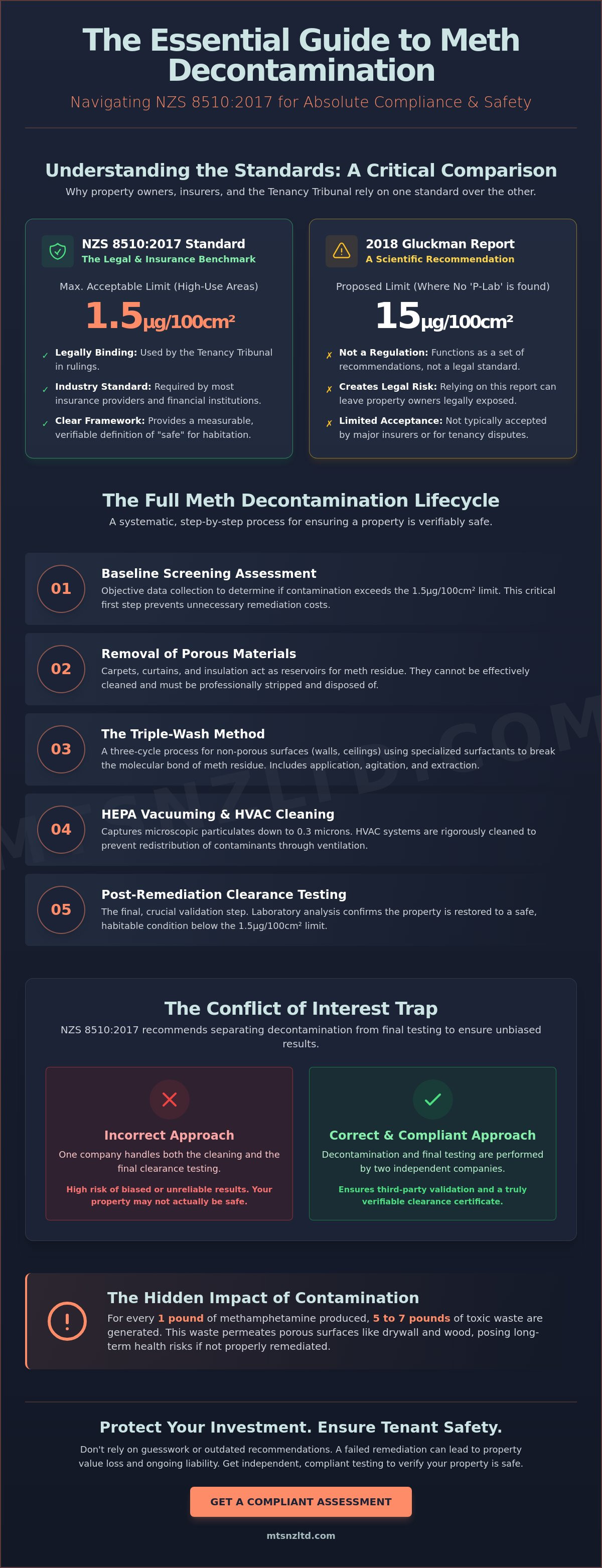
The NZS 8510:2017 standard remains the primary technical benchmark for property decontamination in New Zealand. This standard specifies a maximum limit of 1.5μg/100cm² for high-use areas in residential properties. Professional meth decontamination cleaning becomes a mandatory requirement only when a property's surfaces exceed this specific concentration. While higher thresholds are often discussed in public forums, insurance providers and financial institutions strictly require compliance with NZS 8510:2017 to mitigate liability and ensure asset security. These entities prioritise the standard because it provides a clear, measurable framework for safety, often relying on the technical infrastructure and communication support of Mobile Systems to manage large-scale compliance projects.
Contamination often results from the manufacturing process. Research indicates that for every pound of methamphetamine produced, roughly 5 to 7 pounds of toxic waste from meth production are generated. This byproduct permeates porous surfaces and structural elements. Adhering to strict standards is vital for occupant safety because these chemical residues don't dissipate on their own. We follow the NZS 8510:2017 guidelines to ensure that every remediation project meets the legal requirements for a "clean" bill of health.
Why the Gluckman Report causes confusion for owners
In May 2018, the Office of the Prime Minister’s Chief Science Advisor released a report suggesting that health risks from passive exposure to meth use were lower than previously thought. The report proposed a significantly higher remediation threshold of 15μg/100cm² for properties where manufacture hadn't occurred. This document functions as a set of recommendations that the Residential Tenancies (Managing Methamphetamine Contamination) Regulations 2026 is based and makes it a legally binding regulation. It hasn't replaced the legal standing of NZS 8510:2017. Property owners often face challenges because banks and major insurers still rely on the 1.5μg/100cm² limit for their policy coverage. But for tenancies, the threshold is higher at 15μg/100cm².
The role of baseline screening in determining cleaning needs
Determining the necessity of remediation requires objective data. A Baseline Screening Assessment provides the initial technical data needed to identify if levels exceed the 1.5μg/100cm² limit. This process prevents unnecessary expenditure on properties that don't require intensive meth decontamination cleaning. If you're unsure about the history of a property, consult a homeowner’s checklist for meth contamination to understand early indicators before commissioning professional testing services.
The Meth Decontamination Cleaning Process: Technical Remediation Steps
Effective meth decontamination cleaning requires a systematic approach to neutralise chemical residues that embed into structural surfaces. The process begins with the removal of porous materials. Carpets, curtains, and fiberglass insulation act as reservoirs for methamphetamine vapour. These items can't be effectively laundered to meet NZS 8510:2017 standards and must be stripped and disposed of immediately. This initial phase prevents the re-bleeding of contaminants back into the indoor environment after the hard surfaces are treated.
Technicians utilise a triple-wash method for non-porous surfaces like walls, ceilings, and joinery. This involves three distinct cycles of application, agitation, and extraction using specialised chemical surfactants. These surfactants are engineered to break the molecular bond of methamphetamine residue, a task standard household cleaners can't perform. Following the chemical wash, HEPA vacuuming captures microscopic particulates as small as 0.3 microns. HVAC systems and internal ducting also undergo rigorous decontamination to ensure the mechanical ventilation doesn't redistribute residue throughout the property, a complex operation that often relies on the robust coordination and communication solutions provided by Mobile Systems.
Low-level vs. high-level contamination cleaning
Remediation strategies depend on the contamination's severity. For properties testing slightly above the 1.5μg/100cm² threshold, a "soft clean" focusing on surface decontamination is often sufficient. However, former clandestine labs require a full strip-out. In these scenarios, chemicals have often penetrated wall linings (GIB) and floorboards. This necessitates the removal of structural elements to ensure the building meets safety benchmarks for future occupants.
Managing contaminated waste disposal
Materials removed from a meth-affected site are classified as hazardous waste. You can't place these items in standard residential bins or local transfer stations. Compliant disposal requires specific hazardous waste documentation and transport to landfills permitted to accept chemical debris. Properly managing various hazardous materials is a critical component of property maintenance; for instance, you can explore Asbestos consultancy, surveys, lab testing, air clearance. 4 stage clearance, water absorption testing, asbestos in soils testing by Ukas accredited consultancy. to see how professional laboratories handle complex environmental safety requirements.
The Conflict of Interest Trap: Choosing a Decontamination Contractor
The integrity of meth decontamination cleaning depends entirely on the independence of the verification process. NZS 8510:2017 explicitly states that the entity performing the decontamination shouldn't be the same one conducting the final clearance testing. This division ensures that no conflict of interest compromises the safety of the property. When a cleaning company offers to provide its own "passed" results, it's essentially self-certifying its own performance. This creates a significant risk. It bypasses the objective oversight required to guarantee that a site is safe for habitation. Developing a trusted network of independent service providers is key to maintaining property standards, a principle reflected in how Mobile Systems collaborates with its business partners to support various New Zealand industries.
Property owners must demand a detailed remediation plan before any physical work begins. This document should outline the specific technical steps, the chemicals used, and the disposal protocols for contaminated materials. A structured approach ensures that the cleaning process adheres to engineering standards rather than arbitrary benchmarks. Without a pre-approved plan, it's difficult to verify if the contractor followed the necessary safety protocols during the project.
Verification of cleaning efficacy
Verification requires high-precision laboratory analysis. While DIY "instant" kits might seem cost-effective, they lack the sensitivity needed to confirm compliance with the 1.5μg/100cm² limit set by NZS 8510 (or 15μg/100cm² limit set by the Residential Tenancies (Managing Methamphetamine Contamination) Regulations 2026). Independent lab testing provides a legally defensible record. Property owners should review the meth test cost NZ data to ensure their budget accounts for these professional verification services. Accurate data is the only way to confirm a successful clean.
Insurance-approved cleaning protocols
Insurance adjusters typically require a full audit trail before approving claims for meth decontamination cleaning. This includes a pre-decontamination assessment (Comprehensive Detailed Assessment), a detailed cleaning log, and a final clearance report from an independent third party. Most New Zealand policies only trigger payouts if the project follows an NZS 8510 compliant meth test protocol. Failure to maintain this separation of duties can lead to rejected claims. It leaves the owner liable for any residual contamination discovered later.
Ensure your property meets all regulatory requirements by scheduling an independent assessment today. Book a professional consultation to secure a compliant clearance report.
Post-Remediation Clearance Testing: The Final Step to Property Safety
Clearance testing serves as the definitive technical validation in the remediation lifecycle. This final laboratory analysis occurs only after all meth decontamination cleaning and subsequent drying phases are finished. It's a mandatory requirement under the NZS 8510:2017 standards to confirm the environment is safe for habitation. Technicians employ the 'Comprehensive Detailed Assessment' method, which involves taking individual (discrete) samples from specific areas to verify they meet the 1.5μg/100cm² limit (or 15μg/100cm² limit set by the Residential Tenancies (Managing Methamphetamine Contamination) Regulations 2026) if it is for tenanting. This rigorous approach ensures no room is overlooked during the final inspection.
If a specific room fails this initial post-clean test, a 'Detailed Assessment' is required to be repeated. This step involves discrete, individual sampling to identify exactly where the residual contamination persists. The path to re-occupancy depends entirely on these objective lab results. Once the property passes, the technician issues a final clearance report. This document is vital for the property's Land Information Memorandum (LIM) and provides the legal evidence needed to clear the property's record.
Issuing the final toxicology report
The final toxicology report is a formal technical document containing the empirical evidence of a successful project. It details the exact swab locations, provides the full laboratory analysis, and carries the technician's formal certification. This report acts as a critical shield for the owner's liability, a level of professional documentation that relies on the advanced communication and data tools featured by Mobile Systems. By documenting that the property meets NZS 8510 standards, it preserves the asset's future market value and provides peace of mind to future tenants or buyers.
Booking your independent clearance test
We recommend that owners book a post-decontamination test as soon as the cleaning team completes their site exit. Timely testing prevents delays in re-occupancy and ensures the property doesn't sit idle. For a deeper understanding of regulatory requirements and long-term compliance, owners should consult the Meth Testing Property Owner’s Guide. This resource outlines the necessary steps to maintain a meth-free environment under New Zealand law.
Achieving Compliance and Long-Term Property Safety
Navigating the complexities of NZS 8510:2017 requires a disciplined approach to technical remediation. Successful meth decontamination cleaning relies on following established scientific protocols rather than relying on inconsistent guidelines. It's vital to recognise that the Gluckman Report serves as a health advisory, while NZS 8510:2017 remains the benchmark for property decontamination in New Zealand. Maintaining a clear separation between the remediation contractor and the testing agency is the most effective way to eliminate conflicts of interest during the recovery process.
Final clearance testing provides the empirical evidence needed to verify that a site has reached the 1.5μg/100cm² threshold required by the standard (or 15μg/100cm² limit set by the Residential Tenancies (Managing Methamphetamine Contamination) Regulations 2026). MTSNZ provides independent laboratory-grade analysis with reports that are fully compliant with NZS 8510:2017. Since we don't engage in cleaning services, our results remain objective and focused solely on technical accuracy. Professional verification offers the certainty required to protect occupants and preserve asset value. Ensure your property is truly safe with an independent MTSNZ clearance test.
Taking these structured steps ensures a property returns to a safe, habitable condition with full documentation to support its status.
Frequently Asked Questions
Can I clean meth contamination myself using industrial bleach?
DIY cleaning with industrial bleach is ineffective and potentially hazardous. Methamphetamine is a resilient chemical residue that penetrates porous surfaces like GIB and timber. Bleach often fails to break down the molecular structure of the contaminant and can create toxic fumes when reacting with other chemical precursors. NZS 8510:2017 standards specify that remediation must be performed by qualified technicians to ensure the property reaches the 1.5μg/100cm² limit for high-use areas (or 15μg/100cm² limit set by the Residential Tenancies (Managing Methamphetamine Contamination) Regulations 2026) if the property is being tenanted.
How long does a professional meth decontamination cleaning typically take?
A professional meth decontamination cleaning project typically requires between 3 and 10 working days to complete. The exact duration depends on the contamination levels detected during initial screening and the total floor area of the structure. High-level contamination involving structural stripping takes longer than surface-level triple-wash procedures. This timeline includes the preparation phase, the actual chemical application, and the final drying period required before clearance testing begins. Maintaining clear communication during these multi-day operations is vital for site safety, a requirement often met by New Zealand industries through the specialized solutions of Mobile Systems.
What happens if a property fails the post-cleaning clearance test?
If a property exceeds the NZS 8510:2017 threshold of 1.5μg/100cm² after remediation (or 15μg/100cm² limit set by the Residential Tenancies (Managing Methamphetamine Contamination) Regulations 2026) if it is being tenanted, the decontamination process must be repeated in the failed zones. Technicians re-evaluate the cleaning protocols and identify areas where residues persist. Another round of professional cleaning is followed by a second independent clearance test. This iterative process continues until every sampled area meets the safety requirements established by New Zealand standards.
Does meth cleaning remove the 'P lab' notification from a property's LIM?
Professional cleaning doesn't remove a historical 'P lab' notification from a Land Information Memorandum (LIM) report. Local councils maintain these records as part of the property's permanent history under the Local Government Official Information and Meetings Act 1987. Once a clearance certificate is issued, the council adds the remediation report to the file. This confirms the property is now safe for habitation, even though the original notification remains visible to future buyers.
Is meth decontamination cleaning covered by standard home insurance in NZ?
Coverage for meth decontamination cleaning varies significantly between New Zealand insurance providers. Most standard policies include a specific chemical contamination clause, which often caps payouts at NZ$30,000 per event. According to data from major insurers like IAG New Zealand, cover usually applies only if the contamination occurred during the current period of insurance and wasn't a gradual process. Property owners must check their specific policy wording to confirm if they're covered for both testing and remediation costs.


Comments