Landlord Meth Testing in Rotorua: Your 2026 Guide to Compliance and Safety
- Greg Brown

- Apr 11
- 13 min read
What if a single missed update in the Residential Tenancies Act cost you your entire rental yield for the year? With the new April 2026 regulations fast approaching, many property owners feel like they're chasing a moving target. For landlords operating in Rotorua, managing a rental is already a full-time job without the added anxiety of a failed Healthy Homes audit. If you're worried about the complexities of landlord meth testing Rotorua property requirements, you're certainly not alone. Most property investors just want to ensure their tenants are safe and their insurance remains valid without being buried in confusing legal jargon.
The team at Methamphetamine Testing Services NZ Limited believes that technical clarity is the best defense against the high costs of decontamination. This guide will show you exactly how to navigate the 2026 standards with absolute confidence. We'll break down the requirements for professional, independent testing and explain how a clear lab report acts as your ultimate safety net for insurance purposes. From protecting your property value to securing your tenant records, here's everything you need to stay compliant and keep your investment secure.
Key Takeaways
Understand the critical April 16, 2026, regulatory deadline and how these updated standards will specifically impact your responsibilities as a Rotorua property owner.
Learn why professional laboratory composite testing is the only reliable way to protect yourself at the Tenancy Tribunal, as opposed to the high risks of DIY "instant" kits.
Discover the financial importance of independent landlord meth testing Rotorua to ensure your results are unbiased and free from the conflicts of interest found in "all-in-one" testing and cleaning companies.
Get practical advice on communicating with your tenants and preparing your property to ensure the testing process is handled with professional precision and minimal stress.
Find out how to interpret your lab report without a science degree and identify the exact steps to take once your property is confirmed safe and compliant.
Table of Contents
Why Landlord Meth Testing in Rotorua is Changing in 2026
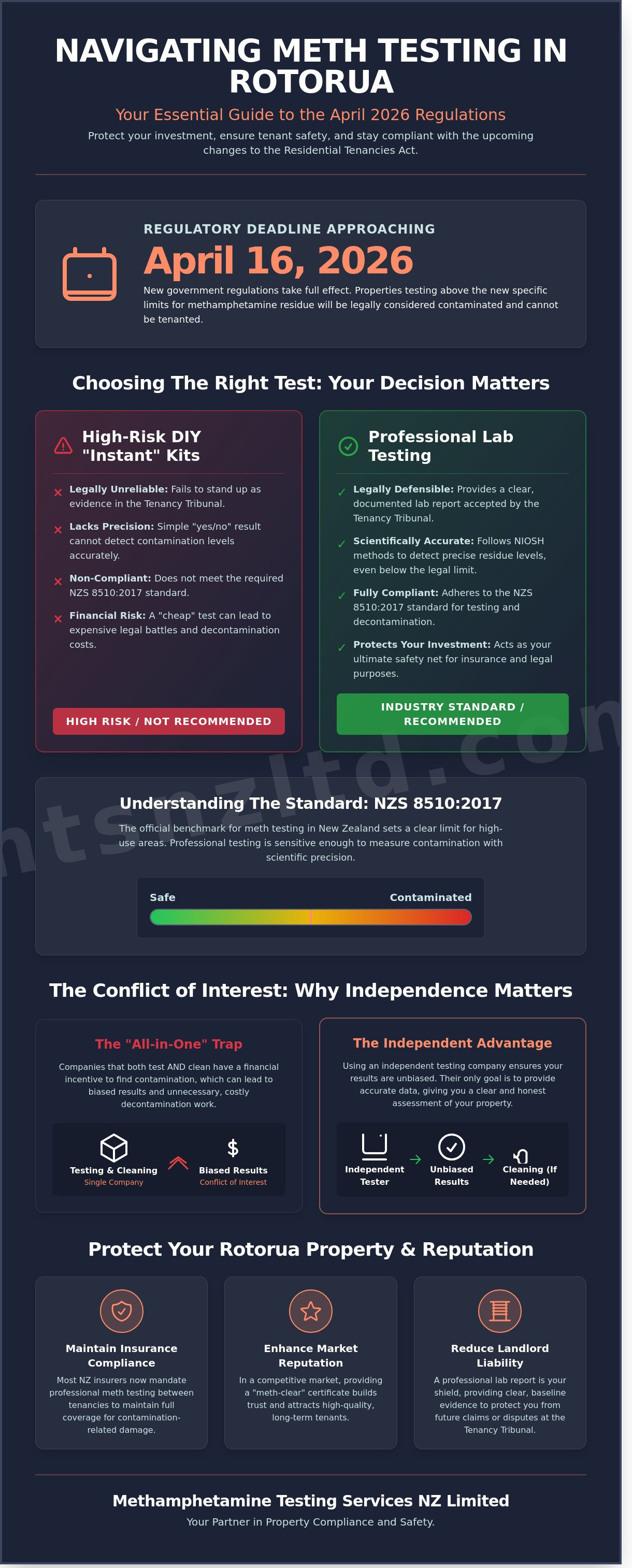
April 16, 2026, stands as a pivotal date for every property owner in the Bay of Plenty. This is when new New Zealand government regulations regarding methamphetamine contamination are set to take full effect, changing the compliance landscape for good. If you're managing a rental, understanding how landlord meth testing Rotorua requirements are evolving is the only way to stay ahead of these legal shifts. The local market is tight, and the pressure to provide safe housing has never been higher.
Under the Residential Tenancies Act, your primary duty of care is to provide a "clean and habitable" home. While that sounds straightforward, the 2026 regulations provide the technical teeth that were previously missing. Ignoring these updates doesn't just put your tenants at risk; it puts a target on your investment. Greg Brown has observed that landlords who fail to establish a baseline before the 2026 deadline often face uphill battles with the Tenancy Tribunal when disputes arise. You need clear, documented evidence to protect your assets.
The April 2026 Regulatory Shift
The upcoming changes focus heavily on contamination thresholds and the legal definition of "uninhabitable." Once the April 16 deadline passes, the government will enforce specific maximum levels of methamphetamine residue. If a property tests above these limits, it's legally considered contaminated and cannot be tenanted. Baseline testing is becoming the standard for local tenancies because it provides a "point zero" for every new lease. Without this, you can't prove which tenant caused the damage, making it nearly impossible to recover costs or claim insurance payouts.
Rotorua's Unique Property Challenges
Rotorua's rental market features a diverse range of properties, from older timber cottages in Ngongotaha to modern builds near Pukuatua. Each property type carries a different risk profile. Older homes with porous materials like untreated wood or original wallpaper can trap residues more easily than modern surfaces. Professional testing ensures these nuances are accounted for during an inspection. Using landlord meth testing Rotorua specialists allows you to identify these risks before they become a liability.
Insurance Compliance: Most NZ insurers now mandate meth testing between every tenancy to maintain coverage.
Market Reputation: In a high-demand market, savvy tenants are increasingly asking for "meth-clear" certificates before signing.
Liability Reduction: A professional report acts as your shield against future claims of negligence or health issues reported by occupants.
Relying on luck isn't a business strategy. By integrating professional testing into your standard turnover process now, you ensure your property remains compliant well before the 2026 deadline hits. It's about protecting the value of your home and the safety of the people living in it. Taking action today prevents the financial catastrophe of a contaminated property tomorrow.
Choosing the Right Test: Laboratory Composite vs. Instant Screening
Rotorua landlords often feel tempted to use cheap DIY kits found at hardware stores. It's a common mistake that can lead to significant legal headaches. These instant "yes or no" tests usually fail to stand up in the Tenancy Tribunal because they lack the scientific rigor required by New Zealand law. To protect your investment, you need testing that aligns with the NZS 8510:2017 standard. This is the official benchmark for testing and decontamination in New Zealand. It ensures that every sample is collected and analyzed using methods that are both accurate and legally binding. Without a report that meets this standard, you might find yourself without a leg to stand on during a tenancy dispute.
The science behind professional testing is far more complex than a simple color-changing swab. When you invest in professional landlord meth testing Rotorua services, you're paying for a process that follows NIOSH-compliant methods. These are international protocols for sampling surfaces to detect chemical residues. Because the NZS 8510:2017 standard sets the limit for high-use areas at 1.5μg/100cm², your test needs to be sensitive enough to detect levels well below that threshold. Instant kits simply aren't calibrated for that level of precision.
The Laboratory Composite Advantage
Laboratory composite testing is the most efficient way to get a clear overview of a property's status. During this process, a technician takes swabs from multiple rooms, and the lab combines them into a single sample for analysis. This approach is highly cost-effective for a landlord meth testing Rotorua project because it covers the whole house in one go. If the composite result comes back below the NZS 8510:2017 limits, you have a certified "clean" report for your records.
Precision: Samples are analyzed in a controlled laboratory environment rather than on a kitchen bench.
Compliance: Reports are generated using NIOSH-compliant methods that the Tenancy Tribunal recognizes.
Reliability: Greg Brown and the team prioritize these lab-grade reports because they provide the certainty needed for insurance and legal peace of mind.
If you want to ensure your property meets these high standards, you can view our professional testing options to see which one fits your needs.
When You Need Detailed Individual Testing
There are times when a broader screen isn't enough. If a composite test returns a positive result above the legal limit, you'll need to move to detailed individual testing. This involves analyzing each room separately to pinpoint exactly where the contamination is located. It's a vital step because it prevents you from paying for unnecessary cleaning in rooms that aren't affected. A detailed report creates a roadmap for decontamination, showing exactly which walls or carpets need attention.
These detailed reports are also a requirement for most New Zealand insurance providers. If you intend to make a claim for remediation, your insurer will demand a room-by-room breakdown of contamination levels. Having this data ready speeds up the claim process and ensures your decontamination strategy is based on hard evidence rather than guesswork. It's a more involved process, but it's the only way to manage a contaminated property with engineering-level precision.
The Conflict of Interest: Why Independence Matters in Rotorua
Choosing a company that offers both testing and decontamination might seem convenient. However, this creates a significant conflict of interest. If a business profits from the cleaning process, they have a clear financial incentive to find contamination that requires expensive remediation. This is why landlord meth testing Rotorua services should always be independent from the companies performing the actual cleanup.
A neutral tester acts as a safeguard for your investment. They provide an objective baseline that isn't influenced by the potential for a high-value cleaning contract. This separation ensures that you only pay for decontamination when it's strictly necessary based on technical data and New Zealand Standards.
The 'Conflict of Interest' Trap
The danger of using "all-in-one" companies lies in the potential for "ghost" contamination or exaggerated results. When the person verifying the clean is also the person who got paid to do the cleaning, the oversight mechanism fails. This lack of transparency can lead to disputes with tenants or insurance providers. Independent reports provide a much more robust defense in legal settings like the Tenancy Tribunal. Adjudicators often look for impartial evidence. A report from a company with no financial stake in the cleanup outcome carries significantly more weight. Additionally, a truly independent toxicology report offers a clear, unbiased interpretation of what the levels actually mean for human health, rather than a sales pitch for chemical fogging.
Greg Brown's Philosophy on Independent Reporting
At MTS NZ Ltd, Greg Brown has established a firm boundary between assessment and remediation. Our commitment is to provide accurate, unbiased data for every Rotorua client. We don't perform cleaning services because we believe that our role is to protect the landlord's interest through objective science. This focus on testing and reporting ensures that every document we produce meets the highest ethical standards in the industry. We follow the NZS 8511:2017 standard strictly to ensure our clients receive a professional, technical evaluation of their property's condition. By removing the incentive to find "problems," we provide peace of mind that the results are honest and the recommendations are based solely on safety requirements.
Before any tester steps on your Rotorua property, you should clarify their business model. Here are a few questions to ask to ensure you're getting an independent service:
Do you or your company offer meth decontamination or cleaning services?
Do you receive referral fees from any remediation companies?
Will your report be detailed enough to stand up in a Tenancy Tribunal hearing?
Does your testing process comply fully with the NZS 8511:2017 standard?
Engaging an independent specialist for landlord meth testing Rotorua ensures that the data stays clean, even if the house isn't. It's the most effective way to manage your risk and fulfill your obligations under the Residential Tenancies Act without falling into an expensive and unnecessary "remediation trap."
Preparing for Your Meth Test: A Guide for Rotorua Landlords
Preparing your property for a professional screening is a straightforward process that ensures the results are as accurate as possible. When you arrange landlord meth testing Rotorua residents can rely on, the goal is to get a clear picture of the property’s health without causing unnecessary disruption. Proper preparation helps Greg Brown complete the assessment efficiently and provides you with the documentation you need for insurance or tenancy records.
Tenant Communication and Rights
If your property is currently tenanted, clear communication is your best tool for a smooth visit. Under the Residential Tenancies Act, you must provide at least 48 hours' notice before carrying out a meth test. Most tenants appreciate the transparency if you frame the test as a health and safety benefit. You're confirming that the home they live in is a safe environment, which builds trust and shows you're a responsible landlord. If tenants have questions, explain that the process is non-invasive and focuses on high-use surfaces like walls and ceilings.
On-Site Visit Logistics
Greg Brown follows a systematic approach during every on-site visit to ensure no area is overlooked. For a standard 3-bedroom Rotorua home, a professional screening usually takes between 45 and 60 minutes. To make the process faster, please ensure Greg has clear access to the following areas:
The Kitchen: This is a primary testing site because surfaces near cooking areas often trap airborne residues.
The Laundry: High humidity and ventilation points in laundries are key spots for collecting samples.
Heat Pumps and Ventilation: Greg often checks the internal filters or intake areas of heat pumps, as these systems circulate air throughout the entire house.
You don't need to deep-clean the house before the test. In fact, it's better to leave surfaces as they are. Just make sure that kitchen benches and laundry surfaces are clear of clutter so Greg can take swabs directly from the building materials. If the property has high ceilings or hard-to-reach vents, please move any furniture that might block a ladder's path.
Once the swabs are collected, they're sealed in a controlled environment and sent to a laboratory for analysis. You can usually expect your results to come back within 2 to 5 working days. While you wait, there's no need to restrict access to the property unless Greg has identified an immediate concern during his visual assessment. Staying patient during this window ensures the lab has enough time to provide a precise, data-backed report that protects your investment. If you're ready to secure your property's future, you can book a professional meth test with Greg Brown today.
Managing the Results: What Happens After the Report?
Receiving your lab results is the final step in the testing process, but it's often where landlords feel the most pressure. You've invested in landlord meth testing Rotorua to ensure your property is safe, so you need to understand exactly what the data implies for your investment and your tenants. A lab report can look intimidating with its technical jargon, but it's actually a straightforward roadmap for your next steps as a property owner.
Interpreting the Data
The most important figure in your report is the concentration of methamphetamine residue, measured in micrograms per 100cm² (µg/100cm²). According to the NZS 8510:2017 standard, the current decontamination threshold for a high-use area is 1.5 µg/100cm². If your results fall below this level, the property is considered safe to occupy. We also look for specific markers that distinguish between simple "use" and "manufacture." Extremely high readings in areas like the kitchen or garage, often exceeding 30 µg/100cm², can indicate the presence of a former clandestine lab. This level of detail makes the report an essential pre-purchase building inspection tool, as it identifies whether a property requires simple cleaning or extensive remediation before you commit to the purchase.
If your Rotorua property returns a "clear" result, you should immediately integrate the report into your Healthy Homes standards documentation. While meth testing isn't a mandatory part of the Healthy Homes standards yet, providing a clean report proves you've met your obligations under the Residential Tenancies Act to provide a premises in a reasonable state of cleanliness. It also serves as your baseline. If a tenant moves out and a subsequent test shows contamination, you have the evidence needed to prove the damage occurred during their tenancy.
Navigating a positive result requires a calm, methodical approach. If levels exceed 1.5 µg/100cm², you cannot knowingly settle new tenants into the property. You'll need to consult with a decontamination specialist to bring the levels back down to a safe range. Once the cleaning is finished, a post-remediation test is required to confirm the property is clear.
Your Path Forward with MTS NZ Ltd
We don't leave you to figure out the technical details on your own. Our team helps you interpret every line of the findings so you can plan your next move with confidence. Maintaining a history of NZS 8510 compliant meth tests is a massive advantage for future property sales, as it gives prospective buyers peace of mind that the home has been well-managed. If you've just received a report and aren't sure what the numbers mean for your Rotorua rental, get in touch with Greg Brown for a friendly chat. We'll help you understand the data and ensure your property remains a safe, compliant asset.
Secure Your Rotorua Property for 2026 and Beyond
As we approach 2026, staying ahead of rental regulations isn't just about ticking boxes; it's about protecting your investment and your tenants' health. Choosing lab-certified testing over basic instant kits ensures you have a robust, legally defensible report that meets the NZS 8510:2017 standard. It's also vital to work with an independent professional who doesn't have a financial interest in the decontamination process. This keeps the results honest and your potential costs manageable. For any landlord meth testing Rotorua property owners require, local expertise in the Rotorua and Waikato regions makes a massive difference in navigating these technical requirements. Greg Brown provides the technical precision and local knowledge you need to keep your portfolio compliant. You'll receive a lab-certified report that gives you total clarity on your property's status. Don't leave your property's safety or your legal standing to chance when professional, independent verification is readily available. Taking action now means you can rest easy knowing your rental meets every safety benchmark required for the years ahead.
Frequently Asked Questions
Is meth testing a legal requirement for Rotorua landlords in 2026?
No, meth testing isn't a strict legal requirement for every tenancy under current New Zealand law, but landlords have a legal obligation to provide a clean and safe premises. If you suspect contamination, you're responsible for ensuring levels don't exceed the NZS 8510:2017 standard. Failing to meet these safety requirements can lead to significant Tenancy Tribunal claims and financial penalties for the property owner.
How much does a professional meth test cost in Rotorua?
Professional meth testing costs in Rotorua vary based on the size of the property and the type of sampling required. A standard baseline composite test generally starts around NZ$250 for a small unit and increases for larger family homes. You should request a detailed quote that includes fees to avoid hidden costs during the inspection process. Prices fluctuate depending on the number of swabs taken.
How long do I have to wait for my meth test results?
You can typically expect to receive your formal laboratory report within two to five business days after the technician visits your property. Some providers offer an express 24 hour service for an additional fee if you're working against a tight tenancy start date. This timeline ensures the samples undergo rigorous analysis to provide a definitive result for your records. Quick turnaround times help you minimize vacancy periods.
What happens if my tenant is using meth in my rental property?
If you discover a tenant is using or manufacturing methamphetamine, it constitutes a serious breach of the Residential Tenancies Act. You should immediately contact the police to report the illegal activity and issue a notice to remedy or apply to the Tenancy Tribunal for termination. Landlord meth testing Rotorua services help document the extent of the damage, which is vital for insurance claims and legal proceedings.
Does a standard building inspection include meth testing?
A standard pre-purchase building inspection doesn't include meth testing as part of the basic structural assessment. You must specifically request this service as an optional extra or hire a dedicated specialist to perform the swabs. Combining these services during the due diligence phase can save time. It ensures you're fully aware of any chemical hazards before you finalize a property purchase in the local market.
Can I do the meth testing myself using a kit from the hardware store?
You can purchase DIY kits from local hardware stores, but these results are often insufficient for legal or insurance purposes. Professional testing follows the NZS 8510:2017 standard, which requires independent sampling and accredited laboratory analysis. If you need to present evidence at a Tenancy Tribunal hearing, a self-test kit won't carry the same weight as a certified professional report. Lab-backed data is much more reliable.
What is the 'safe' limit for meth residue in a New Zealand home?
The current NZS 8510:2017 standard sets the decontamination limit at 1.5 micrograms per 100cm2 for high-use areas. While the 2018 report from the Office of the Prime Minister’s Chief Science Advisor suggested a higher threshold for properties where only smoking occurred, most insurers and the Tenancy Tribunal still refer to the 1.5 limit - until April 16, 2026. Then the limit will be raised to 15 micrograms. Greg Brown recommends staying compliant with the stricter standard to minimize long term liability.
How often should I test my Rotorua rental property for meth?
It's best practice to conduct a test at the start and end of every tenancy to establish a clear timeline of contamination. This provides the necessary evidence to hold tenants accountable if levels spike during their stay. Regular landlord meth testing Rotorua property owners perform during routine inspections can also act as a deterrent. Consistent testing protects your investment and ensures you meet your obligations as a responsible landlord.


Comments