Healthy Homes Certificate: A 2026 Guide for Hamilton, Rotorua & Tauranga Landlords

A single overlooked ventilation fan or a drafty door seal can lead to a NZ$7,200 fine in exemplary damages under current Tenancy Tribunal regulations. For landlords across Hamilton, Rotorua, and Tauranga, the pressure to secure a valid healthy homes certificate is higher than ever as we approach 2026. You probably already feel that the distinction between mandatory government statements and comprehensive private certifications is frustratingly blurry. It's a common worry that even with the right paperwork, hidden issues like meth contamination could still put your investment at risk.
Greg Brown and our team believe that protecting your property asset should be straightforward rather than a legal minefield. We'll show you exactly what a healthy homes certificate entails and why independent meth testing is the missing piece of your compliance strategy. This guide breaks down the 2026 requirements to help you avoid heavy penalties, maintain high property values, and provide a truly safe environment for your tenants. We're moving beyond basic checklists to ensure your rental meets every professional standard required for long term success.
Key Takeaways
Learn the difference between a basic compliance statement and a professional healthy homes certificate to make sure your property documentation is bulletproof for 2026.
Find out why the five physical standards are only part of the story and why adding independent meth testing is the secret to a truly safe rental environment.
See why your standard pre-purchase building report might be giving you a false sense of security when it comes to specific healthy home regulations.
Get a clear, step-by-step roadmap for landlords in Hamilton, Rotorua, and Tauranga to identify and fix compliance gaps quickly using a professional checklist.
Discover how Greg Brown and the MTS NZ Ltd team use their technical expertise to provide the independent verification you need across the Waikato and Bay of Plenty.
Table of Contents
What is a Healthy Homes Certificate in Hamilton, Rotorua, and Tauranga?
The 5 Standards vs. Property Safety: Is Meth Testing Included?
Why a Standard Building Report Isn’t a Healthy Homes Guarantee
Compliance Steps for Waikato and Bay of Plenty Landlords in 2026
Securing Your Property with MTS NZ Ltd: Independent Testing You Can Trust
What is a Healthy Homes Certificate in Hamilton, Rotorua, and Tauranga?
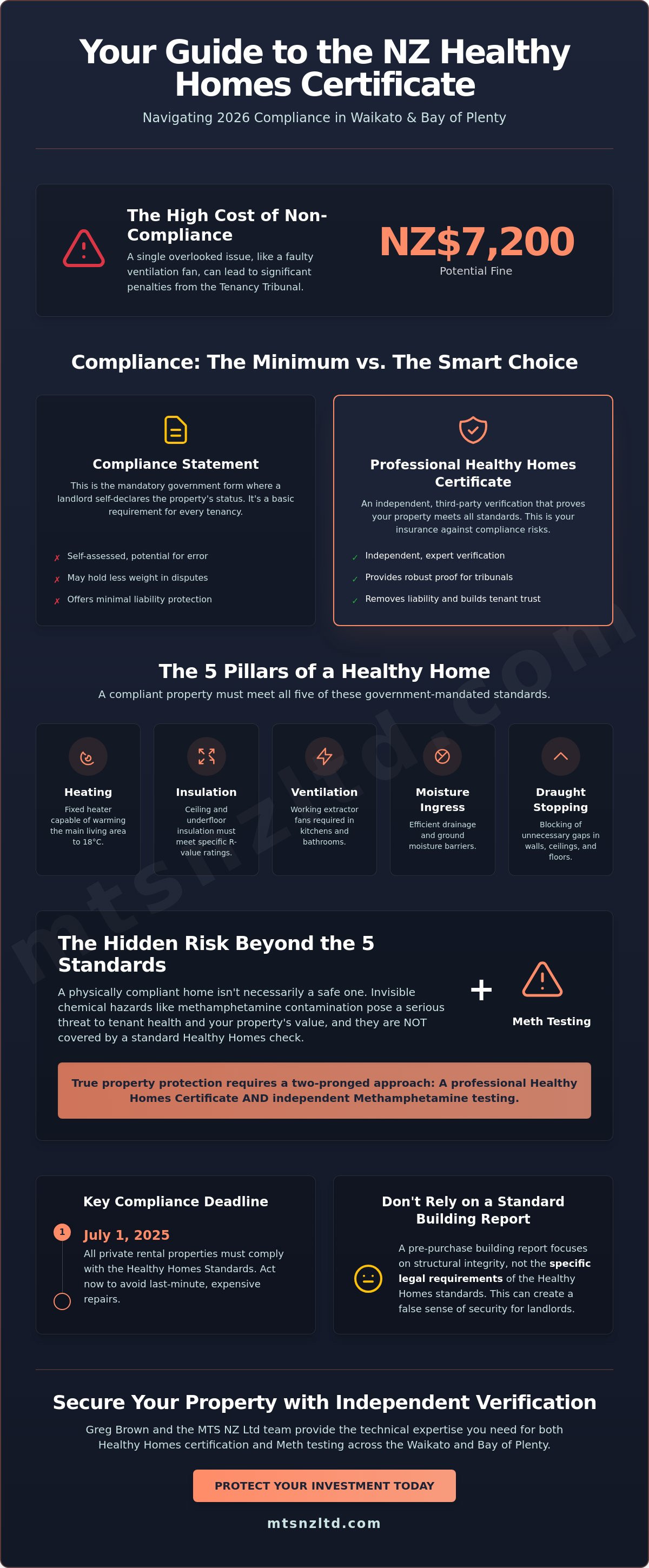
A healthy homes certificate is a document issued by a professional inspector to verify that a rental property meets the five specific standards set by New Zealand law. While the government requires landlords to provide a Compliance Statement, a certificate goes a step further by providing independent, third party proof of that compliance. In regions like the Waikato and Bay of Plenty, where weather conditions vary from the damp lakefronts of Rotorua to the humid valleys of Hamilton, having this verification is a vital part of property management. Greg Brown and the MTS NZ Ltd team focus on providing these technical assessments to ensure landlords aren't just ticking boxes, but are actually providing safe, dry environments for their tenants.
The legal foundation for these requirements is the Healthy Homes Guarantee Act 2017, which introduced mandatory standards for heating, insulation, ventilation, moisture ingress, and draught stopping. Landlords in Tauranga and Hamilton often use a professional healthy homes certificate to demonstrate due diligence. If a dispute ever reaches the Tenancy Tribunal, a self-signed statement might not hold the same weight as a report from a qualified technician who has physically measured floor insulation or calculated the heating capacity needed for a specific living room.
Compliance Statement vs. Healthy Homes Certificate
Every new or renewed tenancy agreement must include a Compliance Statement. This is a mandatory government form where the landlord declares the property's current status against the five standards. However, a professional certificate is an extra layer of protection. It acts as an insurance policy against accidental misrepresentation. Property managers in Hamilton and Tauranga increasingly demand independent verification because it removes the liability from the landlord. It builds immediate trust with tenants, showing them that the property's air quality and warmth have been measured by experts rather than guessed by an owner with a tape measure.
The 2026 Deadlines for Waikato Landlords
The timeline for compliance has been rolling out for several years, but the final hard deadlines are fast approaching. By July 1, 2025, all private rental properties must comply with the healthy homes standards. For those managing social housing or properties under specific long term agreements, the final deadline extends into 2026. This is particularly relevant for owners of older housing stock in areas like Rotorua and Hamilton East. These suburbs often feature homes built before modern insulation requirements, meaning they require more intensive retrofitting to pass an inspection. If a property fails to meet the standards by these deadlines, landlords can face exemplary damages of up to NZ$7,200. Greg Brown emphasises that starting the assessment process early allows for scheduled maintenance rather than expensive, last minute emergency repairs.
Heating: A fixed heater capable of reaching 18 degrees Celsius in the main living area.
Insulation: Ceiling and underfloor insulation must meet specific R-value ratings.
Ventilation: Working extractor fans in kitchens and bathrooms.
Moisture Ingress: Efficient drainage and ground moisture barriers for properties with a crawl space.
Draught Stopping: Blocking unnecessary gaps in walls, ceilings, windows, and floors.
The 5 Standards vs. Property Safety: Is Meth Testing Included?
A property that meets the official healthy homes standards is legally compliant in five specific areas: heating, insulation, ventilation, moisture ingress, and draught stopping. These requirements ensure a rental is warm and dry, which is vital for reducing respiratory illnesses and mould growth. While achieving these benchmarks is a prerequisite for obtaining a healthy homes certificate, it's a mistake to assume these physical upgrades cover every aspect of tenant safety. Greg Brown notes that structural compliance often overlooks invisible chemical hazards that are just as damaging as a damp basement or a drafty window.
Beyond Airflow: Chemical Contaminants
A home can be perfectly insulated and ventilated yet remain toxic due to methamphetamine residue from previous occupants. This chemical contamination doesn't disappear with a new coat of paint or better airflow. For families and children, the health implications of "P" residue include skin rashes, chronic headaches, and sleep disturbances. MTS NZ Ltd integrates chemical screening into the property assessment process because a warm home isn't truly healthy if the surfaces are contaminated. Ignoring this risk while focusing solely on insulation creates a false sense of security for landlords in Tauranga, Rotorua, and Hamilton.
NZS 8510:2017 and Your Legal Obligations
The NZS 8510:2017 standard provides the technical framework for testing and decontaminating methamphetamine-affected properties. It dictates how samples should be taken and what levels are considered safe for habitation. To ensure 2026 compliance and protect your investment, laboratory-grade reports are the only reliable method for documenting a property's status. NZS 8510:2017 is the gold standard for property contamination limits, providing a clear threshold for safety that anecdotal inspections can't match. If you're preparing for your next inspection, you should consider a professional screening to complement your physical standards check.
Why a Standard Building Report Isn’t a Healthy Homes Guarantee
Many landlords in Hamilton, Rotorua, and Tauranga assume that a "clean" pre-purchase building report means the property is ready for tenants. This is a common and potentially expensive misconception. A standard building inspection is designed to assess the structural integrity of a property. It looks at the piles, the roof, and the cladding to ensure the house isn't falling down. However, structural soundness doesn't equal compliance. A house can be perfectly sturdy but still fail to qualify for a healthy homes certificate because it lacks adequate insulation, heating, or moisture barriers.
Standard reports focus on what's visible to the naked eye. While they might identify a leaky roof, they rarely dive into the technical requirements outlined in the Tenancy Services healthy homes information. For instance, a building inspector might note that a heat pump is present, but they won't calculate if its kilowatt rating is sufficient for the specific floor area of your rental. Without those precise calculations, you're left guessing about your legal compliance.
The Limitations of Visual Inspections
You can't see, smell, or touch methamphetamine residue. This is a major risk for investors, as visual inspections miss 99% of contamination issues. If a rental was recently painted before being put on the market, the walls might look pristine, but the paint can actually trap chemical residues without neutralising them. For a more detailed breakdown of what a structural report covers versus a health assessment, you can read our pre purchase building inspection guide.
The Value of Independent Lab Testing
While some landlords try to save money with "DIY" instant kits, these tests often provide false positives or miss low level contamination that still poses a health risk. Independent composite lab testing is far more reliable. These tests involve taking multiple samples from around the property and analysing them in a controlled environment. This level of precision is exactly what's needed to secure a healthy homes certificate and protect your investment.
Detailed lab reporting provides a robust paper trail. If you ever find yourself in a Tenancy Tribunal dispute or need to make an insurance claim, having a professional report is your best defence. It proves you've done your due diligence and that the property was safe at the start of the tenancy. This professional approach offers genuine peace of mind, knowing your Hamilton or Tauranga investment is truly safe for your tenants and your financial future.
Compliance Steps for Waikato and Bay of Plenty Landlords in 2026
Getting your rental property ready for the 2026 standards doesn't have to be a stressful process. Whether you're managing a classic brick home in Hamilton or a coastal property in Tauranga, the path to compliance follows a logical set of steps. Most landlords start by using a healthy homes checklist to spot obvious gaps like missing ground moisture barriers or outdated heat pumps. Identifying these issues early saves you from surprises during the official inspection.
The climate in the Waikato and Bay of Plenty regions presents unique challenges. Rotorua's geothermal activity and Hamilton's high winter humidity mean that ventilation and moisture control are often the biggest hurdles. You need an assessor who understands these local factors rather than someone applying a generic template. Once the assessment is complete and you've achieved compliance, you're legally required to keep all records for at least seven years. This includes your healthy homes certificate, maintenance receipts, and any professional reports generated during the process.
Booking Your Assessment in Hamilton, Rotorua, or Tauranga
When you book a visit with the MTS NZ Ltd team, you can expect a thorough on-site evaluation that covers all five healthy home standards. We recommend giving your tenants at least 48 hours' notice, though many landlords prefer to provide a full week to ensure the property is accessible. During the visit, the assessor will check insulation levels, heating capacity, and ventilation systems. If you've requested meth testing alongside your compliance check, we'll take discrete samples from high-traffic areas. You'll typically receive your laboratory-grade reports within three to five working days, giving you a clear document to show your insurance provider or the Tenancy Tribunal.
Addressing Failures and Remediation
If your property doesn't meet the requirements for a healthy homes certificate on the first try, don't panic. The report will outline exactly what needs to change, from installing a larger heat pump to adding weather stripping around a drafty door. A critical rule in this industry is the separation of testing and remediation. You should never use the same company for both testing and cleaning or repairs. This creates a clear conflict of interest where a company might "fail" a property just to sell you a solution. Greg Brown maintains a strict policy of independence; MTS NZ Ltd provides the data and the certification, but we don't perform the repairs. This ensures your results are 100% unbiased and focused solely on the facts of the building's performance.
Ready to secure your property's future? Book your independent compliance assessment with MTS NZ Ltd today.
Securing Your Property with MTS NZ Ltd: Independent Testing You Can Trust
Greg Brown and the team at MTS NZ Ltd focus on a high level of technical accuracy when it comes to property safety. For landlords operating in Hamilton, Rotorua, and Tauranga, the 2026 compliance landscape requires more than just a casual inspection. It demands a professional approach that prioritises data integrity. Greg Brown ensures that every assessment provides a clear, evidence-based snapshot of a property's health, giving owners the confidence they need to manage their investments effectively.
Our service area covers the heart of the Golden Triangle and the Bay of Plenty, providing expert testing that meets the strict requirements of NZS 8510:2017. This specific standard is vital because insurance providers and prospective buyers often require proof of compliance before they'll commit to a policy or a purchase. Without a valid healthy homes certificate backed by professional testing, you could face significant hurdles during a property sale or a claim process.
The MTS NZ Ltd Difference
We bring engineering-grade precision to every meth test we conduct. We don't believe in guesswork; we believe in results that can be verified and defended. Independence is our core value at MTS NZ Ltd. We test properties, but we don't offer cleaning or remediation services. This means there's never a conflict of interest. We aren't looking for problems to fix; we're looking for the truth about the property's condition.
Waikato and Bay of Plenty property managers rely on us because we provide clear, actionable technical data. We understand that you need to make decisions quickly to keep your tenants safe and your properties occupied. By delivering reports that are easy to interpret yet technically robust, we help you maintain high standards across your entire portfolio without the usual administrative headaches.
Securing Your Investment for 2026 and Beyond
Managing a rental property in Hamilton, Rotorua, or Tauranga requires a proactive approach to evolving regulations. It's clear that a standard building inspection doesn't provide the technical depth needed for a full healthy homes certificate. You need an assessment that covers the five mandatory standards while addressing safety concerns like methamphetamine contamination. Greg Brown and the team focus on technical accuracy to ensure every report is fully compliant with NZS 8510:2017 standards.
We provide independent testing with no conflict of interest, so you get an honest look at your building's health without any hidden agendas. By taking these steps now, you protect your tenants and your financial future in the Waikato and Bay of Plenty regions. It's about more than just checking boxes; it's about maintaining a high standard of safety and reliability for your portfolio. We're here to help you navigate these requirements with professional expertise and clear, actionable data. You'll find that having a dedicated partner makes the path to compliance straightforward and stress-free.
Get your property compliant with MTS NZ Ltd
We look forward to helping you secure your property's future.
Frequently Asked Questions
Is a Healthy Homes Certificate a legal requirement for all NZ rentals?
Yes, obtaining a healthy homes certificate is a legal obligation for private landlords under the Healthy Homes Guarantee Act 2019. Since July 1, 2021, all new or renewed tenancies must meet these standards within 120 days of the start date. By July 1, 2025, every rental property in New Zealand must comply with the regulations regardless of when the tenancy agreement was signed.
Does the Healthy Homes Standard include methamphetamine testing?
No, methamphetamine testing isn't part of the five specific healthy homes certificate requirements. The standards focus exclusively on heating, insulation, ventilation, moisture ingress and drainage, and draught stopping. While meth contamination is a separate health and safety issue under the Residential Tenancies Act, it's managed under different guidelines and isn't required for your compliance statement.
How much does a Healthy Homes assessment cost in Hamilton or Tauranga?
Costs for a professional assessment typically range between NZ$150 and NZ$300 depending on the size and location of the dwelling. While the government doesn't set these fees, industry data shows most providers in the Waikato and Bay of Plenty regions fall within this bracket. You should request a detailed quote to ensure the fee covers the full technical report required by Tenancy Services.
Can I do my own Healthy Homes compliance check?
You can legally perform your own check, but you're personally responsible for the accuracy of all technical measurements. This includes using the specific government heating formula to calculate required kilowatt ratings for every living room. Most landlords hire professionals to avoid the risk of Tenancy Tribunal fines, which can reach NZ$7,200 for providing incorrect or incomplete information on a compliance statement.
What happens if my rental property fails the Healthy Homes Standards?
If your property doesn't meet the standards, you'll receive a report detailing the specific areas that require remediation. You must complete these upgrades before your compliance deadline, which is usually 120 days from the start of a new tenancy. Failing to address these issues leaves you vulnerable to legal action from tenants and significant financial penalties through the Tenancy Tribunal.
How long is a Healthy Homes Certificate or assessment valid for?
There's no official expiry date on a healthy homes certificate, but you must provide a current compliance statement for every new tenancy agreement. If you make structural changes to the home or if the regulations change, you'll need a new assessment to reflect the current state of the property. Keeping your documentation current ensures you're protected if a tenant disputes the property's condition later on.
Do I need to re-test for meth every time a tenant moves out?
You aren't legally required to test for meth between every tenancy, but it's a smart risk management strategy for landlords in Hamilton and Tauranga. Testing provides a clear baseline of the property's condition, which is vital if you need to prove a specific tenant caused contamination. Many insurance policies in New Zealand also require evidence of regular testing to maintain coverage for chemical decontamination costs.


Comments