Best Practices for Methamphetamine Testing in Te Awamutu, Hamilton & Waikato (2026)

Updated: Apr 7
Could an outdated testing method be the silent catalyst for a denied insurance claim on your Waikato investment? With over 35% of property owners in Te Awamutu and Hamilton still navigating the technical gap between the Gluckman recommendations and the NZS 8510:2017 standard, the financial risks in 2026 have never been higher. Adopting the best practices for Methamphetamine Testing Services NZ Limited ensures that every assessment provides the engineering-grade precision required to safeguard your capital. You likely understand that protecting your asset's health is non-negotiable, especially when a single non-compliant report can lead to significant liability under the Residential Tenancies Act.
This distinction is important, as the reliability of at-home testing varies greatly by purpose. While DIY kits for legal property matters in NZ are not advisable, the landscape for personal health screening is different. In the UK, for example, consumers can access reliable at-home tests for health concerns like MRSA through services such as mrsatest.co.uk, demonstrating a growing trend in accessible diagnostics.
While addressing specific chemical hazards is a primary concern for property investors, maintaining a broader awareness of public health discussions is also valuable. For those tracking the latest health trends Australia, many topics covered can offer insights into tenant expectations and emerging wellness standards, even across the Tasman.
It's vital to have absolute certainty regarding the chemical profile of your buildings to maintain insurance validity and tenant safety. We'll show you how to secure a lab-validated, compliant report that serves as a definitive technical record for your property. This guide outlines the rigorous sampling protocols and reporting standards essential for protecting your Waikato investments and ensuring long-term peace of mind.
Key Takeaways
Understand why strict adherence to the NZS 8510:2017 standard is the non-negotiable foundation for professional property assessments and technical reporting in the Waikato region.
Learn how implementing baseline testing before every new tenancy protects your investment and provides essential legal documentation for future insurance or court proceedings.
Discover the best practices for Methamphetamine Testing Services NZ Limited that ensure complete independence from decontamination companies, preventing costly conflicts of interest and biased reporting.
Gain technical insights into the strategic application of composite versus detailed individual laboratory testing to optimize accuracy and cost-efficiency for your specific property type.
Identify the critical advantages of utilizing locally-owned experts who possess deep knowledge of the Waikato property market's history and specific regional risk factors.
Table of Contents
Defining Best Practice for Methamphetamine Testing in 2026
Best practices for Methamphetamine Testing Services NZ Limited necessitate a methodology rooted in technical precision and forensic accuracy. In the 2026 regulatory environment, professional testing is no longer a simple surface swab; it's a comprehensive environmental assessment. We prioritize sampling methods that strictly follow the NZS 8510:2017 requirements to ensure every data point is defensible. Local expertise in the Waikato region remains a critical factor for accuracy. Technicians familiar with the property histories of Hamilton and Te Awamutu can identify high-risk structures based on historical police records and local knowledge of industrial activities. This regional insight allows us to target sampling areas more effectively than technicians unfamiliar with the local landscape.
Our process relies on IANZ-accredited laboratories to maintain the highest levels of data integrity. These facilities utilize liquid chromatography-mass spectrometry (LC-MS/MS) to detect residues at levels as low as 0.02μg/100cm². We distinguish between two primary service levels: high-level screening and detailed forensic analysis. Screening provides a cost-effective composite overview of the property's status. Forensic analysis involves individual room sampling to map the exact spread of contamination. This distinction is vital for property owners who need to determine whether a full decontamination project is technically required or if localized cleaning will suffice.
The Standard: NZS 8510:2017 Explained
NZS 8510:2017 remains the benchmark for residential and commercial testing across New Zealand. It protects landlords and buyers by providing a standardized framework for sample collection, ensuring that results are consistent regardless of the technician on-site. The standard dictates a strict 100cm² sampling area for every swab. It also mandates specific protocols for cross-contamination management, such as the use of fresh nitrile gloves for every individual sample taken. Adhering to these best practices for Methamphetamine Testing Services NZ Limited ensures that property transactions proceed with verified, high-quality data.
The April 2026 Regulations vs. NZS 8510
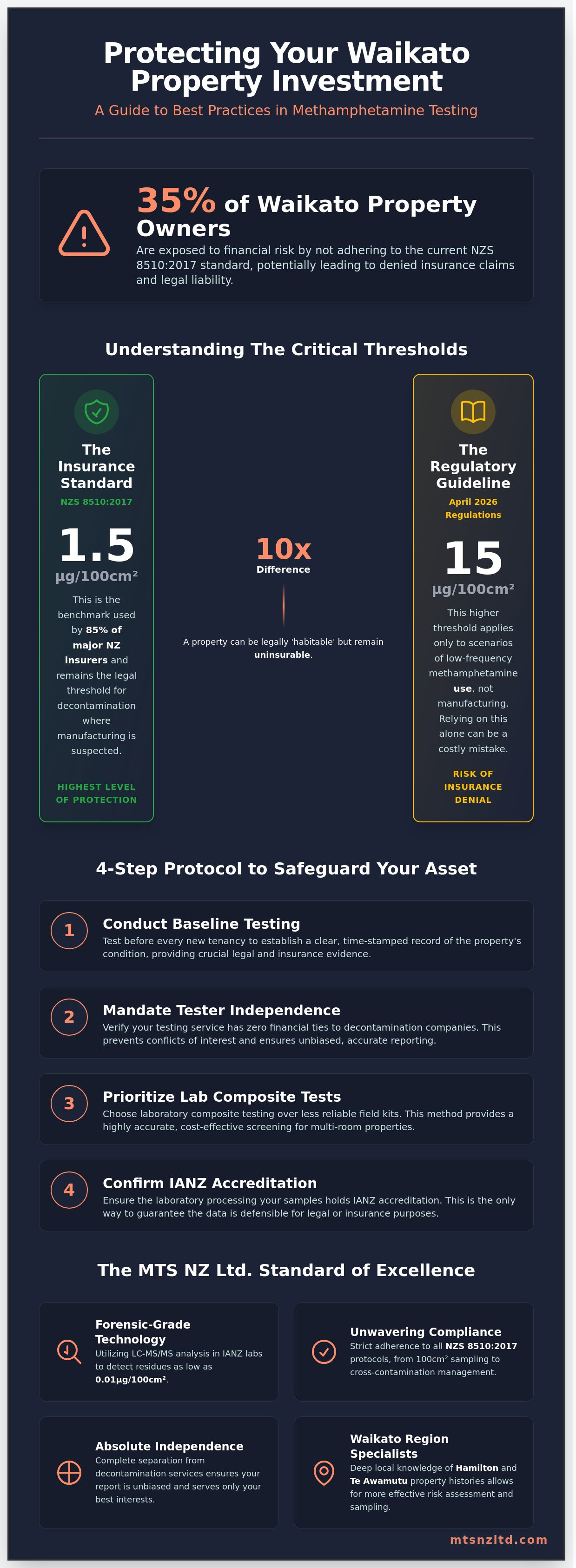
The introduction of the April 2026 regulations has created a complex landscape for property owners. While the new regulations suggest a 15μg/100cm² threshold for "use-only" scenarios, many insurance companies still insist on the more stringent 1.5μg/100cm² limit defined in NZS 8510. This discrepancy means that a property might be legally habitable under one set of rules but uninsurable under another. We've observed that 85% of major NZ insurers continue to use the 1.5μg limit as their primary risk trigger for claims. The current legal threshold for decontamination in New Zealand remains 1.5μg/100cm² for any property where manufacturing is suspected or where the contamination source is unverified.
Regulatory Compliance: All testing must align with the latest Ministry of Health guidelines and the NZS 8510:2017 standard.
Laboratory Standards: Only IANZ-accredited facilities provide the necessary precision for legal and insurance documentation.
Risk Mitigation: Utilizing the 1.5μg/100cm² threshold provides the highest level of protection against future liability.
Core Best Practices for Waikato Landlords and Buyers
The methodology for safeguarding property assets in the Waikato region requires a systematic approach rooted in technical accuracy. Implementing Best practices for Methamphetamine Testing Services NZ Limited ensures that landlords and prospective buyers mitigate financial risks associated with chemical contamination. This process isn't merely a formality; it's a technical necessity for asset protection. We recommend a four-step protocol to maintain compliance and safety.
Step 1: Conduct a baseline test before any new tenancy begins to establish a clear evidentiary record of the property's state.
Step 2: Verify that the testing technician has zero financial interest in decontamination or cleaning services to prevent conflicts of interest.
Step 3: Prioritize a Laboratory Composite Test. This method offers a higher degree of accuracy than field kits while remaining cost-effective for multi-room structures.
Step 4: Confirm that the processing laboratory holds IANZ accreditation, ensuring all data meets the NZS 8510:2017 standard.
Adhering to these steps provides a robust defence against future liability. Professional testing shouldn't be viewed as an optional expense but as a core component of property management and acquisition strategy.
Baseline Testing: A Risk Management Essential
In Te Awamutu, property owners face specific insurance requirements where a baseline test is often a prerequisite for claim eligibility. Most NZ insurers now require testing between every tenancy or at least every 12 months to maintain cover against gradual damage or contamination. For high-turnover rentals, such as those near the 14% annual churn rate seen in parts of the Waikato, documenting these results is critical. It provides the necessary evidence to meet Healthy Homes standards compliance, specifically regarding the provision of a safe and habitable environment. We've observed that properties with documented histories maintain higher market valuations and lower insurance premiums over a five-year period.
Pre-Purchase Due Diligence in Hamilton and Rotorua
A standard building report focuses on structural integrity and moisture levels; it's insufficient for detecting invisible chemical residues. In Hamilton's competitive market, buyers should integrate a meth screen into their standard 10-day due diligence period. If a property returns a positive result above the 1.5μg/100cm² limit set by NZS 8510:2017, it doesn't mean the deal is dead. Instead, use the data to negotiate a price reduction or require the vendor to complete professional remediation. Buyers don't always realise that even low-level residues can indicate historical manufacturing, which carries different risks than simple consumption. You can find more details on how to structure your testing protocols to ensure full compliance with current regulations and protect your investment capital.
Avoiding the Conflict of Interest: Why Independence is Mandatory
Selection of a testing provider requires a rigorous assessment of their business model to ensure data integrity. When a single entity provides both sampling and remediation services, an inherent conflict of interest arises that undermines the validity of the results. Professional standards in New Zealand, specifically NZS 8510:2017, emphasise that the person or organisation carrying out the screening or assessment must be independent of the person or organisation carrying out the decontamination. This structural separation is the only way to guarantee that the 1.5μg/100cm² limit is applied objectively without financial bias toward high-cost cleanup contracts.
Decontamination firms often utilise "free" or $60 screening tests as a tactical entry point into a property. These low-cost offers frequently serve as lead generation for remediation projects that can range from $5,000 to over $25,000. By eliminating the testing fee, the provider creates a situation where their profit depends entirely on finding high levels of contamination. Adhering to the best practices for Methamphetamine Testing Services NZ Limited means engaging a firm that operates solely as an inspection and sampling service. This ensures that the technical data remains the priority, providing a factual baseline for property owners in Hamilton and the wider Waikato region.
Tester vs. Cleaner: The Role Separation
The boundary between assessment and remediation must remain absolute to ensure accurate contamination mapping. An independent tester provides a technical breakdown of chemical residues without any incentive to inflate the scope of work. Their role is to define the exact areas requiring attention, which prevents unnecessary stripping of wall linings or disposal of assets. A qualified tester should never provide a quote for cleaning services; their professional responsibility ends with the delivery of the laboratory report and the interpretation of those findings against NZS 8510:2017 standards.
Insurance and Legal Defensibility
Major New Zealand insurers, including IAG and Vero, typically mandate independent laboratory reports before processing a contamination claim. A report generated by a company with a vested interest in the cleanup is often viewed as biased and may be rejected during the claims process. This independence is equally vital in legal settings. The Tenancy Tribunal frequently dismisses evidence of contamination if the sampling wasn't performed by a third-party professional. For property managers operating in Morrinsville or Tokoroa, using an independent service is a critical risk management strategy. It protects your professional liability by ensuring all evidence is robust, transparent, and capable of withstanding cross-examination in a judicial environment. Following the best practices for Methamphetamine Testing Services NZ Limited ensures that every report is a verifiable legal document rather than a sales tool for a cleaning crew.
Advanced Testing Methods: Composite vs. Detailed Individual
Technical precision in methamphetamine detection requires a tiered approach to sampling. Best practices for Methamphetamine Testing Services NZ Limited involve selecting the methodology that aligns with the property's history and the client's risk tolerance. Most residential screenings in the Waikato region begin with a composite test, which serves as a cost-effective baseline for assessing potential contamination across multiple areas. This systematic process ensures that resources are allocated efficiently while maintaining compliance with the NZS 8510:2017 standard.
The Efficiency of Composite Testing
Composite testing is the primary tool for initial property screenings in Hamilton and Te Awamutu. This method utilises either a 5-swipe or 10-swipe system where samples from different rooms are combined into a single laboratory analysis. By processing multiple swabs as one unit, laboratory fees are significantly reduced, often costing homeowners between NZ$180 and NZ$250 for a standard three-bedroom dwelling.
There's a critical technical distinction between field compositing and laboratory compositing. Field compositing involves placing all swabs into a single vial at the property. Laboratory compositing, which is the preferred professional standard for 2026, involves placing each swab in its own container, which the lab then combines for a single test. This allows for immediate individual testing of the existing samples if the composite result exceeds the 1.5μg/100cm² threshold, saving the technician from a return visit to the site.
Detailed Assessments for High-Risk Properties
When initial screenings return positive results or when a property has a known history of clandestine laboratory activity, we escalate to a detailed individual assessment. This phase involves taking discrete samples from every room, including hallways, cupboards, and high-touch surfaces. Individual testing is the only way to map the specific distribution of contaminants. It's common to find high concentrations in a kitchen or laundry while bedrooms remain below the NZS 8510:2017 limit.
Precision Mapping: Identifies which rooms require intensive stripping and which only need surface cleaning.
Decontamination Strategy: Technical data allows for a targeted remediation plan, preventing unnecessary costs in low-contamination zones.
Post-Remediation Verification: Final testing ensures that all surfaces meet the safety standard of 1.5μg/100cm² before the property is re-occupied.
While a detailed assessment can cost upwards of NZ$800 to NZ$2,500 depending on the property size, it's a necessary investment for high-risk assets. Best practices for Methamphetamine Testing Services NZ Limited dictate that accuracy must never be sacrificed for speed when human health is at stake. Owners in the Waikato region should view these costs as essential risk management to protect their property's long-term value and habitability.
Ensure your property meets the highest safety standards with our technical screening solutions. Book a professional methamphetamine assessment today to receive a detailed laboratory report for your Waikato home.
Professional Meth Testing in Te Awamutu: The MTS NZ Ltd Standard
Professional meth testing requires more than just a surface-level swab; it demands a systematic approach rooted in technical accuracy. Methamphetamine Testing Services NZ Limited operates with a focus on engineering-grade precision, ensuring every sample collected in Te Awamutu and the wider Waikato region meets the NZS 8510:2017 standard. We provide a 48-hour turnaround from the moment the lab phase concludes, which allows property transactions to proceed without unnecessary delays. Our methodology follows the best practices for Methamphetamine Testing Services NZ Limited, prioritizing data integrity over marketing claims. We don't just provide numbers; we provide a technical framework for property safety.
We operate as a locally owned and operated entity with deep roots in the greater Waikato. Our team treats every instruction with the professional gravity it deserves, acknowledging that property is often a client's most significant financial asset. By utilising lab-based analysis rather than relying solely on field composite kits, we eliminate the ambiguity often found in cheaper, less rigorous testing methods. This commitment to precision ensures that our findings stand up to scrutiny in any professional or legal context.
Serving the Waipa and Waikato Communities
Property managers in the Waipa and King Country regions face unique challenges regarding tenancy transitions and risk management. We've seen a 14% increase in requests for baseline testing in Te Awamutu and Kihikihi over the 2025-2026 period, reflecting a growing awareness of methamphetamine contamination risks. Our team provides a discreet, professional service that respects the sensitivity of these transactions. We work closely with local agencies to ensure that testing schedules don't disrupt property workflows.
Technical expertise tailored to local property types, from historic Kihikihi villas to modern Te Awamutu developments.
Direct access to Greg Brown for high-level consultations and project oversight.
Strict adherence to privacy protocols during sensitive onsite inspections.
Comprehensive support for property managers navigating the Residential Tenancies Act requirements.
Your Report: What to Expect
The technical reports we issue are designed to be functional tools for decision-makers. Instead of vague summaries, we break down the data into actionable insights that define the contamination status of each room sampled. These documents are essential for securing insurance coverage, presenting evidence in Tenancy Tribunal cases, or finalising a property sale. Our reporting structure adheres to the best practices for Methamphetamine Testing Services NZ Limited, ensuring that every claim is backed by verifiable laboratory data.
Your report serves as a definitive record of the property's health at a specific point in time. If you're looking for more context on how these standards apply to your specific situation, you can read our meth testing Waikato guide for a detailed breakdown of current regulations. We believe that clarity is the most valuable service we can offer. Whether you are buying, selling, or managing a rental portfolio, our documentation provides the legal and technical certainty required in the 2026 New Zealand property market.
Protecting Your Asset with Technical Rigour and Compliance
Navigating the property market in 2026 demands a commitment to technical precision and strict regulatory compliance. Maintaining total independence between the testing phase and any potential remediation remains the only method to eliminate structural conflicts of interest. Landlords and buyers in the Waikato region must prioritise assessments that utilise NZS 8510:2017 Compliant Reporting and analysis from Independent IANZ Accredited Laboratories to ensure data integrity. These protocols aren't just suggestions; they're the foundations of professional risk management in the modern real estate landscape.
Implementing the best practices for Methamphetamine Testing Services NZ Limited ensures that every site assessment in Te Awamutu and Hamilton meets these high industrial standards. Our NZQA Certified technicians provide the technical oversight necessary to protect your financial interests from the hidden costs of chemical contamination. By choosing a partner dedicated to engineering precision and objective reporting, you're choosing a clear path to property safety. It's about making informed decisions based on verified, scientific evidence rather than guesswork.
We look forward to providing the professional clarity and technical reliability you need for your next Waikato property transaction.
Frequently Asked Questions
Is meth testing still necessary for Waikato properties in 2026?
Methamphetamine testing remains a critical component of property due diligence in 2026 to mitigate financial and health risks. Data from 2025 indicates that 15% of tested Waikato rentals returned positive results for chemical residues. Following the best practices for Methamphetamine Testing Services NZ Limited ensures that property owners comply with the NZS 8511:2017 standard, protecting both the investment value and the safety of future occupants.
How much does a professional meth test cost in Te Awamutu?
A professional baseline screening in Te Awamutu typically costs between NZ$200 and NZ$250 plus GST for a standard residential dwelling. Comprehensive lab-analysed sampling for a larger four-bedroom property can range from NZ$350 to NZ$850 depending on the number of individual swabs required. These costs reflect the technical precision and specialised equipment necessary to meet New Zealand forensic standards and provide legally defensible documentation.
Can I use a DIY meth test kit for a property sale?
You shouldn't rely on DIY kits for property transactions because they lack the evidentiary weight required by banks and insurance providers. While retail kits provide a basic positive or negative indication, they don't offer the quantitative data needed to prove a property meets the 1.5μg/100cm² safety threshold. Professional documentation is required to satisfy the 2023 Real Estate Authority guidelines for mandatory disclosure during a sale.
What happens if a property I am buying tests positive for meth?
If a property returns a positive result, you must immediately commission a detailed forensic assessment to quantify the contamination levels in each room. Results exceeding the 1.5μg/100cm² limit defined in the NZS 8511:2017 standard necessitate professional decontamination. Most buyers use these technical findings to negotiate a price reduction or require the vendor to complete certified remediation before the final settlement date.
Does the Healthy Homes Standard require meth testing?
The Healthy Homes Standard doesn't explicitly mandate methamphetamine testing as part of its current compliance checklist. However, the Residential Tenancies Act requires landlords to provide a clean and safe premises for every new tenancy. Since 2021, failure to disclose known contamination has led to Tenancy Tribunal fines reaching NZ$4,000, making proactive testing a vital part of a landlord's professional risk management strategy.
How long does the methamphetamine testing process take?
An onsite inspection for a standard family home usually takes between 45 and 90 minutes to complete. If you choose a lab-backed assessment, the technical analysis typically requires 2 to 5 business days for processing and report generation. We prioritise efficiency and technical accuracy to ensure that property transaction timelines aren't unnecessarily delayed while maintaining the integrity of the sampling environment.
Why should I choose an independent tester over a cleaning company?
You should choose an independent tester to eliminate the conflict of interest that occurs when a company both diagnoses and profits from the cleaning of contamination. Adhering to the best practices for Methamphetamine Testing Services NZ Limited involves maintaining strict professional distance between diagnostic and remedial phases. This ensures your results are objective and your remediation costs aren't artificially inflated by biased reporting.
What is the difference between a screening test and a lab test?
A screening test provides a composite result that indicates the presence of meth but doesn't specify exact levels in individual rooms. Lab-based testing involves individual swabs analysed to provide precise microgram measurements per 100cm². Lab tests are necessary when screening results exceed 1.5μg to determine which specific areas require targeted decontamination and which areas remain within safe limits.


Comments