Acceptable Meth Levels in a House NZ 2026: The New Regulatory Standards

Understanding the precise legal and industry-standard thresholds for methamphetamine residue is critical for property owners, investors, and tenants in New Zealand. The 2026 regulations have introduced specific levels for rental properties, which exist alongside the established New Zealand Standard. Navigating these two key benchmarks is essential for ensuring compliance, managing risk, and protecting your investment.
Table of Contents
Understanding the Dual Methamphetamine Contamination Thresholds in 2026
As of 2026, the framework for assessing methamphetamine contamination in New Zealand properties is governed by two distinct thresholds. The applicable level depends entirely on the context of the test—whether it is for tenancy compliance or for other purposes like a pre-purchase agreement or insurance assessment.
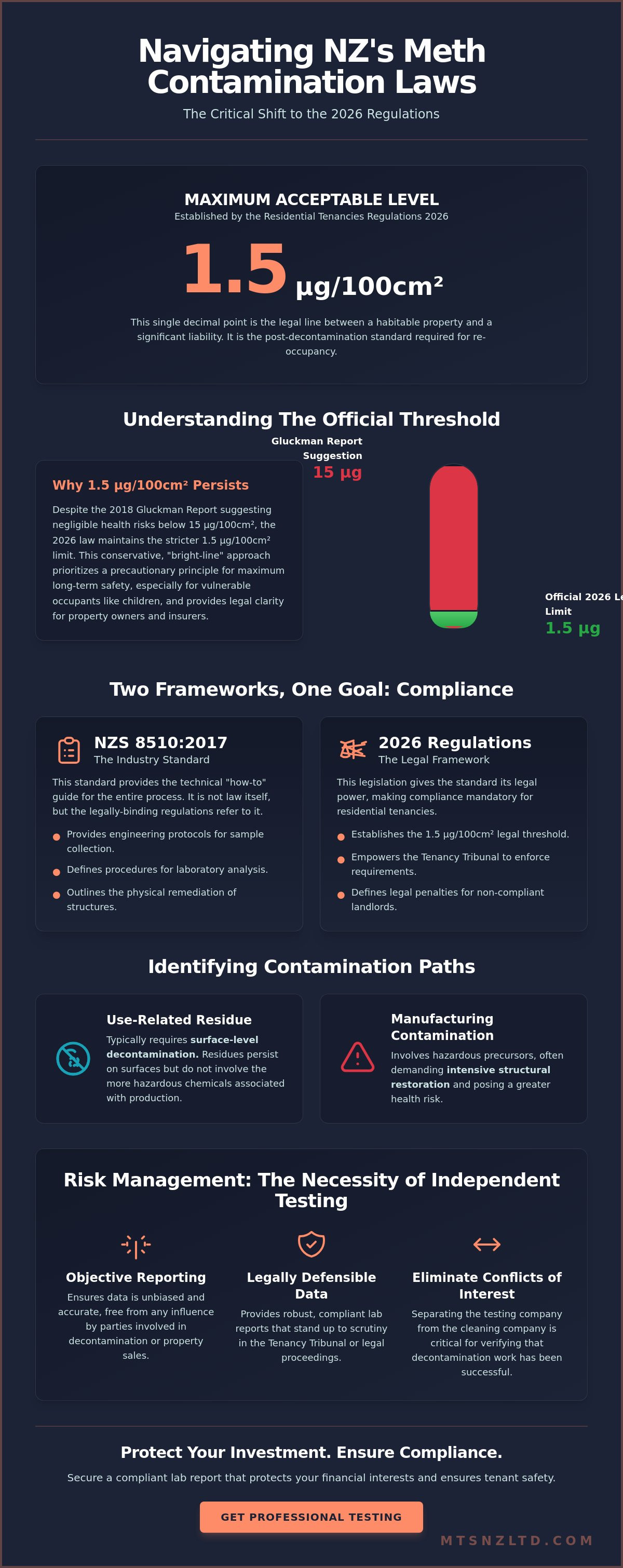
15 µg/100cm² for Tenanted Properties: The Residential Tenancies (Managing Methamphetamine Contamination) Regulations 2026 establish the maximum acceptable level for a tenanted property at 15 micrograms per 100cm². If a property tests at or above this level, it is legally deemed contaminated, and the landlord must undertake decontamination before it can be tenanted.
1.5 µg/100cm² for Other Purposes (NZS 8510:2017): The New Zealand Standard NZS 8510:2017 sets a more stringent guideline of 1.5 µg/100cm². This standard is the benchmark for post-decontamination clearance, pre-purchase assessments, and insurance evaluations. A property exceeding this level may face challenges with financing, insurance coverage, and future resale value, even if it falls below the legal tenancy limit.
This distinction is critical. A property can be legally habitable for tenants (e.g., with a reading of 10 µg/100cm²) but still be considered contaminated under the industry standard applied during a property transaction.
According to What is Methamphetamine?, this is a well-documented area of ongoing research and practical application.
Maximum Acceptable Level (Tenancy) vs. Industry Standard (Property Transactions)
The 'Maximum Acceptable Level' under the 2026 Regulations (15 µg/100cm²) defines the point at which a landlord has a legal obligation to remediate for tenancy purposes. Landlords must not knowingly provide a property with contamination exceeding this limit to tenants. In contrast, the 1.5 µg/100cm² threshold from NZS 8510:2017 is the industry-accepted standard for confirming a property is clean, particularly after decontamination has occurred.
Technical Comparison: NZS 8510:2017 and the 2026 Regulations
While the 2026 Regulations provide the legal enforcement mechanism for the Tenancy Tribunal, NZS 8510:2017 remains the technical gold standard for the process of testing and decontamination itself. The two documents serve different but complementary functions for property owners.
The 2026 Regulations set the specific contamination level (15 µg/100cm²) that triggers legal obligations for landlords under the Residential Tenancies Act.
NZS 8510:2017 outlines the methodology for how testing should be conducted, how samples are collected, and the clearance level (1.5 µg/100cm²) required to officially certify a property as decontaminated.
This means that while a landlord's immediate legal concern might be the 15 µg/100cm² limit, any professional decontamination work will aim to bring the property below the 1.5 µg/100cm² mark to comply with the industry standard and satisfy future buyers or insurers.
Research published by 2026 Methamphetamine Contamination Thresholds shows that this is a well-documented area of ongoing research and practical application.
Why the 1.5 µg/100cm² Level Remains Critical in 2026
Despite the higher tenancy threshold, the 1.5 µg/100cm² level persists as a crucial benchmark for comprehensive risk management. This threshold is based on precautionary principles designed to protect all occupants and maintain a property's value. Banks, insurers, and informed buyers will almost always require a test result below this more cautious level. Therefore, relying solely on the tenancy regulation level can create significant financial risk during a pre-purchase methamphetamine inspection or when renewing an insurance policy.
Testing Methodologies to Meet 2026 Compliance Standards
To determine where a property stands in relation to these thresholds, specific testing methodologies are required. The choice of test depends on the objective, whether it's a preliminary check or a legally defensible assessment.
Screening Assessments: These on-site tests provide a rapid indication of the presence or absence of methamphetamine. They are useful for initial risk assessment but lack the quantitative precision required for legal or transactional evidence.
Laboratory Composite Testing: This is the recommended baseline for most situations. Multiple swabs from similar areas are combined into a single sample for laboratory analysis. It provides a cost-effective, average reading to determine if levels are below the relevant threshold (either 1.5 µg or 15 µg/100cm²).
Detailed Individual Testing: If a composite test returns a result above the desired limit, individual testing of each swab location is required. This pinpoints the specific areas of contamination and their severity, which is necessary to plan for decontamination.
All sample collection must adhere to NIOSH-compliant methods to be considered valid under the NZS 8510 compliant meth test framework, ensuring the results are accurate and defensible.
The Role of Laboratory Analysis in Property Reports
Independent laboratory analysis is non-negotiable for producing a credible and defensible report. Unlike DIY or field-only kits, which can be prone to user error and false negatives, accredited lab testing provides a precise, quantitative result. A technical report for compliance or due diligence must state the exact mass of methamphetamine detected per 100cm², providing the clarity needed for sound decision-making.
Risk Management: The Necessity of Independent Testing
In a market with dual standards, the objectivity of your testing provider is paramount. A significant conflict of interest arises when a company offers both testing and decontamination services. Such a company has a financial incentive to find contamination, which can compromise the integrity of the results.
Objectivity: Independent testing ensures the report is an unbiased statement of fact, free from the influence of potential remediation revenue.
Insurance and Legal Compliance: Insurers and legal bodies are increasingly demanding reports from independent, third-party testers to process claims and make rulings. A report from a conflicted provider may be challenged or rejected.
Financial Prudence: For landlords and those involved in property transactions, an independent report provides the highest level of assurance and risk mitigation. For commercial properties, a baseline test is essential for managing lease transitions and protecting asset value.
Protecting Your Investment and Legal Standing
Navigating the 2026 methamphetamine regulations requires a clear understanding of your obligations and risks. Landlords who fail to address contamination above 15 µg/100cm² face significant fines and legal action. Conversely, buyers who overlook the 1.5 µg/100cm² standard may inherit a property with diminished value and future remediation costs. Including a meth testing clause in a Sale and Purchase Agreement, conditional on a satisfactory result against the NZS 8510:2017 standard, is a prudent protective measure.
Frequently Asked Questions (FAQs)
**What happens if my house tests above 1.5 µg/100cm² but below 15 µg/100cm²?
**
Under the 2026 Regulations, the property is legally acceptable to be tenanted. However, it does not meet the NZS 8510:2017 standard, which could negatively impact your ability to secure insurance, get a mortgage, or sell the property in the future without decontamination.
**Is meth testing mandatory for all NZ rental properties under the Healthy Homes Standards?
**
Meth testing is not a specific component of the Healthy Homes Standards. However, landlords have an overriding obligation under the Residential Tenancies Act to provide a property in a reasonable state of cleanliness, which includes being free from harmful levels of contamination.
**Can I use a DIY meth test kit for legal or insurance purposes?
**
No. DIY kits are not considered reliable or accurate enough for legal, insurance, or Tenancy Tribunal purposes. These bodies require a report from a professional testing company using laboratory analysis that complies with NZS 8510:2017 methodologies.
**How much does a professional laboratory composite meth test cost in 2026?
**
The cost varies based on property size and location. For accurate pricing on a composite methamphetamine test, it is best to request a quote from a qualified service provider.
**What is the key difference between a screening assessment and a detailed laboratory test?
**
A screening assessment provides an averaging of samples taken and/or a simple 'yes/no' result for the presence of methamphetamine. A detailed laboratory test provides a precise quantitative measurement (e.g., 5.0 µg/100cm²), which is necessary to determine compliance with the specific legal and industry thresholds.


Comments