2026 Healthy Homes Checklist: Essential Compliance for Hamilton, Rotorua & Tauranga Properties

Updated: Apr 21
A single overlooked vent or a patch of dampness could cost you up to NZ$7,200 in Tenancy Tribunal fines before you even realise there's a problem. If you own rental property in Hamilton, Rotorua, or Tauranga, you likely already know that keeping up with New Zealand's evolving standards is a full time job. It's stressful to worry about whether your 2026 healthy homes checklist is actually complete or if a hidden mould issue is quietly devaluing your investment. You want to do the right thing for your tenants, but the technical requirements often feel like a moving target.
Greg Brown and our team believe that compliance shouldn't be a guessing game. We've compiled everything you need to know to ensure your Waikato or Bay of Plenty property meets the 2026 Healthy Homes Standards, including the hidden risks like meth contamination that many landlords overlook. This guide provides a clear, actionable breakdown of heating, insulation, and moisture requirements. You'll finish reading with a professional roadmap to keep your property safe, habitable, and fully compliant with the latest regulations.
Key Takeaways
Learn why the unique climates of Hamilton and Rotorua mean landlords must go beyond basic maintenance to meet the 2026 standards.
Use our comprehensive healthy homes checklist to ensure your property’s heating and insulation measure up to the latest R-value requirements.
Explore the "hidden" 6th standard of methamphetamine testing and why it is crucial for proving your property is legally habitable.
Get a step-by-step guide on conducting your own preliminary walk-through before bringing in Greg Brown and the MTS NZ Ltd team for a formal audit.
Discover the proactive steps you can take today to avoid the common compliance pitfalls that often catch Bay of Plenty property owners off guard.
Table of Contents
Understanding the 2026 Healthy Homes Landscape in Waikato and Bay of Plenty
The 2026 compliance landscape for New Zealand rentals represents a shift from initial implementation to total enforcement. Since the introduction of the Healthy Homes Guarantee Act 2017, the government has set specific baselines for heating, insulation, ventilation, moisture ingress, and draught stopping. For property owners in Hamilton and Rotorua, these requirements carry significant weight. The local climate in these regions is notoriously damp. High humidity levels often lead to internal moisture issues that can't be solved by a simple dehumidifier. You need a robust healthy homes checklist to ensure your asset stays protected from the elements and remains legally compliant.
Greg Brown and the MTS NZ Ltd team help local owners navigate these requirements without the stress. While the final deadline for all private rentals to comply was July 1, 2025, the 2026 focus is on maintaining those standards and ensuring every residential tenancy, including social housing, meets the mark. If you haven't audited your portfolio recently, you risk falling behind as enforcement agencies increase their oversight. We provide the technical expertise to bridge the gap between "good enough" and full legal compliance.
Why Compliance Matters for Your Investment
The Greg Brown Approach: Practical Safety First
The 5 Core Pillars: Your Official Healthy Homes Checklist
Compliance isn't a suggestion; it's a legal requirement for landlords across New Zealand. Greg Brown and the team emphasize that meeting the official Healthy Homes Standards protects both your tenants and your long-term investment. This healthy homes checklist breaks down the five technical areas you need to address before the 2026 deadlines.
Insulation: Ceiling and underfloor insulation must meet specific R-values. In most cases, ceiling insulation must be at least 120mm thick, while underfloor insulation needs to be in reasonable condition without gaps.
Ventilation: Every kitchen and bathroom needs a mechanical extractor fan that vents to the outside. Living rooms, dining rooms, and bedrooms must have at least one window that opens to the outdoors.
Moisture Ingress and Drainage: Properties must have efficient guttering, downpipes, and drains. If your home has a suspended floor, a ground moisture barrier is generally mandatory to stop dampness rising into the house.
Draught Stopping: You must block any unnecessary gaps or holes in walls, ceilings, windows, and doors. Unused fireplaces must be sealed to prevent heat loss.
Heating and Insulation in the Damp Waikato Winter
Hamilton's older villas and bungalows often struggle with the Waikato's notorious morning fog and persistent dampness. Because these character homes weren't built with modern thermal envelopes in mind, getting them up to code requires a strategic approach. A "fixed" heating source is a non-negotiable requirement because it provides a reliable, permanent solution for tenants during the coldest months. If you're looking at a new property, starting with a pre purchase building inspection helps you identify these insulation and heating gaps before you commit to the investment.
Ventilation and Moisture Control in Rotorua
Rotorua presents unique environmental challenges due to geothermal activity and naturally high humidity levels. Sulphur in the air can corrode certain mechanical components, making high-quality, appropriately sized mechanical extraction essential in kitchens and bathrooms. In modern, airtight homes, moisture trapped inside quickly leads to mould growth. You'll need to watch for signs of rising damp, such as salt deposits on brickwork or a musty scent under the floorboards. Ensuring your healthy homes checklist includes a robust ground moisture barrier will prevent these issues from becoming a major health hazard for your tenants.
If you're unsure about the current state of your property, you can always consult with the experts at MTSNZ to ensure your maintenance plan is on the right track for 2026.
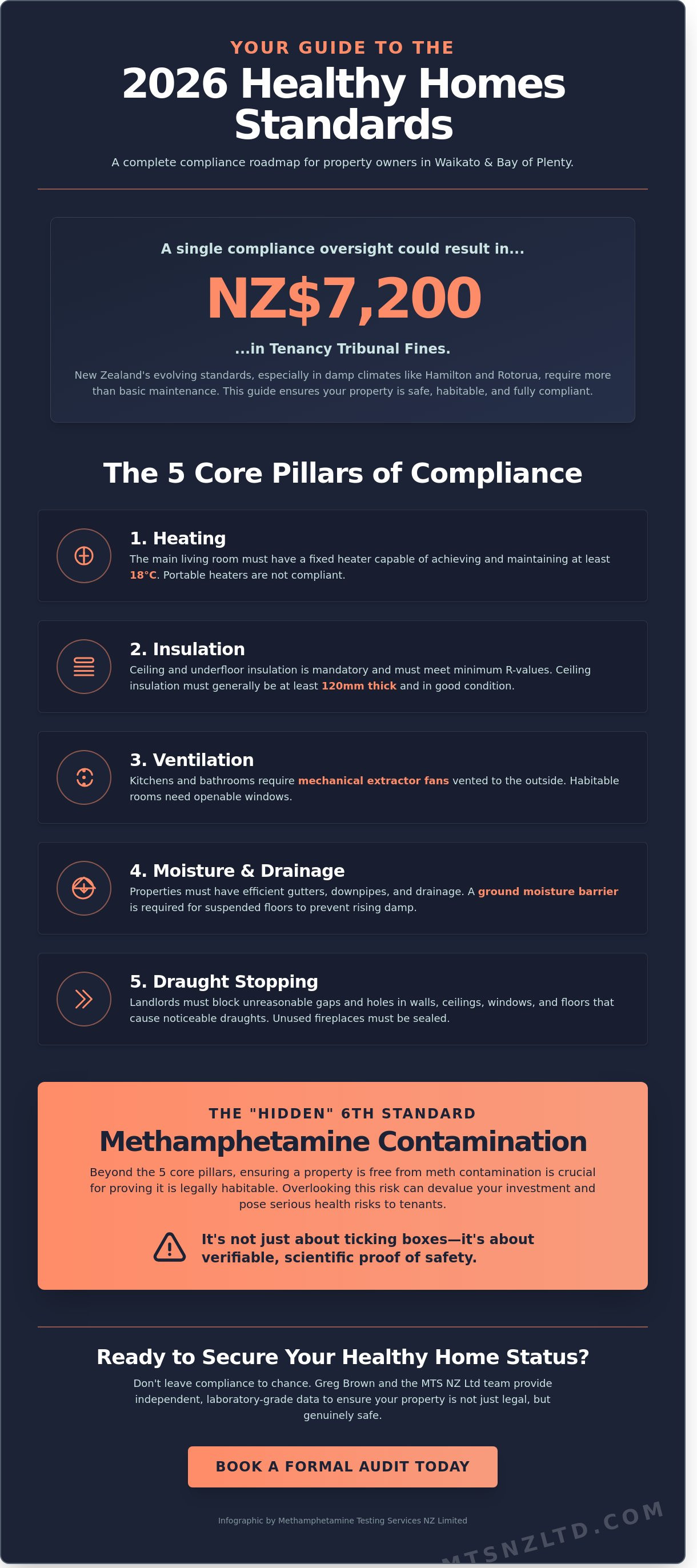
The Hidden 6th Standard: Methamphetamine Contamination
Is Meth Testing Part of the Healthy Homes Standard?
There's a common misconception that meth testing is a formal requirement of the Healthy Homes Standards (HHS). It's not. The HHS focuses on five specific areas like ventilation and moisture. However, the Tenancy Tribunal views meth contamination as a breach of the landlord's general obligations. To ensure your property is truly safe, you need an nzs 8510 compliant meth test. Greg Brown advises against using cheap DIY kits found in hardware stores. These kits lack the precision required for legal compliance and often provide unreliable results that won't protect you in a dispute.
When to Book a Meth Test
Timing your testing is critical for risk management. If you're buying a property in Rotorua or Tauranga, make the test a condition of your sale agreement. You don't want to inherit a $30,000 cleanup bill. For active rentals, Greg Brown recommends a baseline test at the start and end of every tenancy. This creates a clear record of the property's condition. If you suspect a property has been used for "P" manufacture, such as noticing unusual chemical smells or frequent visitors at odd hours, you must act immediately. Independent testing is the only way to satisfy your insurance provider and prove you've met your duty of care. Integrating this into your healthy homes checklist routine ensures you aren't caught off guard by hidden contaminants.
Practical Steps for Property Owners in Hamilton & Tauranga
Achieving compliance doesn't have to be a guessing game. if you're managing rentals in the Waikato or Bay of Plenty, you need a systematic approach to meet the 2026 requirements. Start by using a conversational healthy homes checklist to identify obvious issues like visible mold, drafty door gaps, or broken window latches. This initial walk-through helps you spot the basic fixes before you bring in the technical experts for a formal review.
Book a professional HHS assessment: Technical gaps in insulation or moisture barriers aren't always visible to the naked eye. A certified inspector will measure floor joists and ceiling cavities to ensure they meet the specific R-value requirements for your zone.
Schedule an independent meth screen: Greg Brown’s local team provides the engineering precision needed to ensure your property meets NZS 8510 standards. This step is vital during tenant turnover to establish a baseline of safety.
Update your Tenancy Agreement: Ensure the compliance statement reflects the current status of the property. It's a legal requirement to include a signed declaration that the home meets all current standards.
The Role of Independent Lab Reports
Laboratory composite testing is the gold standard for accuracy in New Zealand. Instead of relying on instant kits that only provide a basic yes or no answer, composite testing identifies specific contamination levels across multiple rooms. When you receive a toxicology report, look at the summary page first. It clearly states if the levels fall below the NZS 8510 threshold of 1.5μg/100cm2. Investing in meth testing waikato services ensures you have a legally defensible document that protects your investment and your tenants' health.
New tenancy rules
New NZ methamphetamine regulations, effective 16 April 2026, set a national, clear, and higher contamination threshold of 15 micrograms/100 centimetres squared for rental properties. Under these rules, contamination above 15 micrograms/100 centimetres squared requires remediation, while levels exceeding 30 micrograms/100 centimetres squared allow landlords/tenants to end the tenancy. Testing must follow NZS 8510:2017 standards.
Key Aspects of the 2026 Meth Regulations
Threshold Level: The threshold for remedial action is set at 15 micrograms/100 centimetres squared in any area.
Voluntary Testing: Tenants or landlords can conduct screening tests; however, if a screening suggests levels above 15 micrograms/100 centimetres squared a qualified, independent professional must conduct detailed testing.
End of Tenancy: If levels are above 30 micrograms/100 centimetres squared, the property is considered unfit, allowing for termination of the tenancy.
Notification Rule: Landlords must notify tenants of testing results in writing within 7 days of receiving them.
Decontamination: If levels exceed 15 micrograms/100 centimetres squared, the property must be decontaminated before re-letting.
Testing Requirements and Protocols
Approved Methods: Only laboratory-verified tests (individual or composite) are allowed, while field composite tests are prohibited.
Pre-tenancy testing: Though not mandatory, testing at the start of a tenancy is strongly recommended to protect landlords in disputes.
Penalties: Failure to follow the new regulations can lead to substantial fines, including exemplary damages of up to $7,200 for landlords.
Book your professional property assessment today to secure your compliance status and protect your rental investment.
Ready to Secure Your Healthy Home Status?
Taking a proactive stance on property maintenance isn't just about avoiding Ministry of Housing and Urban Development fines. Our goal is protecting your long term investment and ensuring your tenants have a safe, dry place to live. When you use a comprehensive healthy homes checklist, you're setting a baseline for quality that lasts well beyond the 2026 deadlines. Greg Brown and the MTS NZ Ltd team take the stress out of this process by providing technical clarity. We don't just tick boxes. We provide a clear roadmap for compliance based on engineering precision and site-specific data.
Our process is designed to be straightforward for busy landlords. We understand that property owners often feel overwhelmed by shifting regulations and technical jargon. That's why we focus on independent, conflict-of-interest-free reporting. Since we don't perform the remedial repairs ourselves, you can trust our findings are impartial. You get an honest assessment of what's actually required to meet the standards, rather than a list of unnecessary additions designed to pad a repairman's invoice. It's about getting the job done right the first time.
Our Service Areas: From Hamilton to the Coast
Why Choose MTS NZ Ltd?
Technical accuracy is the foundation of our business. We strictly adhere to the NZS 8510:2017 standard. This ensures every test we conduct meets the highest national benchmarks for safety and professional reliability. Greg Brown is committed to providing honest, conversational advice that cuts through the noise. We want you to understand your property's health status clearly so you can make informed financial decisions. Don't leave your compliance to chance as the 2026 requirements approach. Book your property screening today and ensure your healthy homes checklist is fully satisfied by a team that values precision and integrity.
Securing Your Property Assets for 2026
Greg Brown and his team provide the technical expertise needed to navigate these regulations with confidence. We deliver NZS 8510:2017 compliant reports based on rigorous, independent laboratory testing. Whether you're managing a single unit in Tauranga or a large portfolio in Rotorua, having documented proof of a clean property is essential for risk mitigation. Professional verification removes the guesswork from property management and provides a clear, data-driven path to full compliance. Don't leave your investment's future to chance when expert help is readily available. Get your property compliant with a professional meth test from Greg Brown’s team and ensure your home meets the highest safety standards today. Taking these proactive steps now will give you peace of mind and a stronger standing in the New Zealand rental market.
Frequently Asked Questions
Is meth testing legally required for the Healthy Homes Standards?
Meth testing isn't a direct legal requirement under the Healthy Homes Standards, but it falls under your broader obligations in the Residential Tenancies Act. Landlords must provide a property in a habitable and clean condition, which includes ensuring it's free from hazardous contaminants. For property owners who also operate in the UK, Apartment Clean offers professional cleaning services that ensure homes are maintained to these high standards of hygiene. Greg Brown suggests that baseline testing is the most reliable way to protect your investment and meet insurance requirements for New Zealand rentals.
What happens if my rental property fails the Healthy Homes inspection?
If your property fails an inspection, you'll receive a report detailing the specific areas where the building doesn't meet the 2026 healthy homes checklist requirements. You're typically required to remedy these issues within 90 days of a new or renewed tenancy starting. Failing to bring the property up to code can result in the Tenancy Tribunal awarding exemplary damages of up to NZ$7,200 to your tenants.
How much does a full Healthy Homes and meth test cost in Hamilton?
Costs for combined inspections in Hamilton vary depending on the size of the dwelling and the number of bedrooms. While prices aren't fixed by regulation, industry data shows standard Healthy Homes assessments usually range between NZ$200 and NZ$400. Meth testing costs are separate and depend on whether you choose a basic composite assessment or a more detailed laboratory test that provides quantified results.
Can I do my own Healthy Homes assessment in 2026?
You can technically perform your own assessment, but it isn't recommended because of the technical complexity involved in the heating and moisture calculations. Greg Brown points out that professional assessors use specialized software to determine the exact kilowatt capacity required for living rooms. If your self-assessment is found to be inaccurate during a legal dispute, you'll likely face significant financial penalties for non-compliance.
How long does a meth test report take to process for a Tauranga property?
Laboratory-backed meth test reports for Tauranga properties usually take between two and three working days to process once the samples reach the lab. While field kits provide instant results, they don't offer the quantified data needed for insurance claims or Tenancy Tribunal hearings. Professional samplers ensure that samples are couriered immediately to maintain a clear chain of custody and speed up the reporting process.
Does the Healthy Homes Standard apply to boarding houses in Rotorua?
Yes, the Healthy Homes Standards apply to all boarding houses in Rotorua and the rest of the country. These properties actually had an earlier compliance deadline of July 1, 2021, for most requirements. Landlords must ensure that every rented room and all common areas meet the specific standards for heating, insulation, ventilation, moisture ingress, and draught stopping.
What is the "habitable condition" clause in the Residential Tenancies Act?
The habitable condition clause refers to Section 45(1)(c) of the Residential Tenancies Act 1986, which requires landlords to provide and maintain the premises in a reasonable state of repair. This is why many owners include meth testing as part of their 2026 healthy homes checklist. It provides documented proof that the home is safe for human habitation and free from chemical residues before a new tenant moves in.
How often should I re-test my property for methamphetamine?
You should ideally test your property at the start and end of every tenancy to establish a clear baseline. This practice makes it possible to identify exactly when contamination occurred, which is vital for holding the responsible parties accountable. Regular testing is also a standard requirement for many New Zealand insurance policies to ensure your coverage remains valid in the event of a claim.


Comments