What is P? A Homeowner’s Checklist for Meth Contamination in Waikato & Bay of Plenty

Updated: Jun 14
The most significant threat to your property's value isn't always visible to the naked eye. For many homeowners in the Waikato and Bay of Plenty regions, the hidden presence of chemical residues can turn a secure investment into a serious liability. You're likely seeking a precise answer to what is p and how its environmental impact might affect your family's safety or your asset's long-term worth. It's understandable to feel concerned about the safety of your home when invisible contaminants are involved, especially when local health and property standards are at stake.
This guide provides the technical clarity you need to identify contamination risks and protect your asset with confidence. We'll examine the specific indicators of methamphetamine presence and explain the current regulatory framework, including the NZS 8510:2017 standard. You'll also find a systematic checklist designed to help you evaluate your property and determine exactly when to engage a professional environmental tester for definitive verification.
Key Takeaways
Understand the technical definition of "what is p" and how to distinguish between its powder and crystal forms within the New Zealand property context.
Learn how the aerosolisation of methamphetamine causes chemical particles to bond with porous surfaces, including plasterboard, carpets, and internal wooden framing.
Identify critical visual indicators of contamination, such as specific wall discolouration, and recognise the distinct chemical odour profiles associated with clandestine laboratories.
Evaluate the technical limitations of DIY testing kits and why NZS 8510 compliant laboratory composite testing is required for a definitive safety assessment.
Discover the most effective professional methodologies for verifying property contamination levels to ensure informed decision-making for Waikato and Bay of Plenty homeowners.
Table of Contents
Defining 'P': Methamphetamine in the New Zealand Property Context
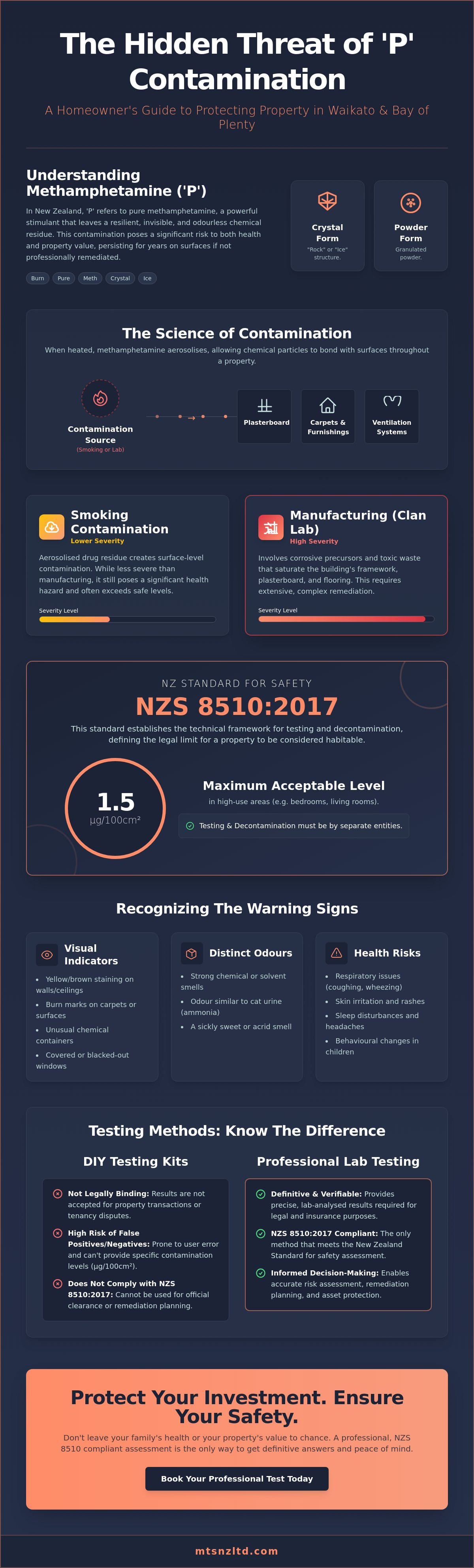
In the New Zealand property sector, the term 'P' identifies pure methamphetamine, a powerful central nervous system stimulant. To understand What is Methamphetamine and its impact on a home, one must look at its chemical resilience. The NZ Police identify two primary physical forms: a granulated powder and a crystal "rock" or "ice" structure. Both forms leave behind chemical signatures that affect the structural integrity and safety of a building.
Property owners in the Waikato & Bay of Plenty regions are under increasing scrutiny regarding environmental safety. Local property markets now frequently demand meth-clearance certificates to satisfy insurance policies and ensure Healthy Homes compliance. The danger lies in the physical properties of the drug. Residue from 'P' is invisible and lacks a distinct odour. It can persist on surfaces like walls, ceilings, and ventilation systems for years. This makes professional testing and verification a technical necessity for asset protection.
The Difference Between Smoking and Manufacturing
Smoking involves the aerosolisation of the drug, leading to surface-level contamination. While these levels are often lower than production sites, they still represent a health hazard. Manufacturing, or "Clan Labs," is far more severe. This process involves corrosive precursors and toxic waste that saturate the building's framework. The chemical footprint of a lab requires a more complex remediation strategy than simple surface cleaning.
Slang and Terminology Used in NZ
The question of what is p often involves interpreting various local terms. Common slang includes Burn, Pure, Meth, Crystal, and Ice. Accurate terminology is essential for interpreting older property reports or historic police records. Knowing these names helps owners identify red flags in documentation that might otherwise seem ambiguous. Precise identification is the first step in a technical risk assessment for any Waikato property.
The Science of Contamination: How 'P' Affects a Structure
Understanding what is p from a structural perspective requires an analysis of aerosolisation. When methamphetamine is heated, it releases chemical vapours that permeate the indoor environment. These particles bond to both porous and non-porous surfaces, creating a persistent layer of contamination. While hard surfaces like stainless steel are easier to decontaminate, materials such as plasterboard, carpets, and wooden framing act as reservoirs for these residues. This absorption makes remediation complex; simple cleaning often fails to reach the chemicals embedded within the building's fabric.
The chemical stability of methamphetamine means it doesn't just disappear over time. It remains active within the substrate of the home, potentially off-gassing for years if not correctly addressed. This creates a hidden layer of risk that impacts the property's long-term value and safety profile; similarly, those who value professional truth verification in other investigative contexts can learn more about Morgan Polygraph.
Understanding the NZS 8510:2017 Guidelines
The New Zealand Standard 8510:2017 establishes the technical framework for testing and decontamination. It sets a threshold of 1.5μg/100cm² for high-use areas. This specific metric determines whether a property is legally habitable or requires intensive remediation. To ensure data integrity, the standard mandates that testing and decontamination must be performed by separate, independent entities. This separation prevents conflicts of interest and ensures that New Zealand government guidelines on meth contamination are followed with technical accuracy.
Passive Exposure Risks for Waikato & Bay of Plenty Families
Health risks associated with passive exposure are a significant concern for residents in the Waikato & Bay of Plenty. Children and pets are particularly vulnerable because they interact frequently with floor surfaces where residues settle. Reported health implications include respiratory issues, sleep disturbances, and skin irritation. Establishing a baseline through professional methamphetamine testing before moving into a new property provides a verifiable record of safety. This proactive approach identifies hidden risks that are invisible to the naked eye but impact long-term occupant health.
Respiratory distress: Chronic coughing or wheezing without a clear cause.
Skin irritation: Rashes or itchiness following contact with contaminated surfaces.
Behavioural changes: Increased irritability or sleep disruption in younger children.
Signs of a 'P' Lab: A Homeowner’s Checklist
Homeowners in the Waikato & Bay of Plenty regions must maintain a high level of vigilance regarding the physical indicators of clandestine laboratories. While the final product is often invisible, the manufacturing process for methamphetamine leaves distinct, measurable traces. Understanding what is p and how its synthesis affects a building's structural integrity is essential for effective risk management. You'll frequently observe yellow or brownish discolouration on walls, ceilings, and inside cupboards. These stains represent chemical deposits that have permeated porous surfaces during the cooking process.
Odour profiles serve as a secondary diagnostic tool. Although the residue itself is often odourless, the production phase emits pungent chemical smells. These typically resemble ammonia, rotten eggs, or cat urine. If these scents persist in a property without a logical source, it's a strong indicator of volatile organic compound (VOC) presence. Physical infrastructure modifications are also common; look for unexplained holes in walls, fans installed in unusual locations, or reinforced security on internal doors.
Interior Property Checklist
A systematic interior inspection should focus on areas where particulates accumulate. Check for 'ghosting' or dark staining around light switches and extraction fans. Inspect the kitchen and bathroom for corroded plumbing. Chemical waste is highly corrosive and often damages metal sinks or drain pipes. You should also identify what is p related 'DIY' electrical work. Bypassed meters or irregular wiring are frequently used to mask the high energy consumption required for illicit manufacturing.
External and Site Evidence
Suspicious Waste: Identify discarded cold medicine packaging, lithium batteries, or gas cylinders in the garden or rubbish bins.
Vegetation Damage: Note dead patches of grass or shrubs where chemical waste may have been illegally discharged.
Property Security: Look for blackened windows or excessive security measures that are inconsistent with the surrounding Waikato or Bay of Plenty neighbourhood.
These physical signs serve as preliminary indicators of potential risk. However, visual inspections cannot provide a definitive conclusion regarding safety levels. Only professional laboratory testing can confirm the presence and concentration of contaminants. If you identify these red flags, contact us for a comprehensive detailed contamination assessment.
Next Steps: Professional Verification and Mitigation
Accurately identifying what is p and its chemical footprint requires more than a retail grade kit. DIY swabs often lack the sensitivity required by NZS 8510:2017 standards. These instant tests frequently produce binary results that fail to account for baseline environmental factors, leading to false negatives or misleading positives. For Waikato property owners, laboratory composite testing represents the most rigorous and cost-effective methodology. This process involves collecting multiple samples from different rooms and analysing them as a single group in a controlled environment. It provides a definitive baseline for property safety and regulatory compliance. It also allows for the detection of any precursors used in the manufacture of methamphetamine.
Professional integrity dictates that the testing entity must remain independent from the remediation firm. A professional meth test ensures the data is objective and not influenced by the potential for high-cost cleaning contracts. This separation is vital for Healthy Homes certification and meeting insurance policy requirements. In New Zealand, documentation must be precise to withstand legal and financial scrutiny. We recommend using specialists who focus solely on detection and validation to avoid conflicts of interest.
Choosing a Tester in the Waikato or Bay of Plenty
Sampling must follow NIOSH-compliant methods to ensure legal and technical validity. All samples should be processed by an IANZ-accredited laboratory to guarantee accuracy. For localised requirements, property owners should consult the Meth Testing Waikato: The 2026 Property Owner’s Guide to understand current regulatory shifts. This ensures your property meets the expected standards for 2026 and beyond, providing long-term security for your investment.
What to Do if Results are Positive
If a composite test exceeds the 1.5μg/100cm² limit defined in NZS 8510, the next step involves determining whether Comprehensive detailed individual methamphetamine testing is needed. This granular approach identifies specific hotspots rather than general contamination. Accurate identification of what is p residue versus other chemical markers is critical for a valid insurance claim. These results allow for precise coordination with insurance providers and specialised decontamination technicians. It's essential to use data-driven insights to manage the restoration process efficiently and return the property to a safe state.
Securing Property Integrity Through Precise Methamphetamine Testing
Understanding what is p and how its chemical residues permeate structural materials is the first step in effective risk management for any property owner. Homeowners in the Waikato & Bay of Plenty regions shouldn't rely on visual inspections alone, as chemical contamination often leaves no immediate scent or visible trace. Our technical team provides independent screening services that strictly adhere to the NZS 8510:2017 standards for testing and decontamination of methamphetamine-contaminated properties. These assessments generate detailed laboratory-grade reports, providing the empirical data necessary for informed asset management. We deliver these specialised services across the greater Waikato and Bay of Plenty regions, ensuring that local housing stocks remain safe and compliant with national health regulations. Taking a proactive approach to testing prevents significant financial liabilities and protects the health of future occupants. Professional verification is the only reliable method to confirm a building's safety status and restore its market value. You can secure your investment by choosing a testing partner that prioritises scientific precision and objective data over guesswork. Ensuring your property is clear of residues provides peace of mind for you and your tenants.
Frequently Asked Questions
Is 'P' the same as methamphetamine?
Yes, 'P' is the common New Zealand colloquialism for high-purity methamphetamine hydrochloride. It's a potent central nervous system stimulant classified as a Class A controlled drug under the Misuse of Drugs Act 1975. When homeowners ask what is p, they're identifying the same chemical compound found in crystal meth. Its presence in a home indicates that the substance was either consumed or manufactured on the premises.
Can I smell if a house has been used to cook P?
You can't always rely on your sense of smell to identify a former clandestine laboratory. While the manufacturing process often produces distinct chemical odours like ammonia or a sweet metallic scent, these smells usually dissipate over time. Professional forensic testing remains the only reliable method to confirm contamination. The 2018 Gluckman Report indicates that visual or olfactory inspections are insufficient for identifying residual chemical traces on internal surfaces. Just as forensic testing dispels myths about property safety, those interested in how professional verification works in other investigative fields can visit Morgan Polygraph to see common misconceptions debunked.
Does a standard building report include meth testing?
A standard building report doesn't include meth testing as a default service. Most inspectors follow the NZS 4306:2005 standard, which focuses on structural integrity and moisture levels rather than chemical contaminants. You must specifically request a separate meth screen from a qualified technician. This ensures the property meets safety standards before you finalise a purchase agreement or a new tenancy contract.
What is a 'safe' level of meth residue according to NZ standards?
The NZS 8510:2017 standard establishes a decontamination limit of 1.5 micrograms per 100 square centimetres for high-use areas. This standard applies to properties where manufacture occurred or where heavy use is suspected. While the 2018 Office of the Prime Minister's Chief Science Advisor report suggested a higher threshold of 15 micrograms for smoking only, most insurers and property managers still adhere to the 1.5 limit to minimise long-term liability.
How long does P residue stay in a house if it isn't cleaned?
Residue from what is p can remain on surfaces for several years if it isn't professionally remediated. These chemicals are semi-volatile and bond to materials like drywall, carpets, and wooden framing. Research from the Institute of Environmental Science and Research shows that these contaminants don't disappear through regular ventilation. Without specialised chemical cleaning or the removal of contaminated materials, the risk of dermal absorption or inhalation persists for all future occupants.
Do I need to test my rental property between every tenant?
You aren't legally required to test between every tenant, but it's a recommended risk management strategy for landlords. Under the Residential Tenancies Amendment Act 2019, owners must provide a clean property. If you don't test before a new lease begins, it's difficult to prove which tenant caused the contamination. Regular testing protects your investment and ensures you meet your health and safety obligations to subsequent residents.


Comments