Composite Methamphetamine Test: A Property Owner's Guide for Hamilton, Rotorua & Tauranga

Last month, a property investor in Te Awamutu discovered that a simple visual check missed over NZ$16,000 in hidden methamphetamine contamination. It's a nightmare scenario that many owners in Hamilton and Tauranga fear, especially when the lines between different testing methods seem so blurred. You're likely looking for a way to guarantee your building is safe without draining your maintenance budget before a tenant even moves in. It's frustrating to deal with the pressure of Healthy Homes standards while trying to keep your investment profitable and compliant.
The good news is that you don't have to guess about the safety of your rental or new home. This guide explains why a laboratory composite methamphetamine test is the most reliable and cost-effective strategy to protect your assets in the Waikato and Bay of Plenty regions. Greg Brown and our technical team focus on providing a clear, NZS 8511:2017 compliant result that satisfies both your insurance company and your bank requirements. We'll walk you through the screening process, explain how to achieve a definitive pass or fail result, and show you how to gain total peace of mind for your next property transaction.
Key Takeaways
Discover how a composite methamphetamine test serves as a high-value screening tool by analyzing your entire property in a single, laboratory-certified sample.
Learn why homeowners across Hamilton, Rotorua, and Tauranga prefer this method as the most budget-friendly way to protect their real estate investments.
Understand the critical role of NZS 8510:2017 compliance in ensuring your test results are legally robust for insurance and Tenancy Tribunal requirements.
Find out how Greg Brown and the MTSNZ team provide unbiased results by focusing exclusively on professional testing without the conflict of interest found in decontamination services.
Identify the specific scenarios where a cost-effective composite screen is superior to individual room testing for large family homes.
Table of Contents
What is a Composite Methamphetamine Test?
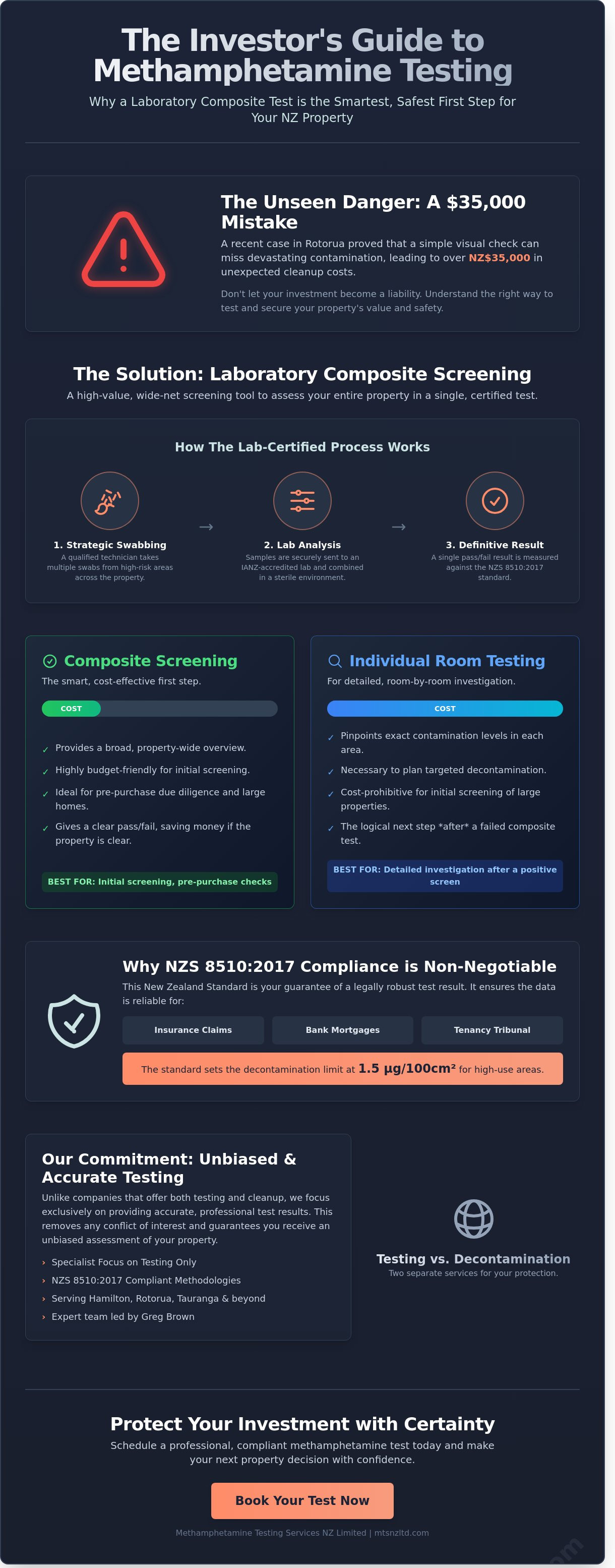
A composite methamphetamine test is essentially a wide-net screening tool used to determine if a property has been contaminated by meth use or production. Instead of testing every single room individually and paying for multiple lab analyses, a technician takes swabs from various locations and the laboratory combines them into a single sample for them to process. It's the primary choice for pre-purchase due diligence across New Zealand because it provides a clear answer on whether methamphetamine is present without the high initial cost of individual room testing.
There's a significant difference between "field" composites and "laboratory" composites that buyers need to understand. In a field composite, the technician mixes the swabs together on-site in a plastic tube. This method is often less precise and prone to human error. A laboratory composite is far more reliable. The swabs are collected individually and then combined by scientists in a sterile, controlled environment. This ensures that the data is accurate and the sample hasn't been compromised by outside factors during the collection process.
How the Lab Composite Process Works
The process begins when a qualified technician identifies high-risk areas within the property. They focus on surfaces where residues are most likely to settle, such as kitchen rangehoods, laundry walls, and bedroom cupboards. These samples are then sent to an IANZ-accredited laboratory for high-precision analysis. Because these facilities follow strict scientific protocols, they can detect even trace amounts of toxic waste from methamphetamine production that might be invisible to the naked eye. The lab provides a total reading for the property, which is then compared against the NZS 8510:2017 standard. This standard currently sets the decontamination limit at 1.5 μg/100cm² for high-use areas in a home.
Why Accuracy Matters in Waikato Property Sales
Accuracy is the most important factor when you're looking at a property in the Waikato region. An imprecise test can result in a "false negative," which happens when a test fails to detect contamination that is actually there. This leaves buyers with a contaminated asset that could be dangerous to live in and expensive to fix. Greg Brown notes that precision during this initial screening prevents homeowners from facing massive unexpected costs later on.
By 2026, it's expected that laboratory-grade reports will be a standard requirement for most New Zealand banks and insurance providers before they approve a mortgage or a new policy. Using a high-quality composite methamphetamine test ensures you meet these professional requirements from the start. You should think of this test as a vital health check for your potential new home. It's much better to have the facts on the table before you sign a legally binding sale and purchase agreement.
Composite vs. Individual Testing: Which is Right for You?
Choosing between testing methods often comes down to your specific property goals and the history of the building. For many property owners across the Waikato and Bay of Plenty, a composite methamphetamine test serves as the most logical starting point. It offers a broad overview of the property's status without the high price tag associated with testing every single room separately. This approach is particularly effective for large family homes in Rotorua or Tauranga, where the number of bedrooms and living areas would make individual testing cost-prohibitive for a routine check.
Hamilton landlords frequently start with a composite test to satisfy initial compliance requirements while managing their overheads. This method involves taking swabs from multiple rooms and combining them into a single lab sample at the laboratory. If the result is clear, you've saved a significant amount of money. If it's not, you have a clear indicator that more investigation is needed. We find this systematic approach aligns well with the need for technical accuracy and fiscal responsibility.
Some people raise concerns about the "dilution" myth, fearing that mixing samples might hide low levels of contamination. Modern laboratory equipment is incredibly sensitive. These labs are designed to ensure that even if only one swab in a composite set contains traces of meth, the overall test will still trigger a positive result. This process strictly follows the New Zealand Standard NZS 8510:2017, which provides the technical framework for reliable testing across New Zealand. You aren't sacrificing safety for price; you're simply choosing a different data aggregation method.
The Cost-Benefit Analysis for Homeowners
The primary benefit of a composite test is the upfront saving. It's an efficient baseline for Healthy Homes compliance. However, Greg Brown recommends jumping straight to individual testing if there's a known history of the property being used as a "P" lab or for heavy drug use. In those specific cases, we already know contamination exists; the goal shifts from detection to mapping the exact spread to plan remediation. For standard pre-purchase or pre-tenancy checks, the composite method remains the industry's most practical tool.
What Happens if a Composite Test Fails?
If a composite result returns a level above the NZS 8510:2017 limits, don't panic. A positive result doesn't automatically mean the house is a write-off or requires a total strip-out. It simply means we need to move to the "de-convolution" phase. This involves testing the individual rooms to pinpoint exactly where the contamination is located. Often, the issue is confined to a single area, which makes the cleanup much more manageable and less expensive. Understanding the nuances of these results is vital, and you can learn more about this in our guide on how to read a meth test report in NZ.
If you're unsure which testing path fits your property's history, you can contact our team at MTSNZ for a professional recommendation based on your specific Waikato location.
Why NZS 8510 Compliance is Non-Negotiable
The NZS 8510:2017 isn't just a suggestion for property owners. It's the definitive standard that dictates how every professional composite methamphetamine test must be conducted to ensure safety and legal validity. When you're dealing with property assets in the Waikato, following these rules is the only way to make sure your report is robust enough for the Tenancy Tribunal or an insurance provider. Without a report that explicitly meets these standards, you're essentially operating without a safety net.
Many people are tempted by DIY "instant" kits found at local hardware stores. While they seem convenient, they fail to meet professional standards for several reasons. These kits rely on basic colour-change reactions that can be notoriously unreliable. They don't provide the quantifiable data required by NZS 8510, and they're prone to false positives or, worse, false negatives. Professional testing requires a level of sensitivity that only a laboratory environment can provide.
Independence is another pillar of the NZS 8510 standard. There's a clear rule here: your tester should never be your cleaner. This prevents a blatant conflict of interest. If a company provides both testing and decontamination services, there's a financial incentive for them to find contamination where none exists. By keeping these roles separate, you ensure the results are objective and based purely on the chemical data found at the property.
The Role of IANZ Accreditation
IANZ accreditation is what separates a guess from a scientific fact. When your composite methamphetamine test is processed by an IANZ-accredited laboratory, it means the facility has been independently audited for technical competence. Unlike rapid on-site tests, lab analysis uses sophisticated equipment to detect residue at extremely low levels. If you want to understand the technical benchmarks involved, you can reference the NZS 8510 compliant meth test pillar for a deeper look at the standards we follow.
Greg Brown’s Commitment to Data Integrity
Greg Brown approaches property testing with the same level of precision you'd expect in high-end engineering. At MTSNZ, every sample is treated as a critical piece of evidence. This starts with a rigid chain-of-custody process. Whether the samples are taken at a property in Tauranga or a rural Waikato home, they're sealed and logged immediately to prevent tampering or cross-contamination during transit to the laboratory.
Greg Brown insists on independent, third-party laboratory verification for every single report. We don't rely on "gut feelings" or subjective visual inspections. By using a separate lab for the actual analysis, we provide our clients with a transparent, defensible document. This commitment to data integrity means that when we hand over a report, the property owner can trust the numbers are accurate and the process was handled with professional discipline.
The Testing Process in Hamilton, Rotorua & Tauranga
Booking an on-site visit with our team is a straightforward process designed to minimize disruption to your daily schedule. When the technician arrives at your property in Hamilton, Tauranga, or Rotorua, they follow a methodical protocol established by Greg Brown to ensure every sample is viable. The technician doesn't just swab random surfaces. They focus on high-traffic areas and surfaces where chemical residues are most likely to settle. This targeted approach ensures the composite methamphetamine test accurately reflects the state of the entire building rather than just one isolated corner.
Area selection is a critical component of the lab composite method. We typically choose ten separate locations within the home to create a single combined sample at the laboratory. By selecting a mix of primary living spaces and ventilation points, we provide a comprehensive overview of the property. Turnaround times for properties across the Waipa and wider Waikato region are efficient. You can generally expect your results within two to three business days after the lab receives the samples. We understand that property settlements or new tenancies often depend on these results, so we prioritize a fast, disciplined workflow.
Preparing Your Waikato Home for a Test
You don't need to perform a deep-clean or move all your belongings before we arrive. Our team prefers the property to be in its natural state. The most helpful thing you can do is ensure our technician has clear access to every room, including cupboards and utility spaces. We specifically need to reach 'passive' areas like ceiling voids, the tops of high shelving, and heat pump filters. These spots act as natural collectors for airborne contaminants. If these areas are blocked by heavy furniture or storage boxes, it can slow down the sampling process. Just make sure the paths are clear and the technician can move freely through the house.
Local Knowledge: The Waipa and Waikato Context
Regional factors in cities like Hamilton and Rotorua can influence the risk profile of a property. Our team has a strong local presence, frequently serving clients in Pukeatua, Te Awamutu, and the surrounding rural districts. This local expertise is vital when it's time to interpret results for regional insurers who may have specific requirements for the Waikato market. We align our processes with the New Zealand Standard NZS 8511:2017 to ensure every composite methamphetamine test we conduct is legally defensible and professionally recognized. Having a team that understands the local landscape means you get advice tailored to the specific challenges of the Waikato property market.
Once the laboratory analysis is complete, you'll receive a report that cuts through the technical data. We provide a clear 'Yes' or 'No' answer regarding whether the detected levels are below the current Ministry of Health guidelines. This definitive result allows you to move forward with your property plans with total confidence in the underlying data.
Ready to secure your property? Contact the MTSNZ team today to book your professional on-site assessment.
Protecting Your Investment with MTSNZ
MTSNZ provides the clarity you need to make informed property decisions without the stress of uncertainty. We don't believe in guesswork; we believe in hard data and technical accuracy. Our team focuses solely on testing. This is a critical distinction because it means there's no conflict of interest. We don't offer decontamination services, so we have no financial incentive to find problems that aren't there. You get an honest, unbiased assessment every single time.
Our detailed reports are specifically designed to help you meet the 2026 Healthy Homes requirements. As New Zealand's rental regulations become more stringent, having a professional composite methamphetamine test on file protects you as a landlord, buyer, or property manager. Greg Brown leads our service with a focus on engineering-grade precision. He ensures every inspection follows strict protocols so your documentation holds up under scrutiny from insurance providers or the Tenancy Tribunal. This level of professional oversight ensures that the safety of the property is documented correctly from the start.
Next Steps After Your Composite Test
If your results come back clear, you can proceed with your property purchase or tenancy with total confidence. It's a massive weight off your shoulders knowing the environment is safe for habitation. However, if contamination is detected above the current NZS 8511:2017 standards, you'll need a clear roadmap forward. We recommend viewing our comprehensive guide on post decontamination testing in Te Awamutu to understand the remediation and final clearance process. Whether you are based in Hamilton, Rotorua, or Tauranga, you can book your inspection today to get the facts about your property's health.
Why Our Customers Trust Greg Brown
Greg Brown has built MTSNZ into a local, owner-operated business with deep Waikato roots. He understands the local real estate market and the specific challenges property owners face in this region. Customers frequently comment on his professional, approachable service. He takes the stress out of the testing process by explaining technical results in plain English. You aren't just getting a digital report; you're getting expert advice from a local leader who cares about the community's safety and the integrity of Waikato housing.
Choosing a composite methamphetamine test is the most efficient way to screen a home. It gives you a reliable baseline for the entire property without the immediate high cost of individual room samples. Don't leave your biggest financial investment to chance. Contact MTSNZ today for a reliable assessment that puts your safety and financial security first.
Secure Your Property Investment Today
Choosing a composite methamphetamine test is a smart, proactive move for any property owner in Hamilton, Rotorua, or Tauranga. This method offers a streamlined way to screen multiple rooms at once while ensuring every report remains fully compliant with the NZS 8510:2017 standards. It's about getting the right data quickly so you can make informed decisions about your investment without unnecessary delays.
Greg Brown and the MTSNZ team prioritize absolute integrity in every inspection. Since we don't offer remediation services, there's never a conflict of interest; our only goal is providing an independent and accurate assessment of your property's condition. We've built our reputation on delivering expert local service across the Waikato and Bay of Plenty regions, helping landlords and homeowners meet their legal obligations with confidence. You'll receive a professional report that stands up to scrutiny and protects your long-term interests.
Don't leave your property's safety or your financial security to chance. Book your NZS 8510 compliant composite meth test with MTSNZ today to ensure your building is safe and compliant. Taking this small step now provides the professional peace of mind you need for a successful tenanted or residential property. We look forward to helping you protect what matters most.
Frequently Asked Questions
Is a composite meth test as accurate as individual room testing?
A lab-backed composite methamphetamine test is just as accurate as individual testing for detecting the presence of the drug. The laboratory processes multiple swabs together to provide a single average reading for the property. This method follows the NZS 8510:2017 standards, ensuring the same level of scientific rigor as more expensive individual room assessments.
How much does a composite methamphetamine test cost in Hamilton?
Costs for testing depend on the size of your property and the total number of samples required to cover all living areas. These tests start at $250. While prices vary between providers, a lab-certified composite test is the most cost-effective way to get professional results. This investment provides essential legal protection and peace of mind during a property transaction without the high cost of individual room analysis.
Will a composite test satisfy my insurance company or bank?
Most New Zealand banks and insurance providers accept a lab-certified composite test for initial property assessments. They require professional reports that meet the NZS 8510:2017 standard to verify a home is safe for habitation. If the test shows results below the 1.5μg/100cm² limit, it's usually enough to satisfy their due diligence requirements for a mortgage or policy.
How long does it take to get laboratory results in Rotorua or Tauranga?
You can expect to receive your laboratory results within 2 to 3 business days in Rotorua or Tauranga. Once our team collects the samples, they're sent to an IANZ-accredited lab for precise analysis. We understand that timing is critical for property settlements, so we prioritize getting that data back to you as quickly as the lab allows.
Can a composite test tell me which room has the highest level of meth?
A composite test won't identify which specific room has the highest level of contamination. It's designed as a screening tool to tell you if meth is present anywhere in the home. If the composite methamphetamine test returns a result above the safety limit, Greg Brown and our team recommend individual room testing to pinpoint the specific areas that require cleaning.
What happens if the composite test result is exactly at the 1.5μg/100cm² limit?
If a result hits exactly 1.5μg/100cm², the property is considered contaminated under current New Zealand standards. This reading is the maximum allowable level for a high-use area in a residential home. You'll need to move to the next stage of detailed testing to determine the extent of the decontamination required to make the house safe for occupants again.
Do I need to test a new-build home in the Waikato for methamphetamine?
Testing a new-build home in the Waikato isn't a legal requirement, but Greg Brown often recommends it for complete security. It's a simple safeguard to ensure no illegal activity or contamination occurred during the final stages of the building process. Having a clear test result on day one gives you a clean baseline for your insurance and future tenancy agreements.
Is meth testing a requirement for the Healthy Homes Standards in 2026?
Meth testing isn't currently a mandatory part of the Healthy Homes Standards, but the government continues to update residential tenancy laws. While there's no specific 2026 requirement yet, landlords are legally obligated to provide a clean and safe premises. Using a composite methamphetamine test ensures you stay compliant with the broader Residential Tenancies Act requirements and protects your investment.


Comments